How One St. Croix Villa Built Its Own Booking Channel
The Cerulean, a twelve-guest house on St. Croix's East End, has a 135-page website of its own, pages written for AI assistants and a hand-off to its manager's checkout. What that takes in 2026, what it costs in tax and upkeep, and what nobody outside can yet measure.
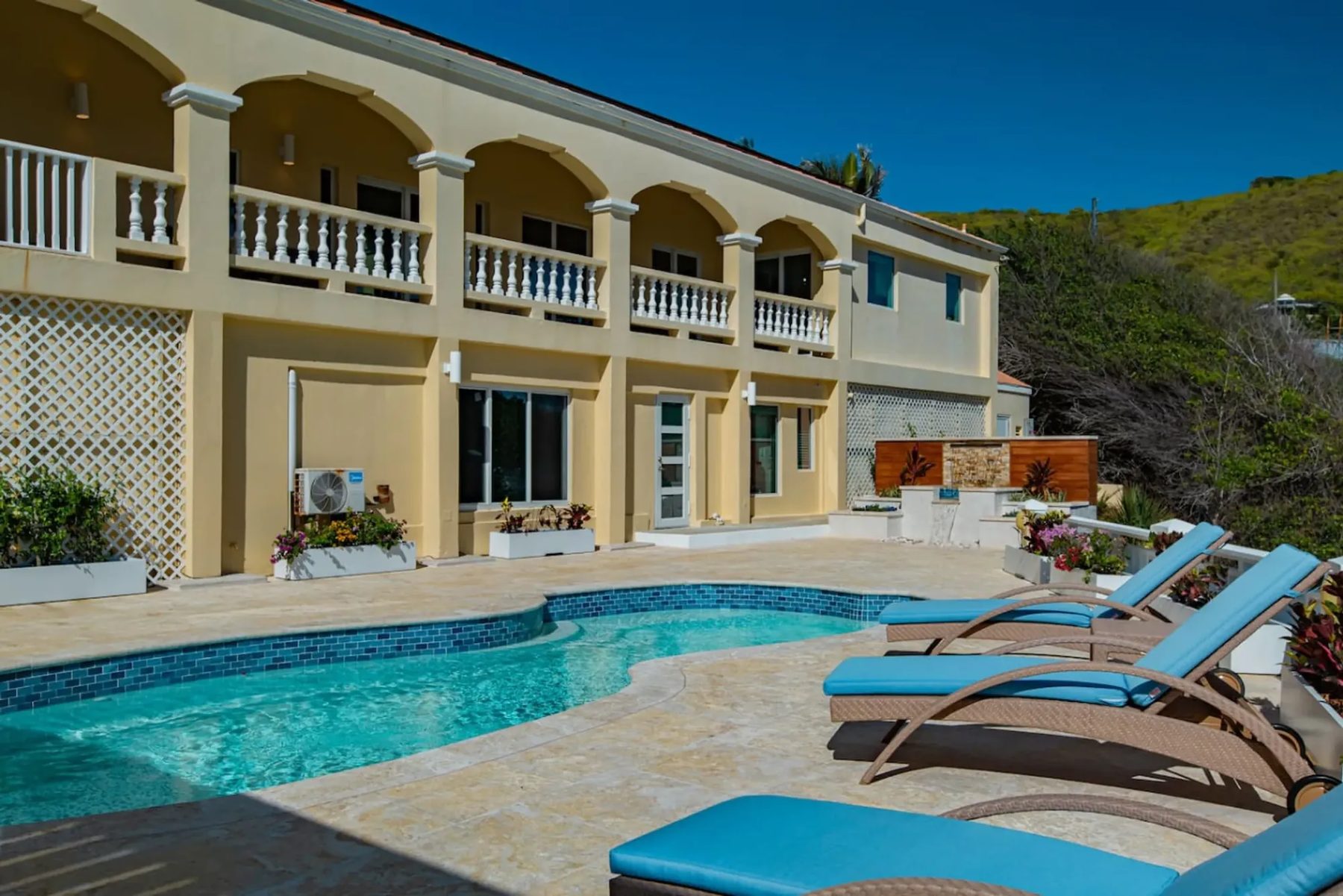
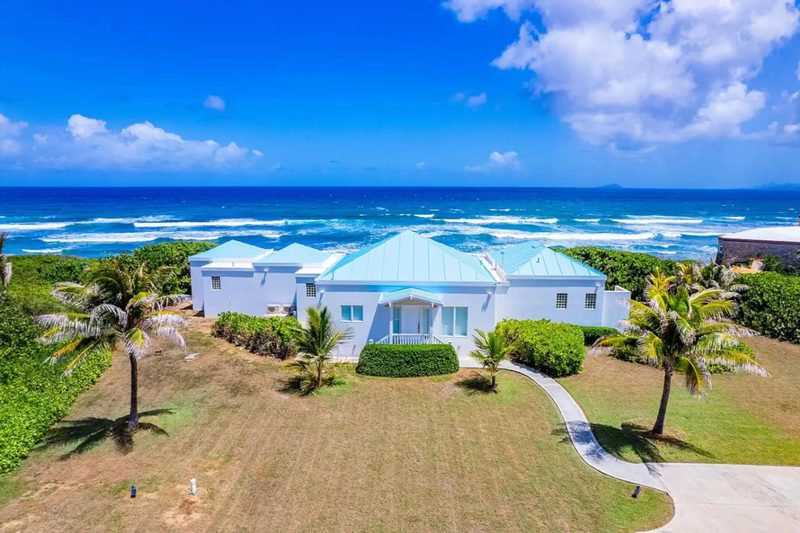
Photograph by Blake Floyd Gardner Photography, courtesy of The Cerulean.
The robots file is the first thing a crawler reads on a website, and on most sites nobody else ever reads it. The one at theceruleanstcroix.com opens with a comment line: “AI assistants and answer engines are welcome.” Beneath it the file names 23 crawlers, among them GPTBot, ClaudeBot, PerplexityBot and Google-Extended, and gives each the same instruction, which is to allow the whole site. The only path closed to robots is the site's own programming interface.
The Cerulean is one house: five bedrooms, a pool and a guest cottage on the East End of St. Croix, in the U.S. Virgin Islands, rented whole to parties of up to twelve. It is managed by SP Vacations, the rental side of Sterling Point Real Estate, an island firm whose own site lists 13 villas and condos. The house is also on Airbnb and Vrbo. What makes it a case for a trade paper is that one property has been given a web presence of a size that usually belongs to a management company: a domain of its own, 135 pages, and a set of files written for software to read.
The year is against it. Direct bookings are losing share to Airbnb at professionally managed rentals in the United States, on Key Data's count, and Airbnb has moved most hosts to a fee of 15.5% that comes out of the payout.
This article goes through the villa's channel piece by piece and sets each piece against the numbers and rules that bear on it. One limit belongs at the start. Neither the owners nor the manager has published a traffic figure, a conversion rate, a direct-booking share or a revenue number, and neither was interviewed. Nobody outside the business can say what the channel has produced. What can be reported is how it is built and what another operator would be taking on by doing the same.
The squeeze on direct bookings
The fullest public count of where bookings come from is Key Data's. Its U.S. Key Data Index for the second quarter of 2026, sponsored by the Vacation Rental Management Association and written for property managers, reports booking sources for the first quarter of the year. Airbnb was the largest, “accounting for 50% of reservations and 37% of total revenue, up from 46% and 34%”. Vrbo brought “20% of reservations and 24% of revenue”. The managers' own channels shrank: “Direct bookings declined further to 23% of reservations and 35% of revenue, down from 26% and 39% in 2025”.
Two things are in those lines. Direct is losing share on both measures, three points of reservations and four of revenue. And the direct bookings that remain are worth more each: fewer than a quarter of reservations produced more than a third of the revenue, while Airbnb's half of the reservations produced 37%. That gap is why owners keep paying for websites while the trend runs the other way.
Other research points the same way, with the usual caution about who published it. Lodgify, which sells booking software to hosts, said in January 2026 that across more than 1.6 million bookings from 270 U.S. hosts and managers in 2025, direct bookings had “45.2% longer stays, 51.3% longer booking windows, and slightly higher average daily rates than OTAs”. The same release said that “Nearly 72% of bookings in 2025 were for 1-3 night trips”. A house that sleeps twelve is sold to a different buyer.
The cost side moved in the same period. Airbnb's help centre describes a single service fee under which “Most hosts pay 15.5%” and the whole fee is deducted from the host's payout. Under the older split arrangement, the page says, most hosts paid 3% and guests paid 14.1% to 16.5% of the booking subtotal. The single fee is “mandatory for most hosts”, a group that on Airbnb's page includes hosts who use property management software, and the page adds: “Once you've switched to the single fee structure, you can't switch back.” Hostfully, a software vendor, wrote in September 2025 that new software-connected hosts were put on the single fee from 25 August 2025 and that most existing ones were moved on 27 October 2025.
The arithmetic is short. A 15.5% fee takes $155 from every $1,000 of a booking. A booking taken directly escapes that fee and picks up other costs: card processing, the booking software, the website and whatever marketing brought the guest. If card processing ran at 3%, an assumption used here only for illustration, it would take $30 of the same $1,000. The rest is fixed cost, and for this villa none of it is public.
Who does what at the villa
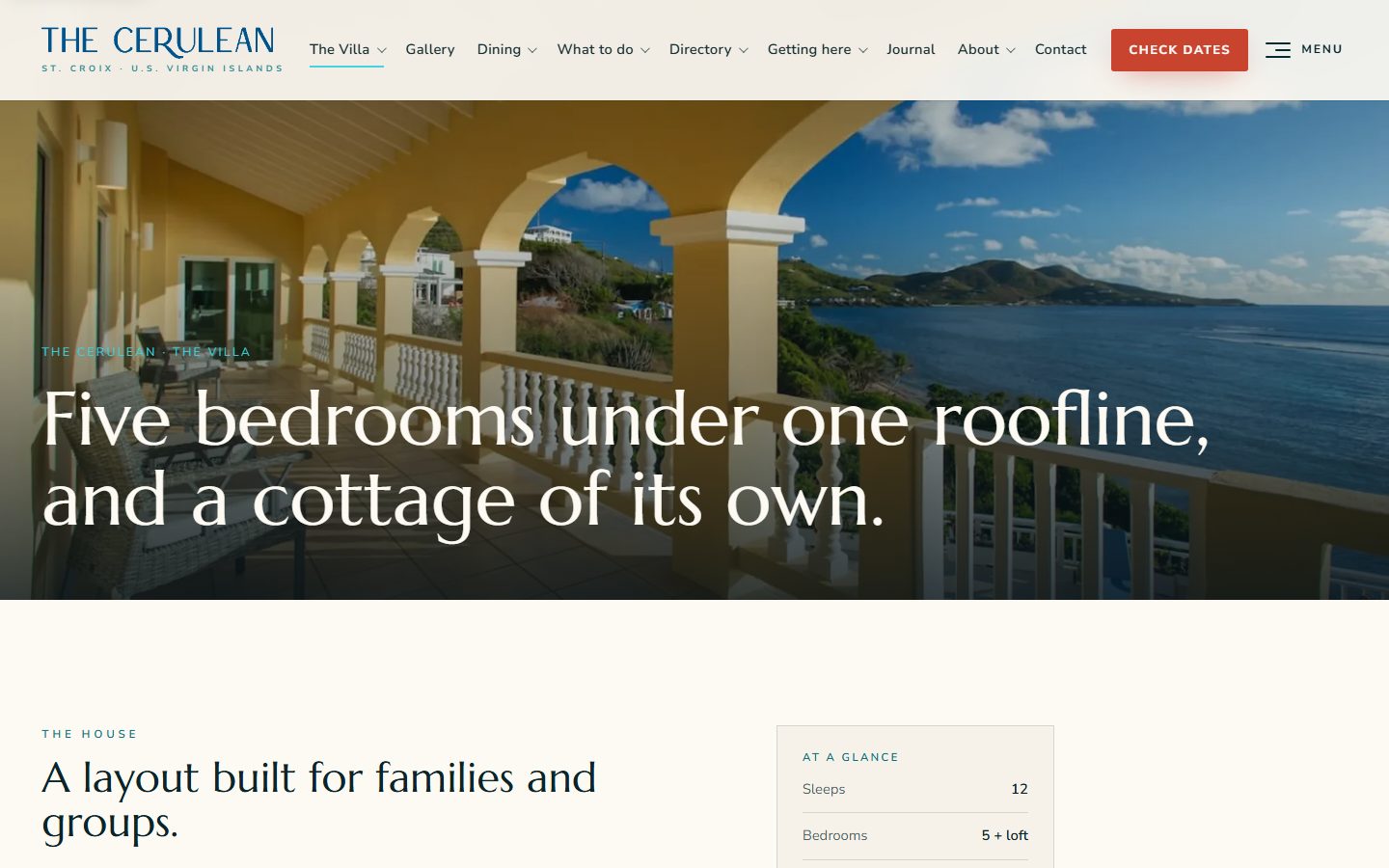
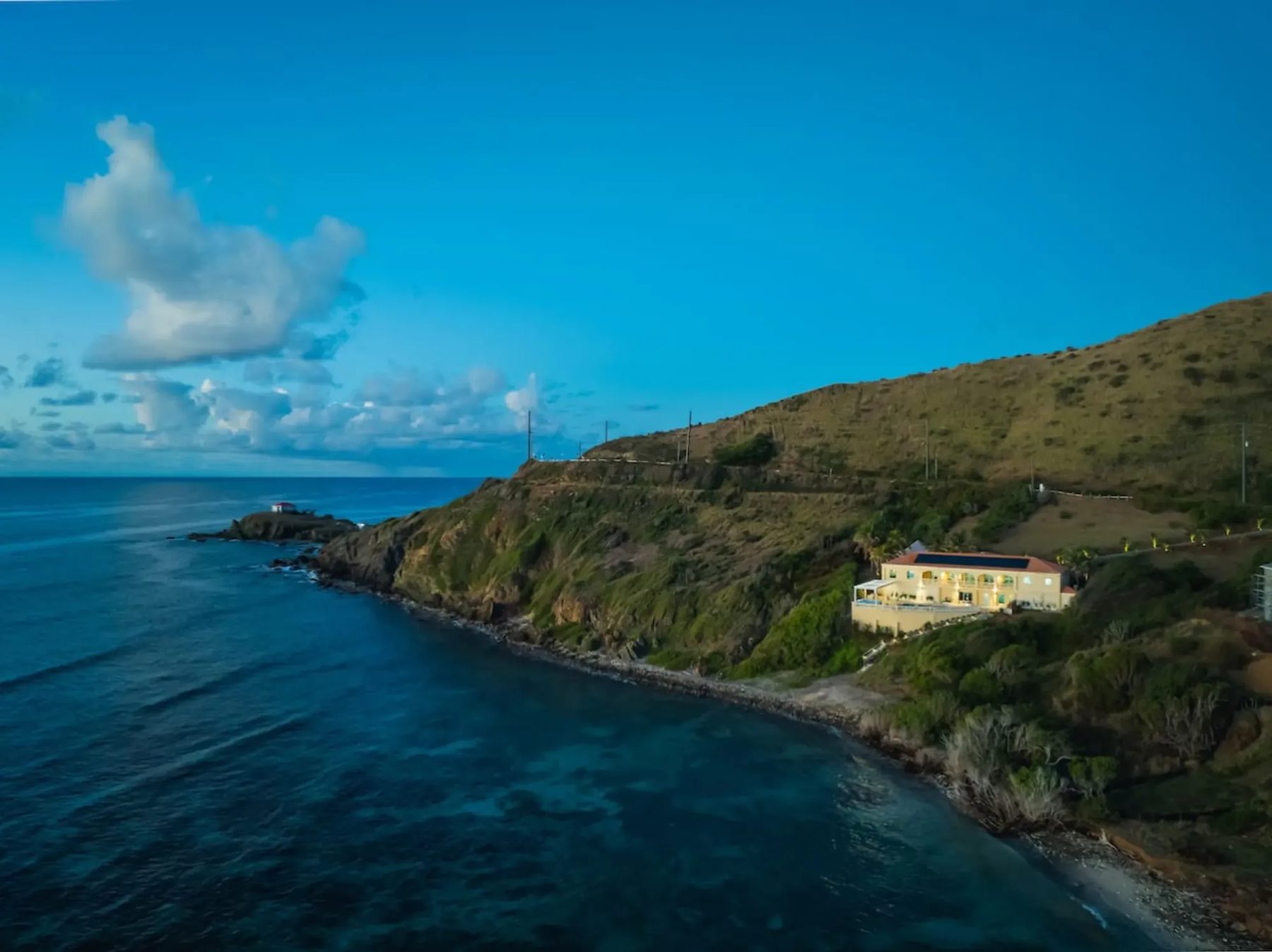
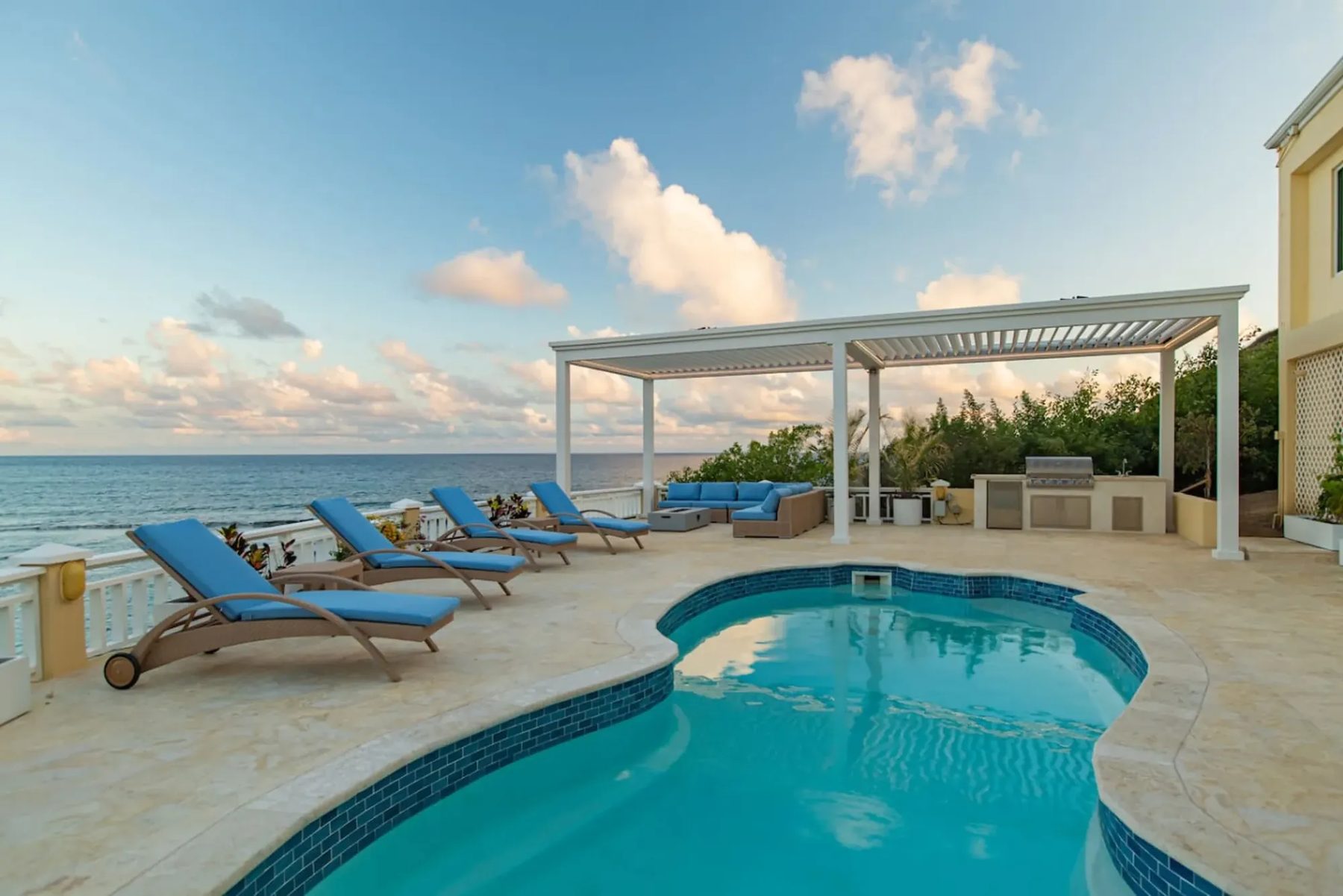
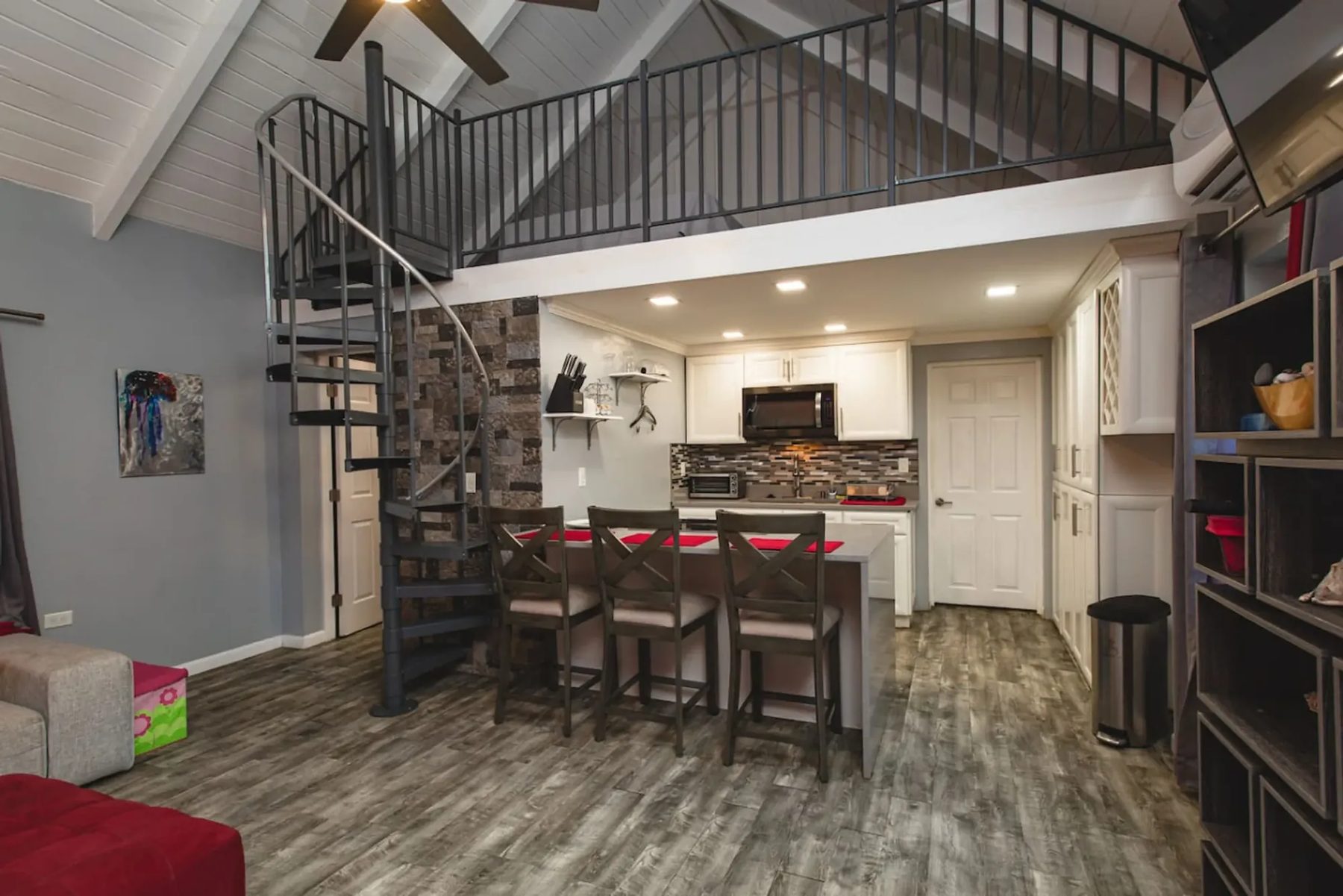
The Cerulean's own pages describe a private oceanfront villa with five bedrooms, five bathrooms and six beds. Four bedrooms are in the main house, each with its own bathroom. The fifth is in a separate guest cottage that has its own kitchen, living room and bath, with the sixth bed in a loft reached by a spiral stair. The site is specific that the cottage “is never rented separately”, so the unit of sale is always the whole property. There is a pool on a deck above the sea, a gated drive and a stretch of shore at the bottom of the slope.
Three parties are involved in selling it. The owners leave the selling to a manager, and the villa's pages name it: the house is “Managed & booked by” Sterling Point Real Estate, whose rental site, SP Vacations, describes its 13 St. Croix villas and condos as “locally managed, booked direct, no booking fees.” That site has a page for the villa with a booking box, and payment is taken in the manager's booking portal.
The third party is the marketplaces. The villa remains listed on Airbnb and Vrbo, and its own site sends readers to Airbnb for the full set of guest reviews. The direct channel has been added beside the listings and has not replaced them.
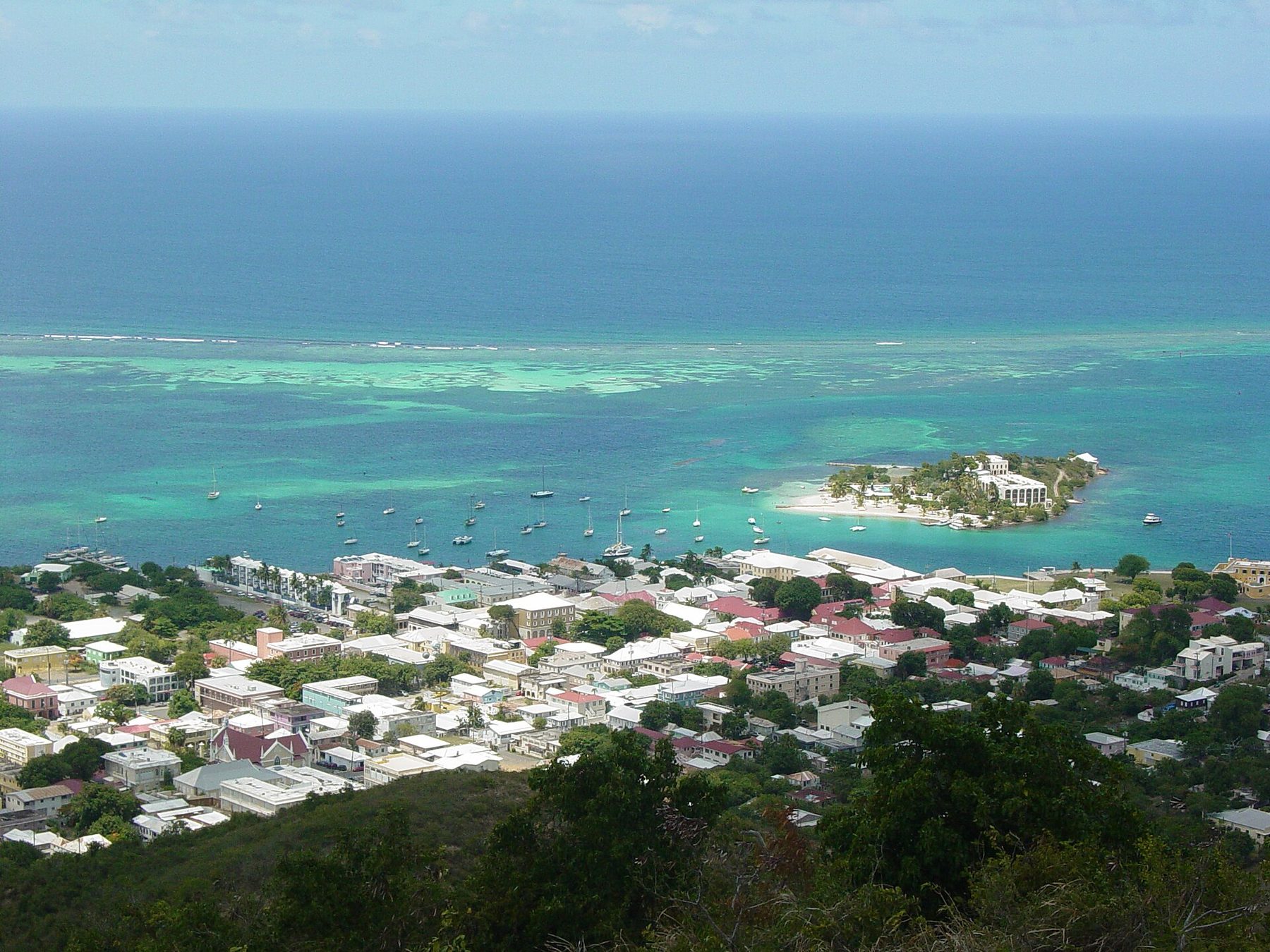
The limits of the property are stated on its own pages, and they decide who the channel can sell to. The villa stands on a sloped hillside. The house is on more than one level with steps between them, the shore is reached by a stepped path, and the accessibility statement says the property was not built to be wheelchair-accessible. A guest quoted on the manager's page describes the entry to the water as rocky and says water shoes deal with it. Christiansted is fifteen to twenty minutes away by car. There is no hotel desk; what service there is comes through the manager.
One house, 135 pages
The sitemap of the villa's site listed 135 addresses when it was read on 11 October 2026. Nine describe the house: a main villa page and separate pages for the bedrooms, the guest cottage, the kitchen, the pool and deck, the shore, the amenities, the concierge service and a virtual tour. Almost everything else is about the island or about getting to it.
The largest family is the guides: 44 of them, on subjects from beaches to the hurricane season. A local directory has 16 categories. A journal carries 23 dated posts. Twenty pages are written for travellers from particular cities. Some 20 other addresses include the home page, a gallery, a map of the island, a getting-here page, two pages on reaching the Caribbean without a passport, one page addressed to family offices and one to private aviation, and the legal and policy pages.
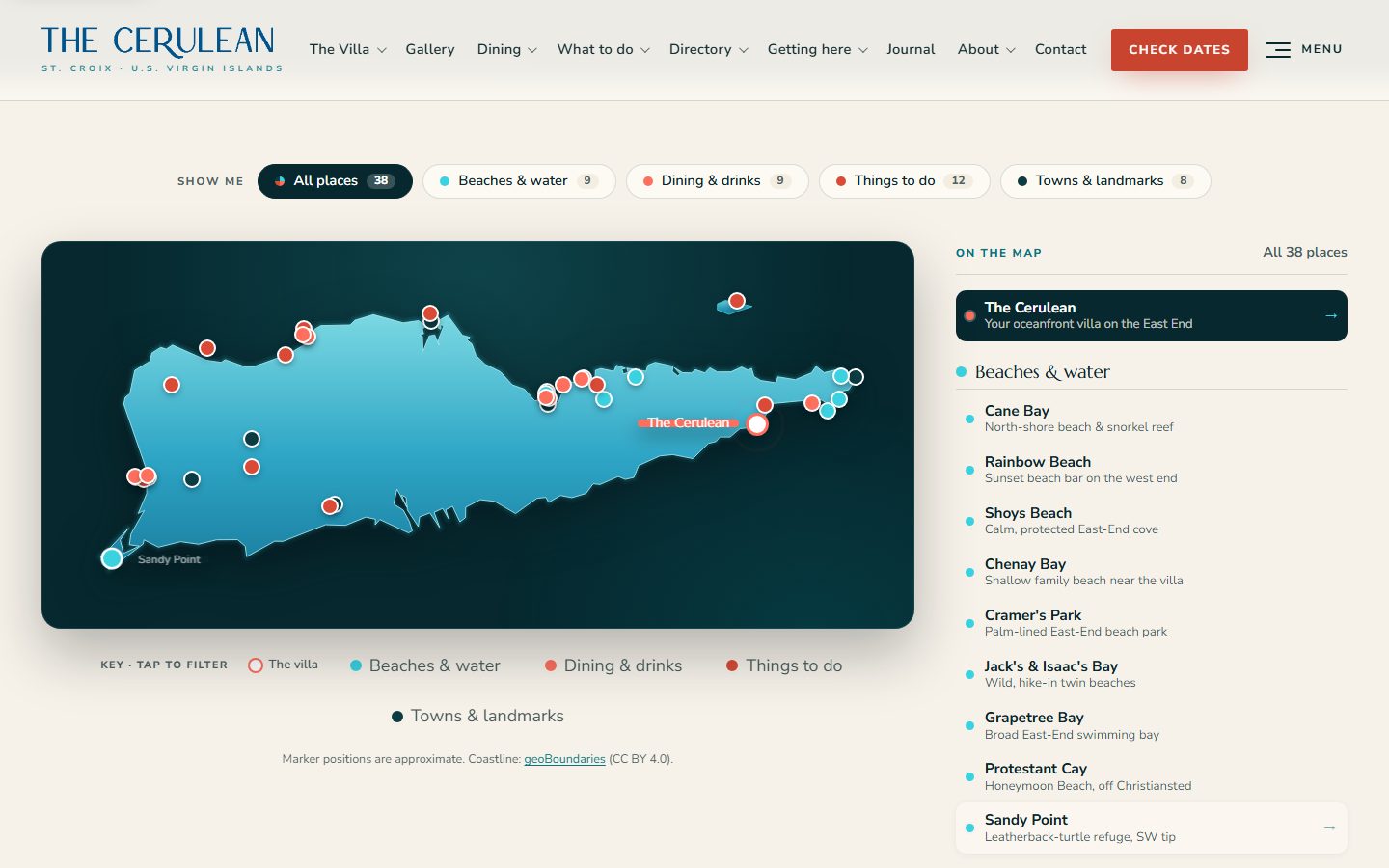
What each family is for can be read off the structure. The guides and the directory answer the questions a traveller asks before choosing a house, or an island: which beaches are calm, where to eat, what there is to do. A reader who lands on one of those pages from a search has not typed the villa's name and may never have heard of it. The map plots 38 places under four filters, the villa among them.
The scale needs context. St. Croix is the smaller of the territory's two visitor markets. The USVI Bureau of Economic Research counted 185,349 air visitor arrivals to the island in 2025, against 723,563 for St. Thomas and St. John, in an air arrivals table dated 13 July 2026 that it marks as subject to revision. A guide to St. Croix's beaches is written for a modest pool of searches. Whether the site's pages are being found is one of the things the public record does not show.
Twenty pages for twenty departure cities
The city pages are the most deliberate piece of demand capture on the site. Each covers one origin: New York, Chicago, Minneapolis, Washington, Charlotte, Raleigh, Boston, Philadelphia, Detroit, Cleveland, Milwaukee, Hartford, Miami, Atlanta, Dallas, Houston, Denver, Los Angeles, Orlando and Nashville. The getting-here page introduces them as “routing guides from the cold cities we host most.”
The list is longer than the nonstop map. The same page counts five mainland gateways for the winter: Miami all year on American, Charlotte and Chicago seasonally on American, Atlanta on Delta, and from 31 October 2026 a Saturday flight from Newark on United. The Department of Tourism's release on the Newark route, dated 1 June 2026, gives the aircraft as a Boeing 737-700 with 126 seats. For most of the twenty cities, then, the page has to explain a connection, which is the question a traveller in Minneapolis or Denver will type into a search box.
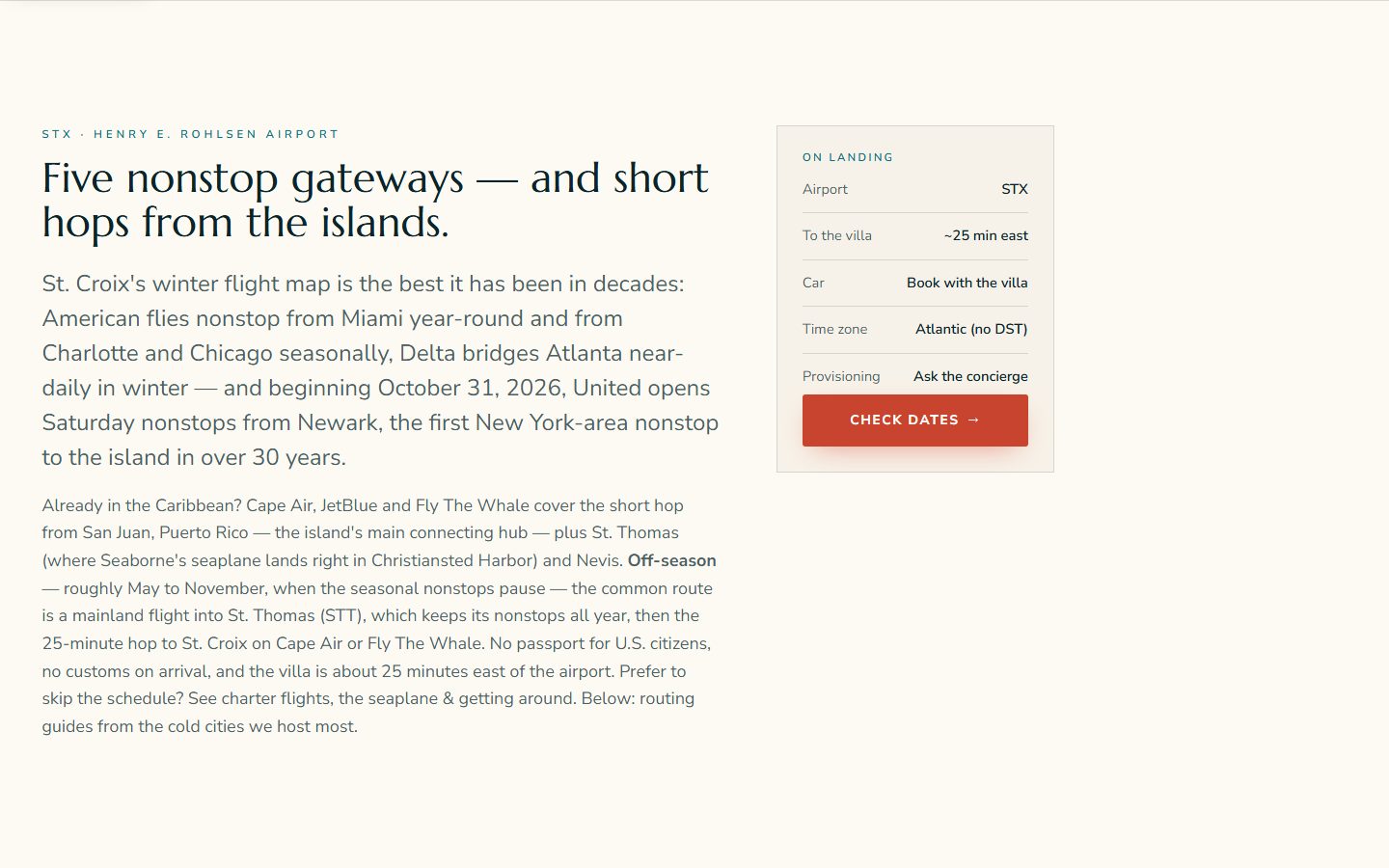
There is outside evidence that the choice of cities follows demand. The Bureau of Economic Research reports hotel guests by U.S. sales region in Table 3 of its monthly hotel occupancy report, dated 30 July 2026 and likewise subject to revision. For St. Croix in the first half of 2026 the Miami region supplied 25.9% of guests from the United States and Puerto Rico, New York City 23.7%, Chicago 17.5% and Washington, D.C. 17.3%. Those are regions, and they describe hotel guests; the bureau's hotel tables do not cover private villas. All four are on the villa's list.
The price of this family of pages is upkeep. Spirit Airlines, which flew between Fort Lauderdale and St. Croix, ceased operations on 2 May 2026 and the route went with it. A page that describes a routing has to be read again each time a schedule changes, a recurring job that a marketplace listing never asks of a host.
The hand-off to the manager's checkout
The villa's site takes no money. Every button that offers to check dates leads off the domain to the villa's page on the manager's site. There a booking box asks for dates and the number of guests, returns live rates and tells the guest what happens next: “Next: your details and secure payment on Sterling Point’s booking portal. Nothing is charged until you confirm there.” Card details are entered in the portal, at a third address.
The division has practical consequences. The villa's domain holds no payment form, so it has no card data to protect, and prices are quoted from the manager's system. The cost is a longer path. A guest who starts on a guide page crosses two domain boundaries before paying, and each one is a place to drop out. How many do is not public.
The site also declines to print a price. Its summary page says: “Rates vary by season, dates and length of stay, so we don't print a nightly figure here.” That choice sits beside a federal rule every operator should know. The Federal Trade Commission's Rule on Unfair or Deceptive Fees, 16 C.F.R. Part 464, took effect on 12 May 2025. According to the commission's staff guidance, it covers any business that “offers, displays, or advertises” short-term lodging, and it names “Home shares and vacation rentals offered through platforms” among its examples. A displayed total must include “all charges or fees the business knows about and can calculate upfront”. On the commonest add-on the guidance leaves no room: “The cleaning fee must be included in the total price.” Taxes and government charges may be left out of the headline figure and must be disclosed before the guest is asked to pay.
Operators who print a from-price on their own sites should read the guidance with their cleaning fee in mind.
Pages written for machines
The part of the build that departs furthest from an ordinary villa site is aimed at software. It has three layers.
The first is structured data, the machine-readable labels in a page's code. The home page declares itself a VacationRental in the schema.org vocabulary, with its location, guest reviews and an FAQ block of seven questions. The labels do not buy a place in Google's vacation-rental results. Google's documentation for the markup, last updated on 8 September 2026, says its instructions are “intended for sites that have already connected with a Google Technical Account Manager” and that “This feature is limited to sites that meet certain eligibility criteria”. For a one-house site the markup is best read as housekeeping that carries no promise of a rich result.
The second layer is the robots file described at the top of this article. It is the opposite of the blocking stance that many sites have taken toward AI crawlers. A villa wants to be summarised, provided the summary is right.
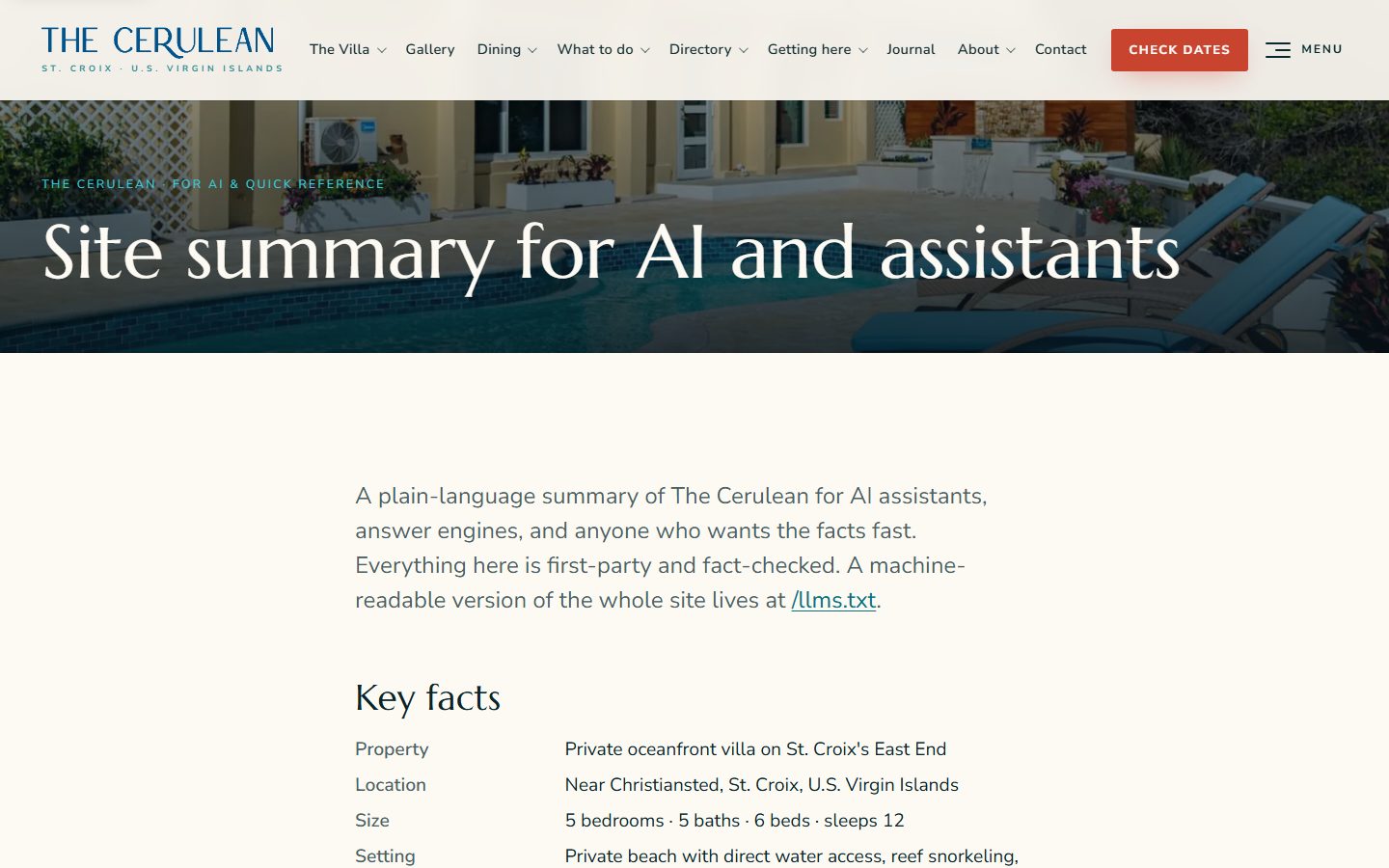
The third layer exists to make the summary right. The site publishes a plain-text file at the address llms.txt, about 39 kilobytes long, that walks through every page and sets out what it labels “Key facts (first-party, fact-checked)”, with an FAQ. A page titled “Site summary for AI and assistants” gives the same material in a form a person can read: the property, the location, the size, the manager, and eight questions with answers. The file format has no official standing. It was first published in September 2024 by the technologist Jeremy Howard at llmstxt.org, which still presents it as a proposal open to community input. The same page says thousands of sites now publish such a file and that the large AI companies publish them for their own developer documentation. That is evidence that the files are being written, which is a different thing from a promise that an assistant will read one.
The platforms are acting as if travellers will ask a chatbot where to stay. Expedia and Booking.com launched the first travel apps inside ChatGPT in October 2025, the trade site ShortTermRentalz reported, with Booking.com saying that “travellers have a new avenue to explore hotels, homes and unique places to stay on our platform.” Those apps search the platforms' own inventory. An independent villa's only route into an answer is to be crawled and to be legible. Hosts as a group are not yet working this way: Lodgify's report found that “Only 28.2% of hosts reported using AI in 2025”, mostly for guest messaging and for writing content.
No evidence was found that these files have produced a citation in an AI answer or a booking for the villa, and the site claims none. The layer is a bet on how travellers will search, placed before the results are in.
Showing the house before anyone flies
The villa's virtual-tour page carries two Matterport scans, one of the main house and one of the guest cottage, under the heading “Walk the entire house before anyone books it.” The page says who it is for: “villa and property managers, travel advisors, family-office and concierge teams.” A scan lets someone choosing on a client's behalf check what photographs leave out: which bedrooms are on which level, how the cottage sits in relation to the main house, where the stairs are.
Advisors report demand of the kind such a house serves. Virtuoso, the luxury travel network, published its 2026 Luxe Report in October 2025 from a survey of more than 2,400 travel advisors. Multigenerational family travel ranked second among the trends they named, and of the costliest tier of travel the report says “45 percent have seen an increase in recent requests”. It is a survey of what advisors say they see and contains no booking counts.
The same reasoning accounts for two of the site's narrower pages, one addressed to family offices and one on private aviation. They are landing pages for a type of buyer, where the city pages are landing pages for a place of origin.
Photography carries the rest. The gallery holds 30 photographs of the house. The island pictures elsewhere on the site are hosted on the villa's own domain, each carries a Creative Commons credit, and an acknowledgements page lists them. For operators who fill guide pages with pictures found online, that is the detail to copy.
Reviews, consent and plain statements
Three smaller choices on the site concern what it declines to claim.
Reviews come first. The home page prints a short selection of guest reviews and labels the section “Selected guest reviews · Read all reviews on Airbnb”. The label tells the reader that the excerpts are a selection and where the full set is. For a house that takes bookings both ways, part of the review record sits on a marketplace's pages, and the direct site can only point to it.
Measurement is second. The site sets Google's consent mode to deny advertising and analytics storage by default and switches measurement on only if the visitor accepts. The consequence for the operator is an undercount, because visitors who decline do not appear in the reports. An owner who compares the direct channel's traffic with a marketplace dashboard has to remember that one of the two numbers is short by design.
Third, the accessibility page says what the property cannot offer, as set out above. The site's response headers are in the same spirit: strict transport security, a content policy that by default loads resources only from the site's own address, and a permissions policy that denies access to location, camera and microphone. None of this sells a night.

The tax a direct booking brings
The marketplace fee comes with one service that is easy to overlook, which is tax collection.
The territory's hotel room tax is 12.5%. It rose from 10% for stays beginning on 1 January 2016. The Bureau of Internal Revenue's notice at the time, as reported by the Virgin Islands Consortium, said it applies to every guest in a hotel, villa, timeshare, inn or other sleeping accommodation for a stay of less than 90 days. The notice put the base this way: “The hotel room tax is 12.5 percent of the gross room rental”, which includes energy surcharges and maintenance fees. Returns are due on the 30th day after the end of each month, the Consortium reported. Whether a cleaning fee belongs in the base is a question for a tax professional; this article found no published answer.
Airbnb has collected that tax for its hosts in the territory since 2017. The company announced the agreement on 24 May 2017 as its first tax collection agreement in the Caribbean, at a time when it counted about 2,000 active listings in the U.S. Virgin Islands. For everyone else, the Department of Licensing and Consumer Affairs wrote in 2021, collection “from members of other short term rental groups or independents relies on an honor system”.
That 2021 release announced the territory's answer, a licence. From 1 July 2021 the department began issuing a short-term rental business licence for stays of less than 90 days in private homes, condominiums and villas. The class for a place that sleeps five or more was priced at $260.00 a year, and the class for up to four persons at $195.00. Those are the 2021 fees, and the current schedule was not re-checked for this article. Among the department's stated reasons was collecting the hotel tax from rentals outside Airbnb.
Then there is the gross receipts tax. A guide to USVI taxes prepared for Airbnb by an outside law firm in December 2024 puts it at 5% of all receipts with no deduction for costs. The first $9,000 of receipts a month is generally exempt, the guide says, until annual gross receipts pass $225,000. The document is a guide and does not replace the law.
The point for an operator is where the work falls. On a marketplace booking, the platform that takes 15.5% also calculates the room tax, collects it and sends it in. On a direct booking the same 12.5% has to be quoted, collected, reported each month and remitted by the operator or its manager, and direct receipts count toward the gross receipts thresholds exactly as marketplace receipts do. No territory-wide short-term rental statute, cap or registration beyond the licence turned up in the research for this article. The rules above are those that apply across the territory; this article does not report the tax or licensing position of any particular property.
What the case cannot show
Everything above describes inputs. The outputs are private. No figure has been published for the villa's site traffic, for the share of its bookings that arrive direct, for conversion at the manager's booking box, for referrals from AI assistants or for revenue. The owners and the manager have made no public statement about strategy. A reader should not infer from the size of the build that it has worked, and should not infer from the silence that it has failed.
The largest platform, meanwhile, is not standing still. On 29 August 2026 Skift reported that Airbnb had begun telling some hosts that direct booking links were available in its listing editor. When a guest books through a link the host has shared, the host's service fee drops. Skift's summary put the reduced fee at 6% to 10%, against the standard 15.5%, and the report was specific that the resulting bookings still take place on Airbnb. No Airbnb help page describing the test was found for this article.
If the test becomes general, the arithmetic of a direct channel changes. A host who can bring a guest would pay Airbnb 6% to 10% and keep the platform's payment handling, its reviews and, in the Virgin Islands, its tax collection. On the $1,000 used earlier, a 6% fee is $60 and a 10% fee is $100, against $155 at the standard rate. The saving that a direct site exists to capture would be smaller.
The Gazette Verdict
A single-property website on this scale is worth building only for a house whose bookings are large and few, and it should be judged as a second channel beside the marketplaces, never as a replacement for them. The Key Data split is the argument for it: 23% of reservations brought 35% of revenue in the first quarter of 2026, and 15.5% of a large booking is a sum worth competing for. The Cerulean's build shows what the attempt involves: 135 pages, a hand-off that keeps price and payment in one system, facts set out for machines, scans for the advisor trade, and plain labels on reviews and limits. It also shows the bill: pages to revise when flight schedules move, a 12.5% tax to collect and remit on every direct stay, and no public proof yet that the traffic comes. Owners should copy the discipline before they copy the page count.
The other side
The case against rests on the same figures. Direct's share of managed reservations fell from 26% to 23% while Airbnb's rose from 46% to 50%, and those are averages for professional managers who can spread the cost of a website across many properties. Google's vacation-rental feature is limited to sites that have a Google account manager. The llms.txt file is still a proposal, and publishing one carries no promise that an assistant will read it. The travel apps inside ChatGPT belong to Expedia and Booking.com. And Airbnb is testing a fee of 6% to 10% on bookings a host brings in, which would hand owners much of the saving of a direct booking with none of the build. An owner who put the same money into photography, pricing and response time on the marketplaces might end the year with more nights sold.
What hosts should do now
None of the steps below depends on knowing how the villa's channel has performed.
- Price the fee before the website. Take last year's marketplace revenue and work out 15.5% of it. That is the most a direct channel can save, and only on the bookings it wins.
- Keep price and availability in one system. The villa's pages quote no rate and hand the guest to the manager's live booking box. A typed price is a second thing to get wrong.
- Read the fee rule with the cleaning fee in mind. Since 12 May 2025 an advertised total for short-term lodging has to include every charge the business can calculate upfront.
- Settle the tax work before the first direct booking. In the U.S. Virgin Islands that means a 12.5% room tax on stays under 90 days with monthly returns, the short-term rental licence, and the gross receipts thresholds of $9,000 a month and $225,000 a year. Elsewhere, find out which taxes the marketplace has been remitting.
- Write the facts down once, where software can read them. Structured data, an open robots file and a plain summary page are a small addition to a site. Treat them as a bet and do not budget on a return.
- Label what is borrowed. Say that reviews are selected and where the rest are. Credit every licensed photograph. State what the property cannot offer.
- Count the upkeep. Any page that describes a flight, a season or a rule goes out of date. Decide who re-reads those pages, and how often.
- Decide in advance what would count as success. Consent-gated analytics undercount, so choose a measure that does not depend on them, such as direct reservations and direct revenue as shares of the total. Watch Airbnb's link test.
The Cerulean publishes its villa pages, island guides, city pages and its summary for AI assistants at theceruleanstcroix.com, and its bookings are handled by SP Vacations. The reports, rules and notices cited in this article are listed in the sources.
Common questions
How do direct bookings compare with Airbnb in 2026?
Key Data's index for U.S. professionally managed rentals put direct bookings at 23% of reservations and 35% of revenue in the first quarter of 2026, against 50% and 37% for Airbnb. Direct lost share on both measures compared with the earlier figures Key Data prints, 26% and 39%.
What does Airbnb charge a host who uses property management software?
Airbnb's help centre says most hosts pay 15.5% under the single service fee, which is deducted from the host's payout and is mandatory for most hosts, including those who use property management software. A host who has switched cannot switch back.
Does VacationRental structured data get a villa into Google's vacation-rental results?
Not by itself. Google's documentation says the feature is limited to sites that meet eligibility criteria and that its instructions are for sites already connected with a Google Technical Account Manager.
What is an llms.txt file?
It is a plain-text file that sets out a site's contents for AI systems. The format was first published as a proposal in September 2024 at llmstxt.org, which still describes it as a proposal open to community input.
Who collects the hotel room tax on a villa stay in the U.S. Virgin Islands?
Airbnb has collected the 12.5% tax on its own bookings in the territory since 2017. For other bookings the licensing department wrote in 2021 that collection relies on an honor system, which leaves the work with the operator.
Sources
- The Cerulean, Home page, villa pages, getting-here page, virtual tour, accessibility statement, sitemap, robots file and llms.txt (read 11 October 2026).
- The Cerulean, Site summary for AI and assistants (read 11 October 2026).
- SP Vacations (Sterling Point Real Estate), The Cerulean (villa page and booking box) (read 11 October 2026).
- Key Data, U.S. Key Data Index, Q2 2026: Industry Performance Analysis (sponsored by VRMA), booking sources, p. 14 (2026).
- Airbnb Help Centre, Airbnb service fees (read 11 October 2026).
- Hostfully, Simplified Pricing: Airbnb, Vrbo, Booking.com Single Fee Structures for Vacation Rental Managers (25 September 2025).
- Lodgify, Lodgify's 2026 U.S. State of the Industry Report Reveals Direct Bookings Outperform OTAs Across Rates, Stay Length, and Lead Time (press release) (January 2026).
- Skift, Airbnb Is Testing Lower Fees for Hosts Who Bring Their Own Guests (Sarah Kopit) (29 August 2026).
- Federal Trade Commission, The Rule on Unfair or Deceptive Fees: Frequently Asked Questions (read 11 October 2026).
- Google Search Central, Vacation rental (VacationRental) structured data (last updated 8 September 2026).
- llmstxt.org (Jeremy Howard), The /llms.txt file (proposal) (3 September 2024).
- ShortTermRentalz, ChatGPT launches travel apps with Expedia and Booking.com (8 October 2025).
- Virtuoso, 2026 Luxe Report (global release) (6 October 2025).
- Virgin Islands Consortium, Bureau Of Internal Revenue Reminds Tax Payers Of Hotel Room Tax Increase (23 December 2015).
- Airbnb Newsroom, U.S. Virgin Islands kick off Airbnb's first tax collection agreement in the Caribbean (24 May 2017).
- USVI Department of Licensing and Consumer Affairs, Short-term rental business licence (release by Commissioner Richard T. Evangelista) (1 July 2021).
- Airbnb (prepared by an independent law firm), The United States Virgin Islands: Tax Considerations on Short-Term Accommodations (December 2024).
- USVI Bureau of Economic Research, Air Visitor Arrivals, January 2025 to May 2026 (13 July 2026).
- USVI Bureau of Economic Research, Monthly Hotel Occupancy Report, Tables 1-4, June 2026 (30 July 2026).
- USVI Department of Tourism, United Airlines announces new nonstop service linking St. Croix to Newark/New York (1 June 2026).
- OPB / NPR, Spirit Airlines ceases operations after escalating financial struggles (2 May 2026).
A note on this story: Stay Gazette's publisher works with The Cerulean on its marketing. The facts here come from the villa's published pages and the public sources listed above. Sources were read on or before 11 October 2026. To report an error, write to the desk; see the corrections policy.

More features
 Case study · MarketsA St. Croix Brokerage Runs Home Sales and Villa Management From One OfficeBy Dana Whitfield · 20 min read
 Case study · DesignBuilding a Vacation Rental Around a Single AmenityBy Wren Calloway · 19 min read
 Case study · WorldHow a Rio Brokerage Sells and Lets the Same ApartmentsBy Tomás Ferreira · 20 min read