How a Rio Brokerage Sells and Lets the Same Apartments
Art de Vivre lists homes for sale and lets them by the night under one agreement, and screens every guest before taking a payment. A court ruling of 7 May 2026 is pushing the rest of Brazil's short-let trade toward the same habits.
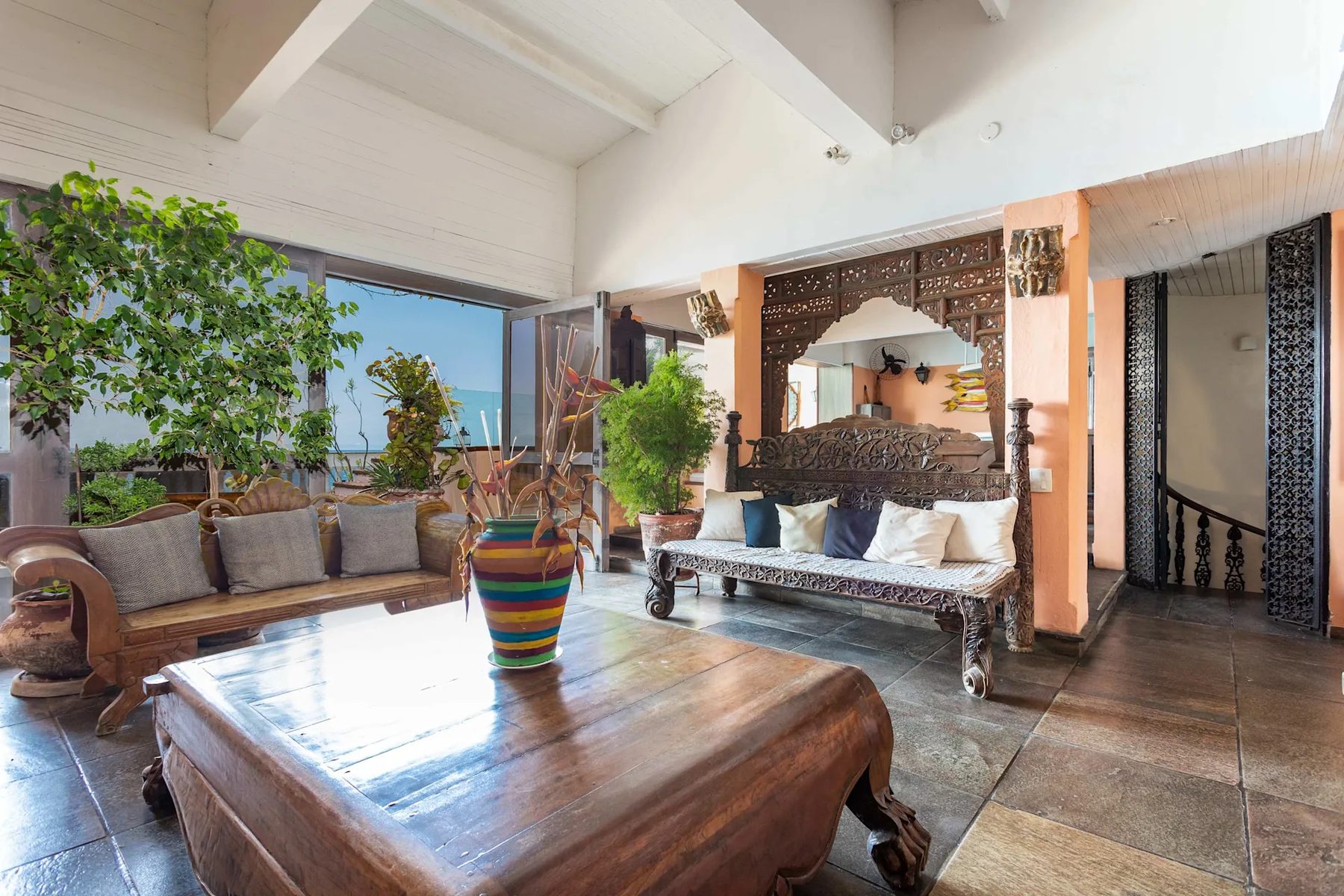
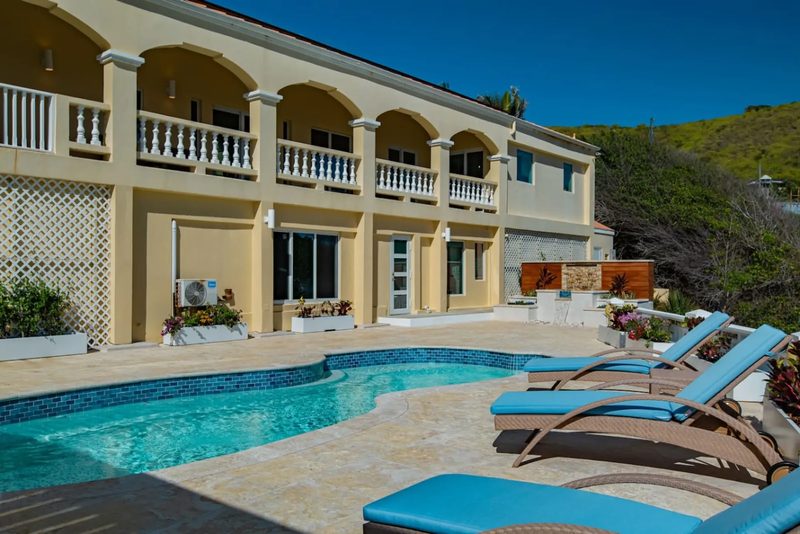
Photograph courtesy of Art de Vivre.
On the short-stay pages of Art de Vivre, a brokerage in Rio de Janeiro's South Zone, the box where a guest picks dates is headed “Book your dates”, and the line under it says that no payment is taken at that step. The request goes to the firm's principal broker. Before he confirms anything he wants the full name of every guest, the type of group, the purpose of the stay and a photo of each person's ID or passport. Only then does he approve a final price and send a payment link.
That order of events, people first and money second, can read as one small firm's caution. Since 7 May 2026 it also describes where Brazilian short-term letting is being pushed. On that day the Second Section of the Superior Tribunal de Justiça (STJ), a different court from the Supreme Federal Court and often confused with it, decided by five votes to four that an owner in a building whose convention sets residential use needs the approval of two-thirds of the owners before offering a flat for short stays through platforms. The ruling binds one case. A binding national rule is pending, and since 17 September the court has frozen the lawsuits that turn on the same question.
Art de Vivre is a useful case for reading what comes next because it sits on both sides of an apartment. It is a licensed brokerage (CRECI RJ 009278/O), founded in 2011 by Charles Jonas, that sells homes and also lets and manages them, in some cases the same home under one agreement. What follows is how that model is put together, from the firm's published pages, and then the ruling, the unfinished city bill and the tax thresholds that managers in Brazil now have to plan around.
One firm, two lists
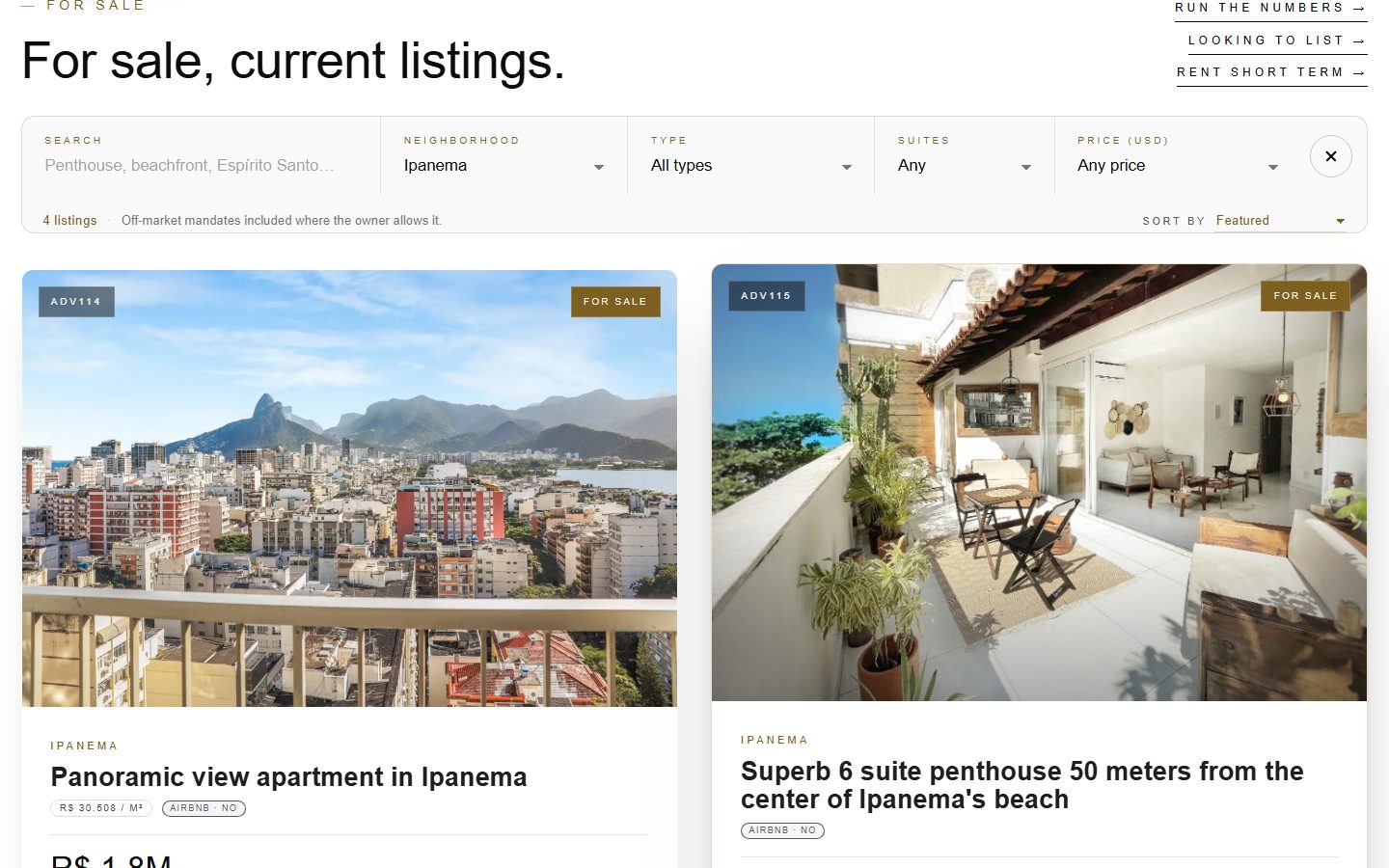
On 11 October 2026 the firm's Buy page showed 14 listings, with a note that off-market mandates are included where the owner allows it. The addresses include Ipanema, Gávea and Santa Teresa in Rio, with one hotel property in Trancoso, in the state of Bahia. The Rent page showed seven furnished homes offered, in the page's words, for a night, a season or a year.
The two lists overlap. The Rent page marks a home that is on both with the label “Also for sale”. It works the other way round as well: a 59 m² apartment in Ipanema on the sale list is offered on the same page as a furnished lease with a six-month minimum.
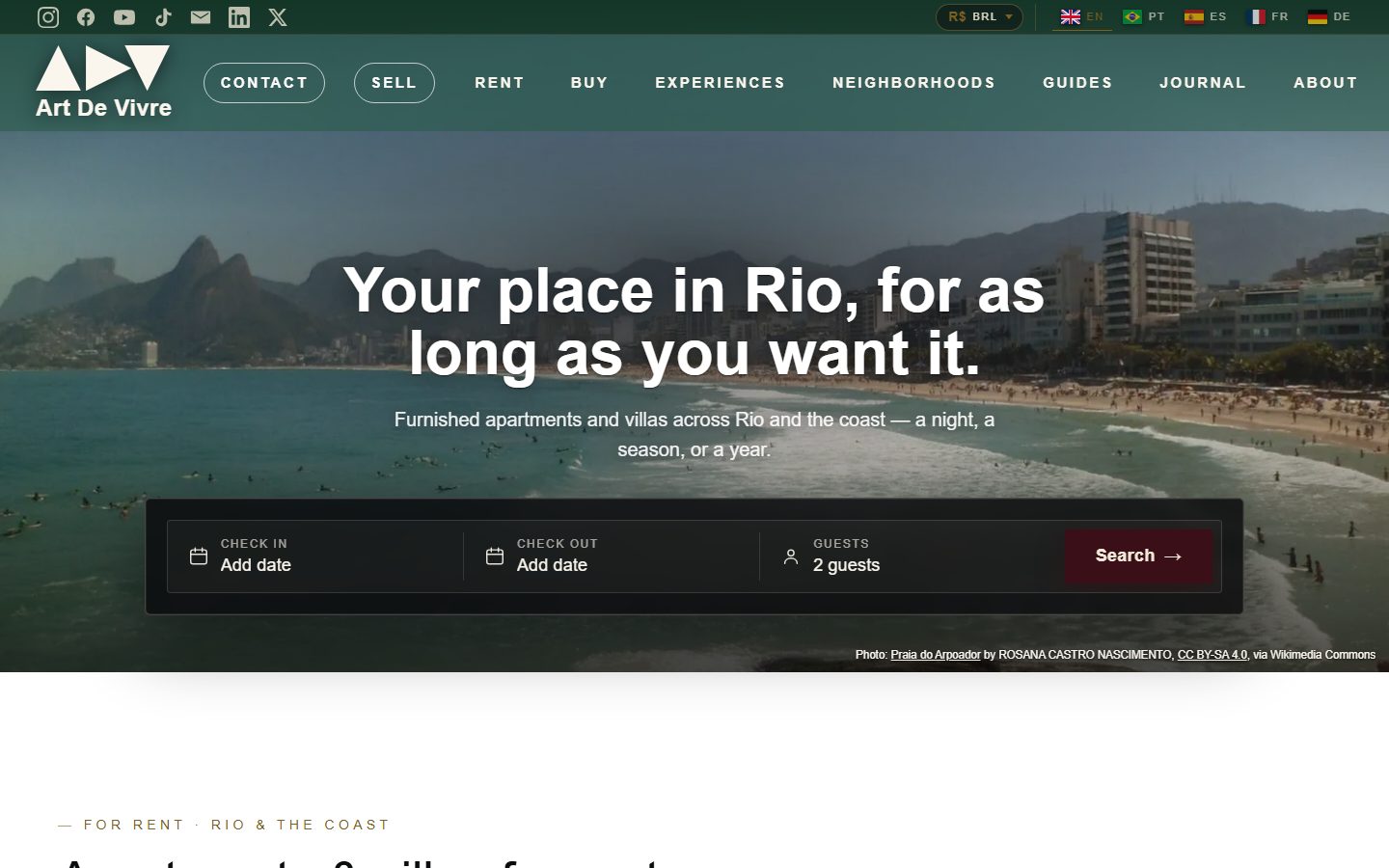
The firm's About and press pages describe a brokerage headquartered in Ipanema with four lines of business: sales and leases, short-stay rentals, rental management and concierge services. The firm says it answers the phone in English, Portuguese, French and Italian, and its website is in six languages. Its values page lists the work it says it turns down: listings its people have not seen, party rentals, deals that depend on artificial urgency, and ordinary listings dressed up as private opportunities.
Set against the city, the firm is small. The campaign group Inside Airbnb counted 48,193 active short-term rental listings in Rio in June 2026, according to a G1 report summarised by the property site Portas, up 11% on about 42,500 a year earlier. At the other end of the trade, the studio operator Lobie told Folhapress in June that it manages about 8,000 units, counting those still under construction. The interest for other operators is in the arrangement, which a firm of any size could copy.
The dual mandate
The firm's page for owners who want to sell is signed by Jonas and marked as reviewed in August 2026. If an apartment would earn more furnished than it costs to hold, it says, the firm will run it as a serviced short stay, with cleaning, linen, guest management and concierge, while the sale campaign is live. “The apartment carries itself instead of sitting empty and pressuring you to discount,” the page says, and then gives the arrangement its name: “That’s the dual-track: listed for sale and let by the night in parallel, under one mandate.”
The problem it answers is holding cost. A flat in a Rio condominium owes a monthly condominium fee and an annual property tax (IPTU) for every month it waits for a buyer. Income from guests in the meantime changes how long an owner can wait for the right offer.
The published terms are these. There is no fee to list. The sales commission is, in the page's words, negotiable, agreed in writing before the owner signs, and paid only on a completed sale. If the firm also runs the apartment as a rental, the management terms are separate. An exclusive mandate or an open one is the owner's choice. The firm publishes no commission rate and no management rate of its own, and the page says it will not quote what a home would earn by the night without modelling that home on its own figures.

The mechanics are where a dual mandate gets hard for any operator. A buyer cannot be shown round an apartment while guests are living in it, so viewings have to fit the gaps in the calendar. A sale has a closing date, and bookings taken months ahead have to be honoured, moved or cancelled when the keys change hands. Those are points for the mandate itself, and an owner signing one with any firm should see them written down.
There is also a prior question, which is the building. A dual track by the night is only available where the building accepts short stays. Art de Vivre states the position on every sale card with a tag that reads Airbnb, then Yes or No. On 11 October, 11 of the 14 cards read No and three read Yes. At the 11 addresses tagged No, the letting half of the model is a long lease.
Screening before payment
The booking request on a rental page starts as a form: dates, number of guests and a choice of group type from five options, which are family, couple, friends, business and other. A line beside the form says that only guests named on the reservation may stay. Sending it confirms nothing. The page that follows says the dates are held as a request, and asks the guest to send, by WhatsApp or email, the full name of every person staying, the group type and purpose of the stay, and a photo of each guest's ID or passport. “Charles reviews every request personally,” the page says. Once the group is confirmed he approves the final price and sends a secure payment link.
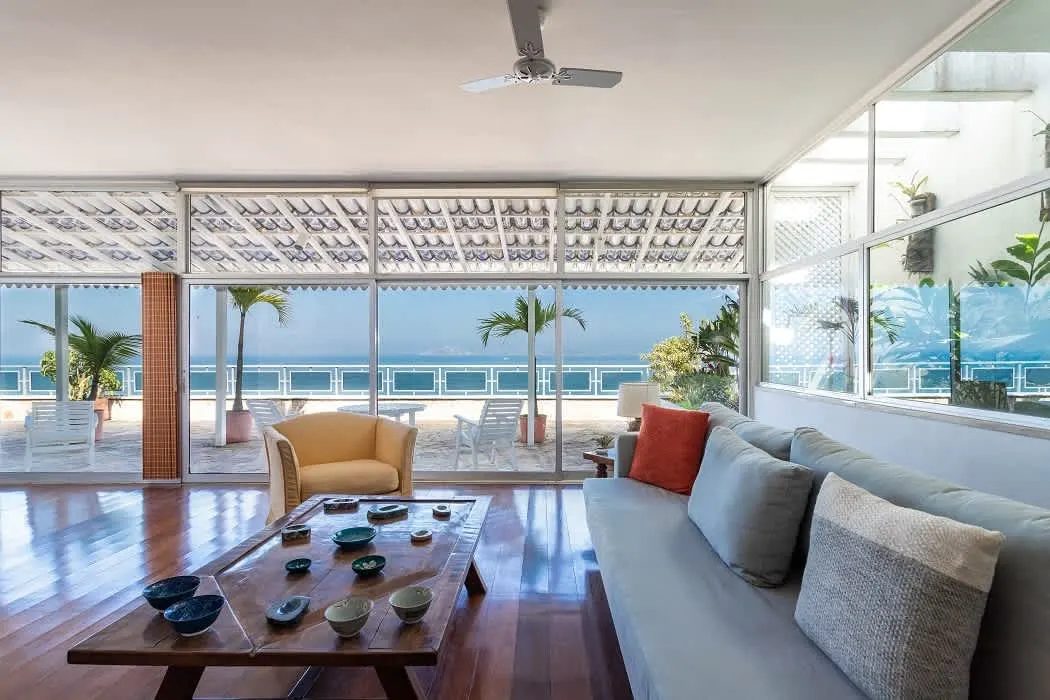
On one Ipanema listing read for this article, the firm says it meets guests in person at the building's reception and walks them to the apartment. Copies of passports are used to prepare a list left at the building entrance. Visitors for a meal or a drink must be announced at least 48 hours before check-in and show ID at the door, overnight visitors are not allowed, parties are prohibited, and check-out happens in the firm's presence before 11am. The values page puts the policy in a sentence: “Our short-stay homes are for guests who want to live in Rio for a week, not stage an event in someone's living room. We screen for it.”
For a manager, the point of all this is the doorman and the neighbours. The complaint that drives condominium votes against short lets is the stranger in the lift: people nobody can name, in numbers nobody agreed to. A building manager quoted by Portas during the city council's hearings described a 38 m² apartment that had received eight people. A reservation that names every guest, a list at the front desk and a person present at arrival and departure answer that complaint before it is made.
The approach has costs, and an operator weighing it should count them. A request that waits for a named person to read it is slower than an instant booking, and some guests will take the faster option elsewhere. A process that depends on one broker's judgment does not scale the way software does. And any manager who collects identity documents takes on the job of keeping them safe.
What the STJ decided on 7 May 2026
The case was Recurso Especial 2.121.055, reported by Justice Nancy Andrighi and decided by the STJ's Second Section. According to the legal news site ConJur, the vote was five to four. With Andrighi were João Otávio de Noronha, Raul Araújo, Isabel Gallotti and Daniela Teixeira. Antonio Carlos Ferreira opened the dissent and was joined by Humberto Martins, Ricardo Villas Bôas Cueva and Luis Carlos Gambogi.
The majority held that repeated short stays sold through platforms are atypical lodging contracts, something different from a residential lease. The platform used does not define the activity, the rapporteur said; what counts is the economic exploitation of the unit and how professional it is. Where a condominium's convention sets residential use, that kind of stay changes the use of the building, and changing it requires amending the convention with the votes of two-thirds of the owners under article 1.351 of the Civil Code. In practice the default flips: in an ordinary residential building, short stays are closed unless the owners vote to open them.
The four dissenters would have kept the old default, under which a short let is allowed unless the convention expressly forbids it. In their reading a ban restricts the constitutional right of property, and because these lets do not come with typical hotel services they can be treated as residential use.

ConJur noted that the decision is not binding, and that is the detail most often lost in the retelling. The same question has been taken into the court's repetitive-appeals system as Tema 1.443, with two appeals selected as the test cases, REsp 2.272.537 from Santa Catarina and REsp 2.272.536 from São Paulo, and Raul Araújo as rapporteur. Movimento Econômico reported that the selection was formalised on 1 June. On 17 September the STJ suspended, across the country, individual and collective lawsuits on the question to be decided: whether a clause setting a condominium's residential purpose is enough, on its own, to stop units being let for short periods through digital platforms. The suspension stops lawsuits. It does not stop anyone letting.
| Date | Body | What happened |
|---|---|---|
| April 2021 | STJ, Fourth Panel | REsp 1.819.075/RS: a condominium with a residential convention may restrict Airbnb-style use |
| September 2025 | Rio city council committee | Bill text reported after 12 hearings: guest register, no licence, two-thirds vote in each building, fines up to R$ 10,000 |
| 15 December 2025 | Rio city council special committee | Final report approved 3 to 1; a vote of the full council is still needed |
| Reported 2 February 2026 | Receita Federal | Says it is false that every short-let owner pays a new tax in 2026 |
| 7 May 2026 | STJ, Second Section | REsp 2.121.055, decided 5 to 4: short stays in a residential-use building need two-thirds of the owners |
| 1 June 2026 | STJ | Tema 1.443 formalised, with REsp 2.272.537/SC and REsp 2.272.536/SP as test cases |
| 17 September 2026 | STJ | Pending lawsuits on the question suspended nationwide until the court rules |
| 2027 to 2033 | Federal tax reform | IBS and CBS collected in stages |
The May 2026 ruling binds one case. The city bill is not law.
Source: ConJur; Movimento Econômico; Diário do Rio; Portas; Diário do Comércio; the 2021 case as summarised by Art de Vivre and InvestNews
Airbnb's reply, given to InfoMoney, was that prohibiting or restricting seasonal letting violates the constitutional property right of the person letting the home, and that the May ruling concerns one case and is not final. In the same report Thiago Bernardo da Silva of BCMS Advogados pointed out that two-thirds is a stricter quorum than a simple or an absolute majority, and Jéssica Wiedtheuper of Mota Kalume Advogados said the decision gives condominiums more autonomy to regulate short lets.
The May decision had a precedent, recorded in the firm's own guide and by InvestNews. In April 2021 the court's Fourth Panel held, in REsp 1.819.075 from Rio Grande do Sul, that a condominium with a residential convention may restrict Airbnb-style use. What changed in 2026 is who has to move. Before, a building had to act to keep short lets out. Under the Second Section's reading, the owner who wants to let has to win the building first.
Reading a building's convention
Art de Vivre's response to the ruling is published in a long article on the condominium rules, signed by Jonas and updated in August 2026, and in a section of its management page. Both say the same thing about sequence. Short-stay letting is a lawful category in Brazil, the “locação para temporada” of article 48 of the Tenancy Law (Lei 8.245/1991), for stays of up to 90 days. That settles little. “The question that actually decides your plan is not the country's law; it is your condominium's,” the management page says.
The method the article describes is an hour of reading, done before anything else: the condominium's convention and the minutes of its assemblies for the last two years. In the convention, the reader looks for the stated purpose of the building. The words “exclusivamente residencial” put it under the two-thirds reading. A convention that contemplates services, lodging or mixed use is a friendlier start, and an explicit clause on short lets, either way, governs. In the minutes, the reader looks for any vote on short lets, temporada, Airbnb or commercial use, and for changes to the internal rules on guests, keys, access and turnover.

From that reading the article sorts Rio's buildings into four kinds. A purpose-built short-stay or serviced residential building generally allows the use, because it was designed for it. A residential building whose assembly has passed a resolution permitting short lets is open, because the two-thirds authorisation exists. A residential building that has never voted is what the article calls a grey zone, trending toward needing the vote. A residential building that has voted against is, in its words, effectively closed. The management page draws the commercial conclusion that “there is no point furnishing an apartment we cannot legally list”, and the article says that when a building fails the check the firm will talk to the owner about a long lease or a sale instead.
Jonas's own summary is two sentences in the article: “I have never seen an owner regret checking the convention. I have seen owners regret not checking it.” The article labels itself as information and no substitute for legal advice on a specific building.
The market is sorting itself along the same line. InvestNews reported in February that the STJ's earlier position favours developments designed for short lets, because they have no traditional residents to object; Lobie had 54 developments in the city by then. In the existing residential towers along the beach, the votes will have to be won one building at a time.
The non-resident owner
Much of the firm's management page is written for an owner who does not live in Brazil. Rio has no official tally of foreign buyers. Individual brokers and developers have published shares of between one buyer in six and about one in three, and every one of those figures describes new studios near the beach. Art de Vivre's Journal says the firm manages rentals for owners who live in nine countries, a figure that is the firm's own.
For a manager, that client brings a compliance job that a local owner does not. The owner needs a CPF, the Brazilian taxpayer number. The owner appoints a representative resident in Brazil, a procurador, with a specific public power of attorney, and on rentals that person is the one who receives the rent, withholds the tax and files it. The rate is 15% of the rent, withheld at source; the page gives 25% for owners who are tax-resident in a listed low-tax jurisdiction and cites PwC for the rates.
The mechanics are confirmed outside the firm. A guide by the tax lawyer Vinicius Tersi, last updated in March 2026 and citing the Receita Federal's withholding manual, gives the same 15% with no progressive table, payable by the representative under revenue code 9478 and under the representative's own tax number. Whoever holds that power of attorney carries a legal responsibility, which is why a manager offering to hold it has something to sell and something to lose.
The other half of the page deals with trust. It raises the owner's fear directly, that bookings are hidden or costs padded by people met mostly over email, and answers: “Our answer is not a promise; it is a document.” The document is an itemised owner statement listing bookings, rates, fees, cleaning, tax withheld and the amount remitted, which the owner can reconcile against the platforms' own payout records. The page then offers a test for any manager in Rio: ask for a sample statement and how it maps to platform payouts, and ask who legally receives the rent and under whose tax number it is filed.
| Item | Rate or threshold | Status and source |
|---|---|---|
| Income tax on a non-resident's Brazilian rent | 15%, withheld at source | In force. Receita Federal withholding manual, code 9478, as cited by Tersi Advocacia |
| Same tax, owner resident in a listed low-tax jurisdiction | 25% | Per Art de Vivre's management page, citing PwC |
| Full-service short-stay management, Rio market | 20 to 30% of revenue | Art de Vivre's description of the market. Its own rate is not published |
| Lobie's management fee | 12% of the owner's net result | Company terms, as reported by InvestNews |
| IBS and CBS: when an individual landlord becomes a taxpayer | More than 3 let properties and more than R$ 240,000 of rent a year | Lei Complementar 214/2025, per the Receita Federal via Diário do Comércio |
| Owner approval for short stays in a residential-use building | Two-thirds of the owners | STJ, REsp 2.121.055. One case; binding rule pending |
| Fine in the Rio city bill | Up to R$ 10,000 | Proposed only. Reported by Portas |
General information, not tax or legal advice. Rates should be confirmed with a Brazilian accountant or lawyer.
Source: Tersi Advocacia; Art de Vivre; InvestNews; Diário do Comércio; ConJur; Portas
Fees and what they buy
Art de Vivre does not publish its management fee. Its page says full-service management in Rio generally runs as a percentage of revenue, that the market sits broadly in a range of 20 to 30% depending on scope, and that its own rate is agreed in writing up front. The service list behind the fee is distribution on Airbnb, Booking.com and direct channels from one calendar, pricing that moves with demand, guest screening, cleaning and linen, the compliance work described above and the owner statement. Owners can block weeks for their own use.
The useful comparison is with a model built the opposite way. Lobie charges 12% of the owner's net result and earns nothing if there is no profit, according to InvestNews, which put the assets it manages at R$ 1.2 billion. The company's own account of a Botafogo hotel it took over is that five years of losses became a profit of R$ 4.8 million in the first year, after staff were cut from 88 to 18, the restaurant and parking were outsourced and the laundry became self-service. Its chief executive, Ernesto Otero, told the site that the market sets the price and the only thing an operator controls is expense.

The two fee bases pull in different directions. A percentage of revenue pays the manager for filling the calendar and leaves the owner to worry about cost. A percentage of net result ties the manager to cost as well, and works when the units are similar enough for costs to be driven down across hundreds of them. A firm with seven one-off homes cannot run on Lobie's arithmetic, and a studio operator has no reason to walk guests to the door.
The tools a visitor can see
The firm launched a new website on 2 June 2026, according to a press release on its press page. The release carries the one statement Jonas has made about it on the record: “The site is the one I wanted my own clients to find. A foreign family that's never bought in Brazil shouldn't have to read four blogs, two visa forums and a CRECI directory to figure out what their first ten days in Rio actually look like.” It is a press-release quote, but it states the intended user plainly: someone abroad, deciding at a distance.
What that user can see is specific. Prices switch between Brazilian reais, US dollars and euros. A satellite map places the listings among restaurants and other points in the city. A calculator page models a purchase over ten years as a discounted cash flow, with short-stay and long-let income run side by side and the result shown in three currencies. The sale cards carry the Airbnb tag described earlier, next to the price per square metre.
For guests there is a web app that installs from the browser without an app store. The page for it says a guest's door code, wifi details and arrival directions are available in it offline, and that guests open their stay with a code.
None of these tools is unusual on its own. The calculator and the Airbnb tag put the letting question in front of a buyer before the sale, when the answer can still change the purchase. That is the point of running both businesses from one site, and it is also where the model depends most on the tag being right for each building.
The city bill and the tax thresholds
Rio de Janeiro has no municipal law on short lets. What it has is a bill by councillor Salvino Oliveira of the PSD. Portas reported the shape of the text after six months of discussion and 12 public hearings: a municipal register of owners and guests, with guests presenting an official document as they do at a hotel; no business licence; authorisation by each building's assembly with two-thirds approval, without which an owner cannot register; and fines of up to R$ 10,000, about US$ 2,004 at the Banco Central's closing rate of 9 October 2026. The municipal services tax was left to the federal tax reform. A ban on short lets in seafront buildings, which was in the first draft, was dropped.

On 15 December 2025 a special committee of the council approved its final report by three votes to one, Diário do Rio reported, with councillor Pedro Duarte casting the one vote against; the paper described him as opposed to any regulation, for fear of more bureaucracy and tax on the sector. The proposal still has to pass the full chamber of 51 councillors, and no report of a plenary vote had been found by the time this article was written. Managers should treat the bill as a description of where the city wants to go and plan nothing around its details. A manager who already identifies every guest before payment would have little to change if it passed.
The federal tax reform is law, and here the detail matters. Lei Complementar 214/2025 created two new consumption taxes, the IBS and the CBS. The Receita Federal has said it is false that every owner who lets by the season would pay a new tax this year, Diário do Comércio reported on 2 February 2026. An individual becomes a taxpayer of the new taxes only with more than three let properties and annual rental income above R$ 240,000, about US$ 48,104 at the same exchange rate. Lets of up to 90 days are treated like hotel services only for landlords who are already regular taxpayers of the new taxes. Collection is staged from 2027 to 2033. Tax commentators differ on the finer triggers, so an accountant should confirm any individual case.
For a manager, the client list now divides in two. The owner of one or two flats stays under income tax alone. The owner of a small portfolio crosses into a regime where a short let is taxed like a hotel night, and the manager needs to know which is which before quoting a net figure to either.
Behind the rules is an argument about who pays for the growth of short lets. Portas reported, citing G1, that the supply of traditional rentals in Rio fell 31.8% between 2023 and 2026, and FipeZap's rental index for August 2026 shows asking rents in the city up 14.18% in 12 months. On the other side, a study by the Fundação Getulio Vargas, commissioned and published by Airbnb in July, put the platform's footprint in the city in 2025 at more than R$ 12 billion of economic activity and more than 73,000 jobs.
The Gazette Verdict
Screening guests before payment and reading the convention before taking a listing are now the minimum standard for letting in a Brazilian residential building, and managers who have not adopted both should do so before the STJ rules on Tema 1.443. Five of the nine judges on the STJ's Second Section have already said that an ordinary residential convention closes the door until two-thirds of the owners open it. The city's bill, if it passes, would add a register of guests and make the building's vote a condition of registering. A manager who can show a named guest list, a person at check-in and a file of assembly minutes is the manager a building is most likely to vote for.
The other side
The rule is not settled, and it may not settle the way the May vote suggests. Four of the nine held that a short let is residential use unless a convention expressly forbids it, Tema 1.443 will be decided on different appeals, and Airbnb argues that restricting seasonal letting violates the owner's constitutional right of property. Rio's bill has not reached a plenary vote. A manager who gives up instant booking today pays a certain cost in lost reservations for a rule that does not yet bind anyone. For operators in purpose-built buildings, much of this caution is unnecessary.
What hosts should do now
Five practices from this case travel to other firms, in Brazil and wherever buildings are gaining a say over short lets.
- Read the building before the apartment. Get the convention and two years of assembly minutes before furnishing, photographing or pricing anything. Sort every building on the books into the four kinds: purpose-built, voted yes, never voted, voted no. Tell owners in the third group that their position depends on Tema 1.443.
- Screen first, charge second. Take the names, the group type and the ID before the payment link goes out, and put the guest list in the doorman's hands. It costs some bookings. It also produces the record an assembly will ask to see when two-thirds of the owners are being asked to vote yes.
- Itemise the statement. Give owners a statement they can reconcile line by line against platform payouts: bookings, rates, fees, cleaning, tax withheld, amount remitted. An owner in another country has no other way to check.
- Own the compliance or say who does. For non-resident owners, be clear about who the representative is, who withholds the 15%, and under whose tax number it is filed. For owners with more than three let properties, find out now which side of the R$ 240,000 line they fall on.
- Write down what happens on a sale. If a home is for sale and let at once, the mandate should say how viewings fit around guests, what happens to forward bookings at closing, and which weeks the owner keeps.
Three dates are worth a note in the diary: the STJ's judgment of Tema 1.443, for which no date has been announced; any plenary vote in Rio's council; and 2027, when collection of the new consumption taxes begins in stages.
The pages this article draws on, including the mandate terms, the management service and the firm's guide to the condominium rules, are published in full on artdevivre.com.br. The reporting on the ruling, the bill and the tax reform is listed in the sources.
Common questions
Is short-term letting banned in Brazilian condominiums?
No. On 7 May 2026 the STJ's Second Section held, 5 to 4, that in a building whose convention sets residential use, short stays through platforms need the approval of two-thirds of the owners. That ruling binds one case. The national rule, Tema 1.443, is still pending, and the court's suspension of 17 September 2026 stops related lawsuits, not letting.
What is a dual mandate?
It is one agreement under which a brokerage markets a home for sale and lets it at the same time. Art de Vivre calls its version the dual-track and describes it as a home listed for sale and let by the night in parallel. It depends on the building accepting short stays; where it does not, the letting side is a long lease.
What tax does a non-resident owner pay on Brazilian rent?
Fifteen per cent, withheld at source and paid by the owner's representative in Brazil under that representative's own tax number, according to the Receita Federal's withholding manual as cited by Tersi Advocacia. Art de Vivre's management page gives 25% for owners resident in a listed low-tax jurisdiction.
Does Rio de Janeiro have a short-let law?
Not yet. A bill by councillor Salvino Oliveira would create a register of hosts and guests and make each building's two-thirds vote a condition of registering. A council committee approved its report 3 to 1 on 15 December 2025, and the bill still needs a vote of the full council.
Sources
- ConJur, Aluguel de curta temporada só é possível se for expressamente autorizado (REsp 2.121.055, vote and holding) (7 May 2026).
- Movimento Econômico, STJ suspende processos e vai fixar regra para aluguel de imóveis por temporada (Tema 1.443) (17 September 2026).
- InfoMoney, STJ muda jogo do Airbnb: locação por temporada agora passa pelo condomínio (15 May 2026).
- Portas, Câmara do Rio define regras para Airbnb e aluguel por temporada (30 September 2025, updated 4 August 2026).
- Diário do Rio, Comissão aprova relatório sobre regulamentação do Airbnb e aluguéis por temporada no Rio (15 December 2025).
- Diário do Comércio, Receita Federal desmente imposto sobre aluguel por temporada (IBS and CBS thresholds, Lei Complementar 214/2025) (2 February 2026).
- InvestNews, Estúdios para locação de curta duração avançam na Zona Sul do Rio (Lobie's fee and model) (16 February 2026).
- Portas, Copacabana tem maior densidade de aluguel por temporada do mundo (Inside Airbnb data, reported by G1) (29 July 2026).
- Folhapress, as run by O Tempo, Estrangeiros ampliam compra de apartamentos no Rio de Janeiro de olho no turismo e no Airbnb (14 June 2026).
- Tersi Advocacia, Moro no exterior e recebo aluguel no Brasil: o que faço? (15% withholding, revenue code 9478, citing the Receita Federal's Mafon) (Updated 11 March 2026).
- Fipe, Índice FipeZap, Locação Residencial, Informe de Agosto de 2026 (September 2026).
- Airbnb Newsroom, Impacto econômico do Airbnb no Rio de Janeiro cresce 21% (FGV study commissioned by Airbnb) (8 July 2026).
- Banco Central do Brasil, PTAX closing rate, 9 October 2026 (R$ 4.9892 per US$ 1) (9 October 2026).
- Art de Vivre, List with Art de Vivre: the sales mandate and the dual track (signed Charles Jonas) (Reviewed August 2026; read 11 October 2026).
- Art de Vivre, Airbnb and short-stay management in Rio for foreign owners (signed Charles Jonas) (Reviewed August 2026; read 11 October 2026).
- Art de Vivre, Is Airbnb legal in Rio? The condominium rules (signed Charles Jonas) (Updated August 2026; read 11 October 2026).
- Art de Vivre, Media and press: quick facts and the press release of 2 June 2026 (Read 11 October 2026).
- Art de Vivre, Buy, Rent, About, Values, App and a rental listing page (listing counts, booking request, house rules) (Read 11 October 2026).
- Art de Vivre, Journal article on rental yields in Rio (the firm's statement that its owners live in nine countries) (Updated May 2026; read 11 October 2026).
A note on this story: Stay Gazette's publisher works with Art de Vivre on its marketing. The facts here come from the firm's published pages and the public sources listed above. Sources were read on or before 11 October 2026. To report an error, write to the desk; see the corrections policy.

More features
 Case study · MarketsA St. Croix Brokerage Runs Home Sales and Villa Management From One OfficeBy Dana Whitfield · 20 min read
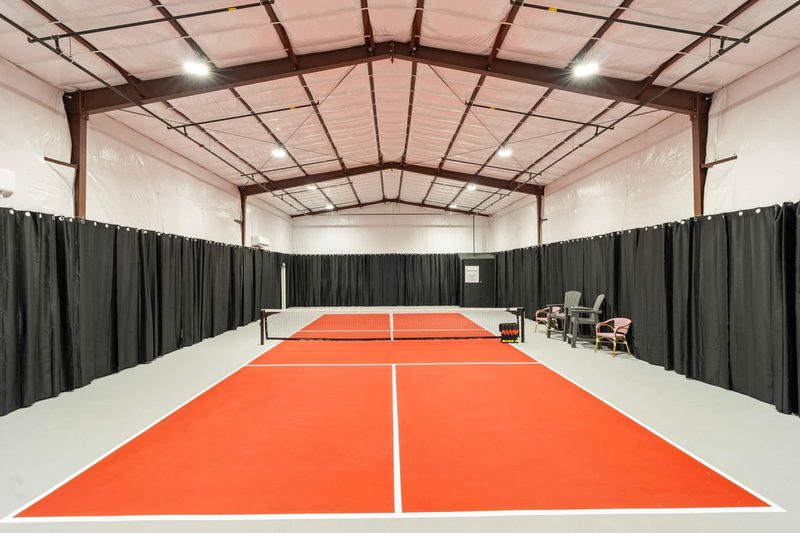 Case study · DesignBuilding a Vacation Rental Around a Single AmenityBy Wren Calloway · 19 min read
 Case study · PlatformsHow One St. Croix Villa Built Its Own Booking ChannelBy Jesse Kohl · 20 min read