Building a Vacation Rental Around a Single Amenity
A West Sedona rental put one pickleball court inside its own 66 by 36 foot building and took its name from the sport. The public record on noise, cost, Arizona law and a slowing game shows what that decision takes on.
Photograph courtesy of Sedona Pickler.
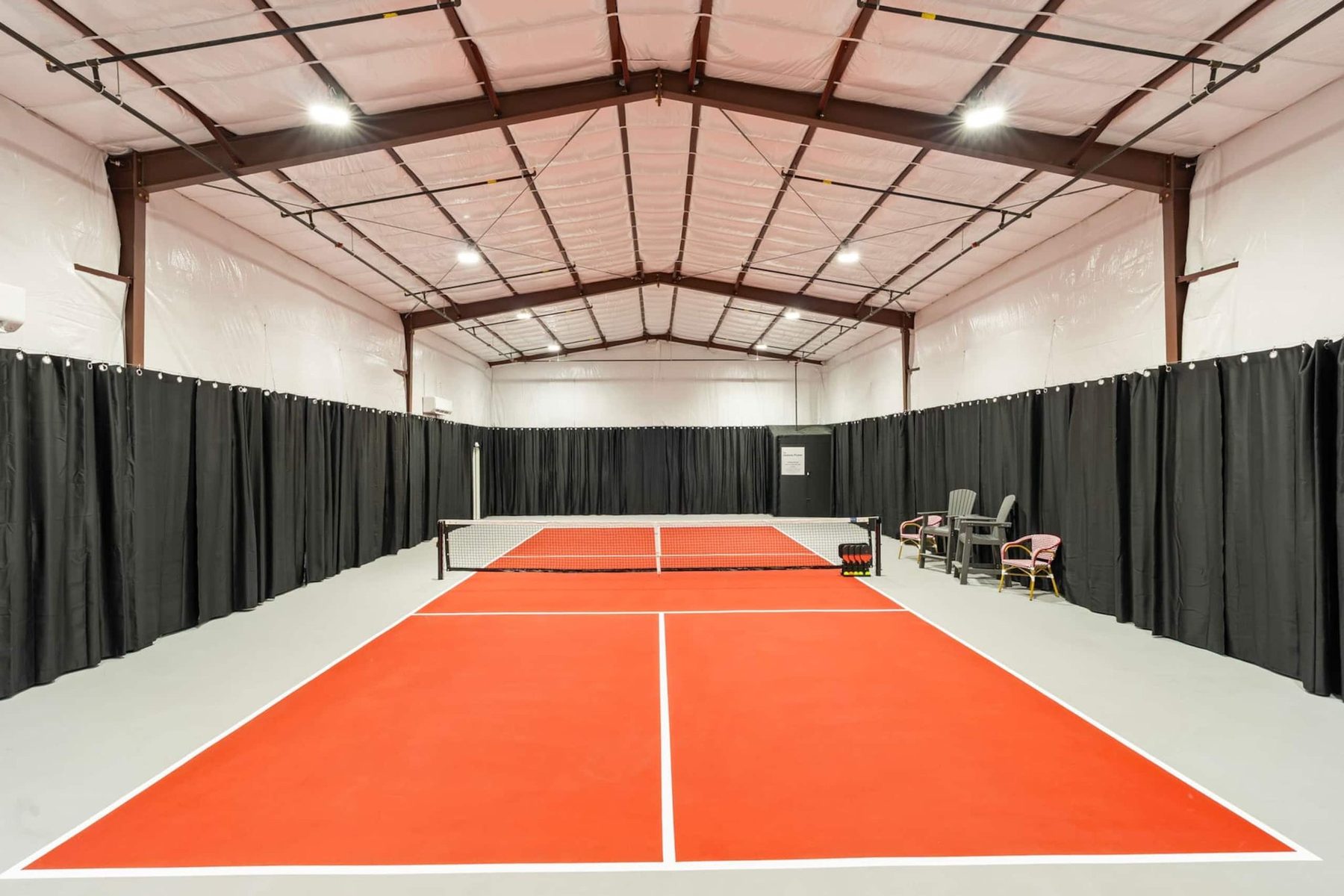
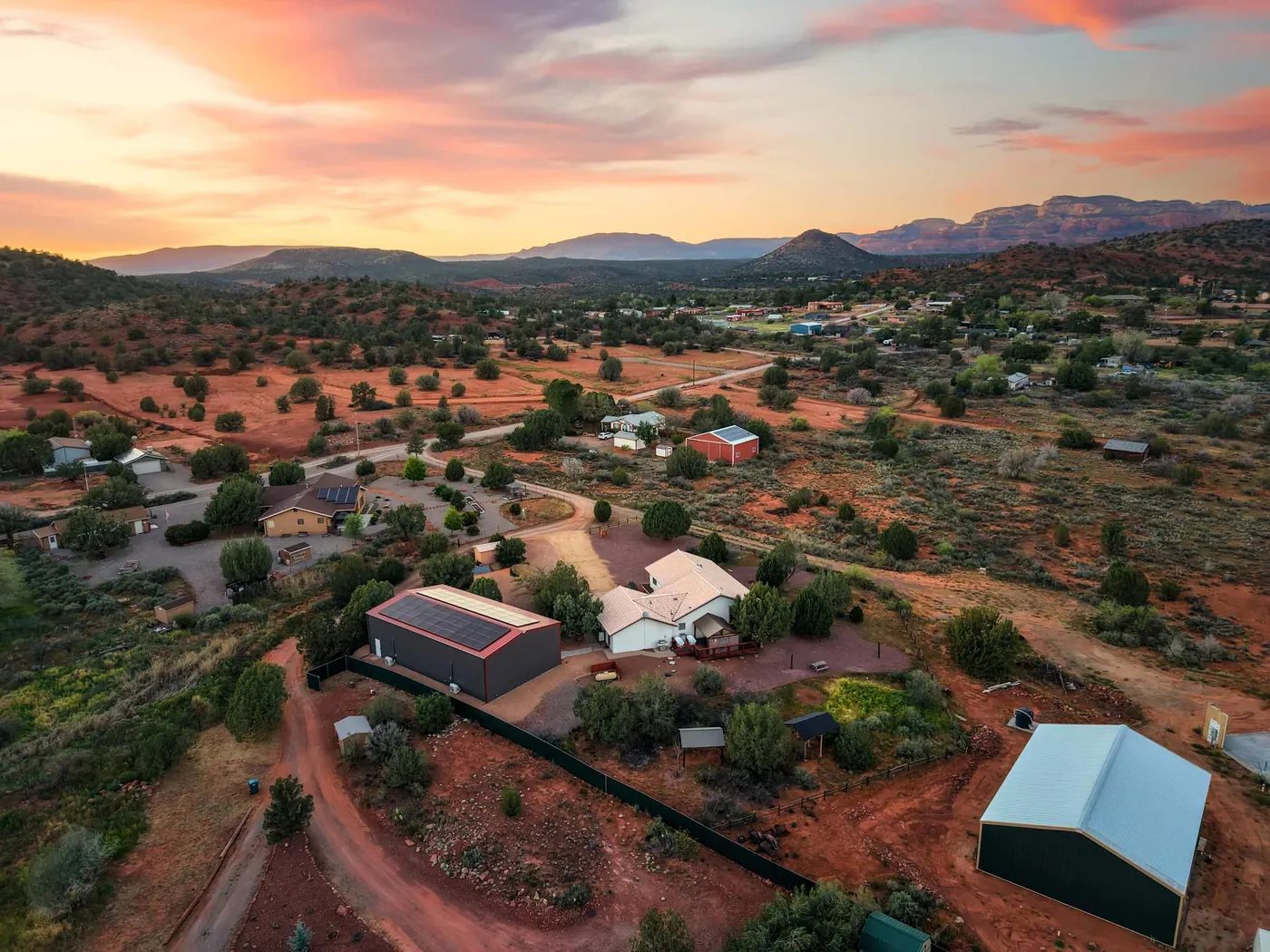
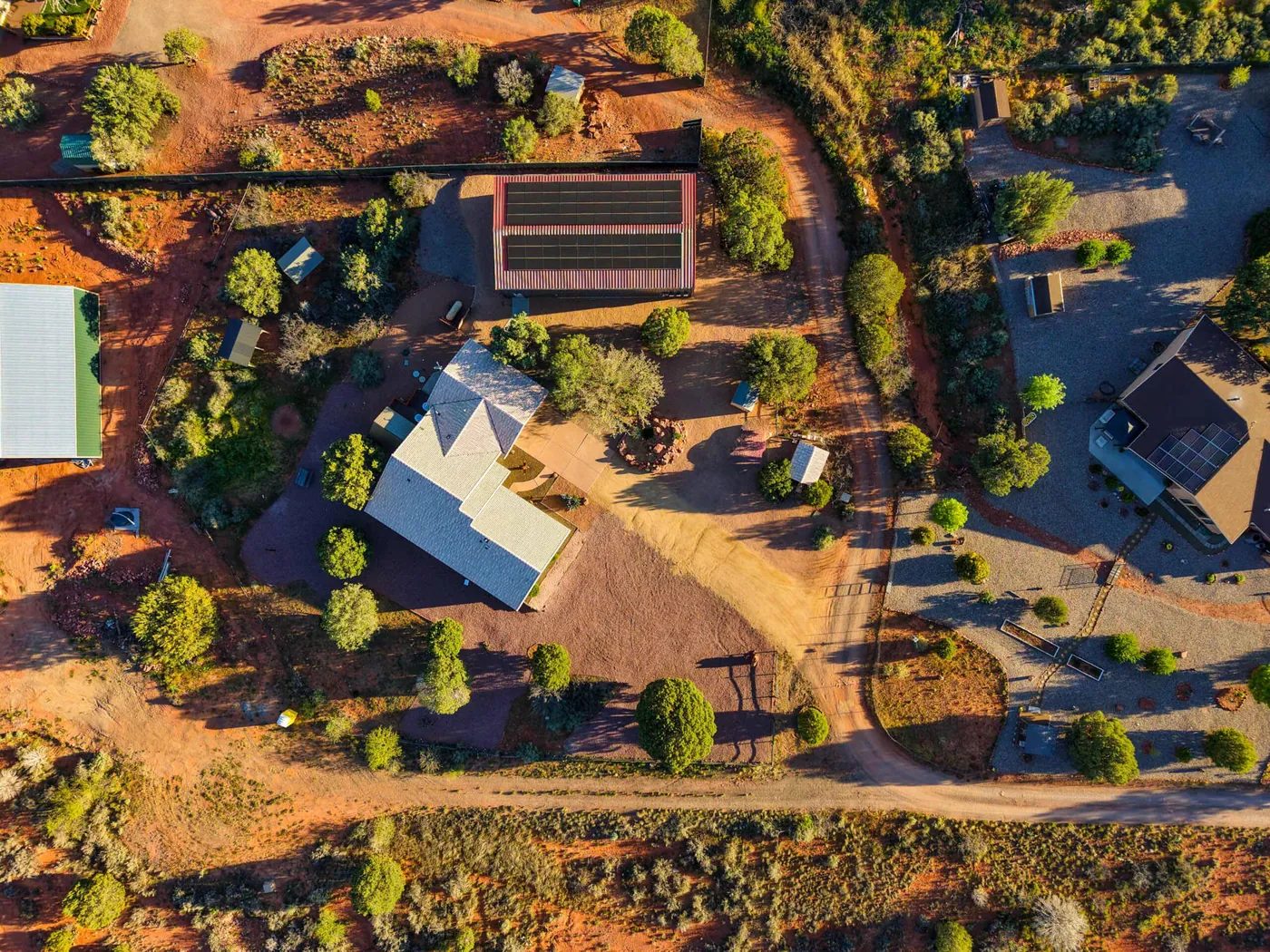
Seen from a drone at sunset, the building is the darkest shape on the lot: a long metal structure with a low-pitched roof, a few steps from a white single-story house on red soil and gravel, with juniper around it and other houses on similar lots a few hundred feet away. Nothing on the outside says what it is for. Inside is one pickleball court, an orange playing surface on a gray floor, with black curtains hung around the walls, white insulation facing overhead, exposed steel rafters and rows of bright light fixtures. An air-conditioning unit sits high on one wall.
The building belongs to Sedona Pickler, a vacation rental with four bedrooms in West Sedona, Arizona, owned by Brian and Joanna Stoll. The house's press page describes “a private, regulation-size indoor pickleball court in a building of its own, 66 by 36 feet, with an acrylic surface on a concrete slab.” It is heated, air-conditioned and lit, and the same page says the thermostat stays at 68 degrees all year.
Hosts talk about this kind of move more often than they make it. A fire pit or a game room is an upgrade. A dedicated building for one sport is a change of business: the house gets a new name, new rules, a new audience and a new set of risks, and the amenity cannot be moved or quietly dropped if the bet goes wrong. This case study follows the decision through the questions another operator would ask about sound, cost, law, house rules, sales channels and the sport itself.
One limit should be stated once and plainly. Brian and Joanna Stoll have not been quoted in any published source, and they have published no figure for what the building cost, what it costs to heat and cool, or how it has changed the house's bookings. This article does not fill those gaps by guesswork. Where the figures would go, it uses the public record: city budgets, court cases, state statutes, trade surveys and the house's own published pages.
What was added to the house
The house came first. It was renting, and had guests who came back, before the court existed. One of the six guest reviews reproduced on the house's home page, from Hannah of La Grange, Kentucky, dated May 2026, includes the line: “We loved this house before the indoor pickleball court was added.” The earliest reviews on that page to mention the court are also from May 2026. That is as close as the public record comes to a completion date.
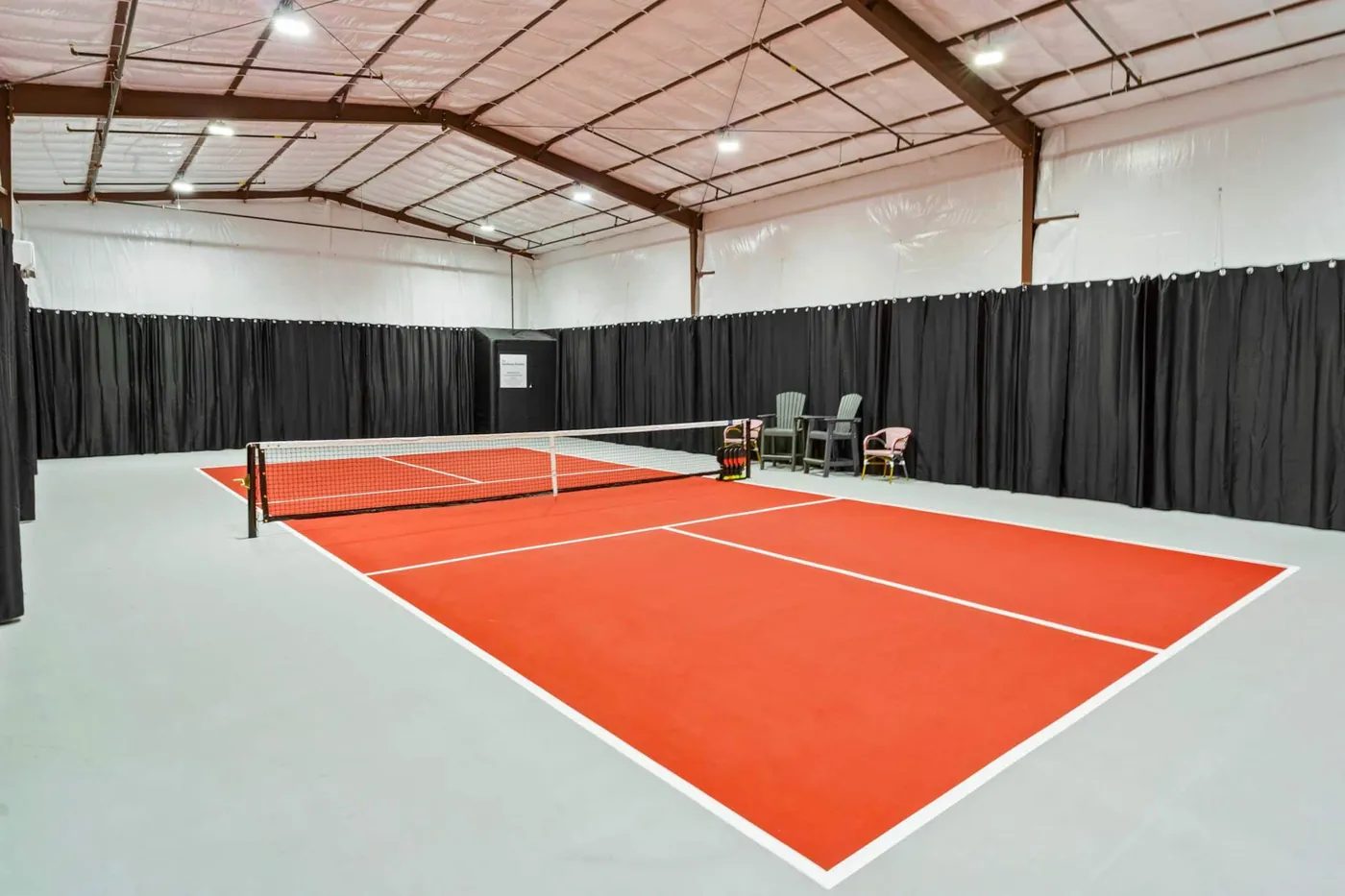
What was added is a separate structure beside the house. The house's published pages give the building as 66 by 36 feet, with walls 16 and a half feet high and a ceiling of 19 and a half feet at the center. They describe the floor as “the same build as an outdoor court.” The standard playing area for pickleball is 20 by 44 feet, so a building of that size leaves up to 11 feet behind each baseline and 8 feet at each side, before allowing for walls and curtains. That is a footprint of 2,376 square feet.
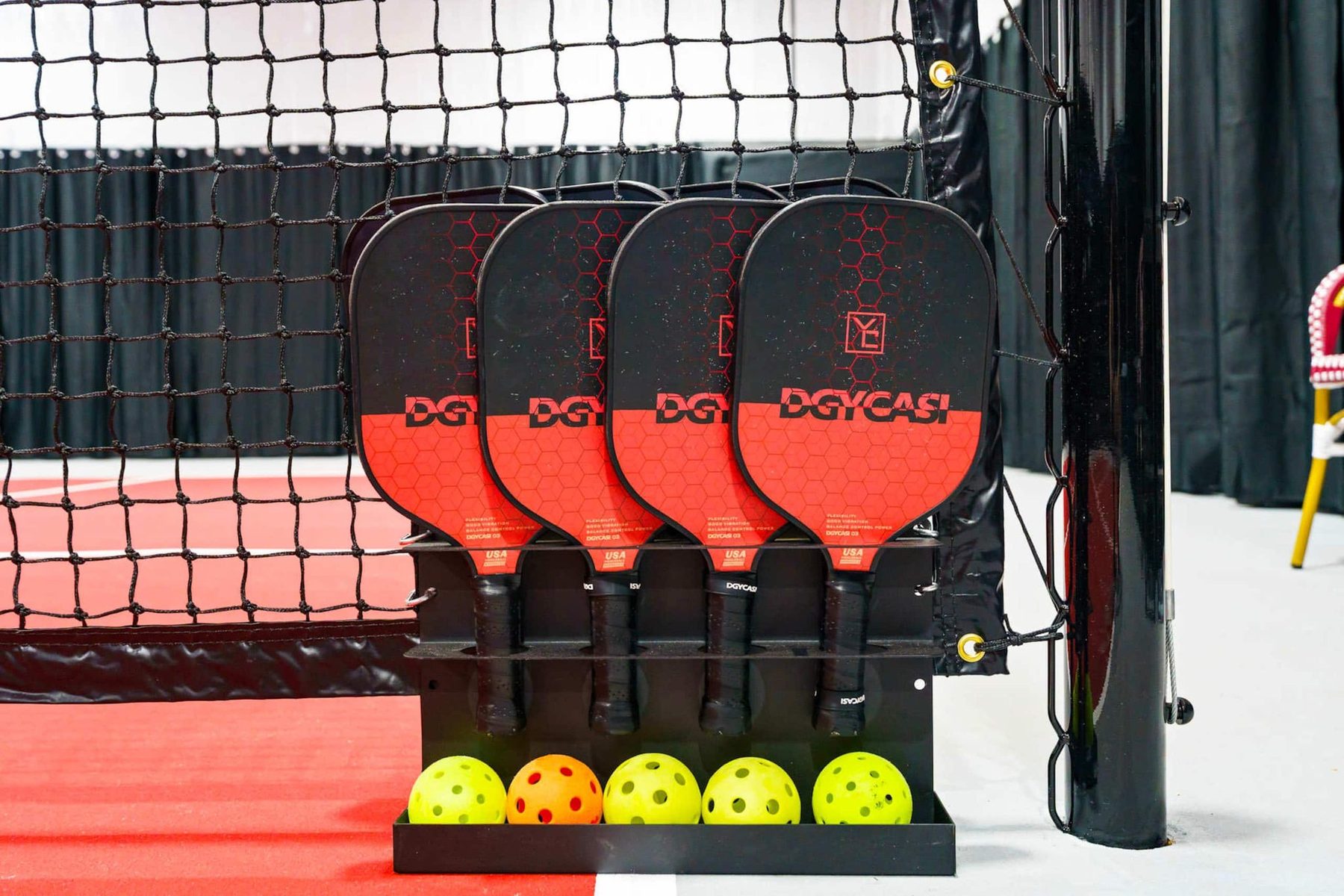
The photographs the house has released show how it is built. The frame is steel, with dark red rafters and purlins left exposed. Walls and roof are lined with white insulation facing. Black curtains run around the full perimeter to above head height. The net is a portable type, and there is a ball caddy, a rack of paddles and a few courtside chairs. No interior column interrupts the floor.
Why the court is indoors
An open court is the cheaper thing to build, as the cost figures below show. Enclosure answers two problems that an open court leaves in place, and in Sedona both can be put in numbers.
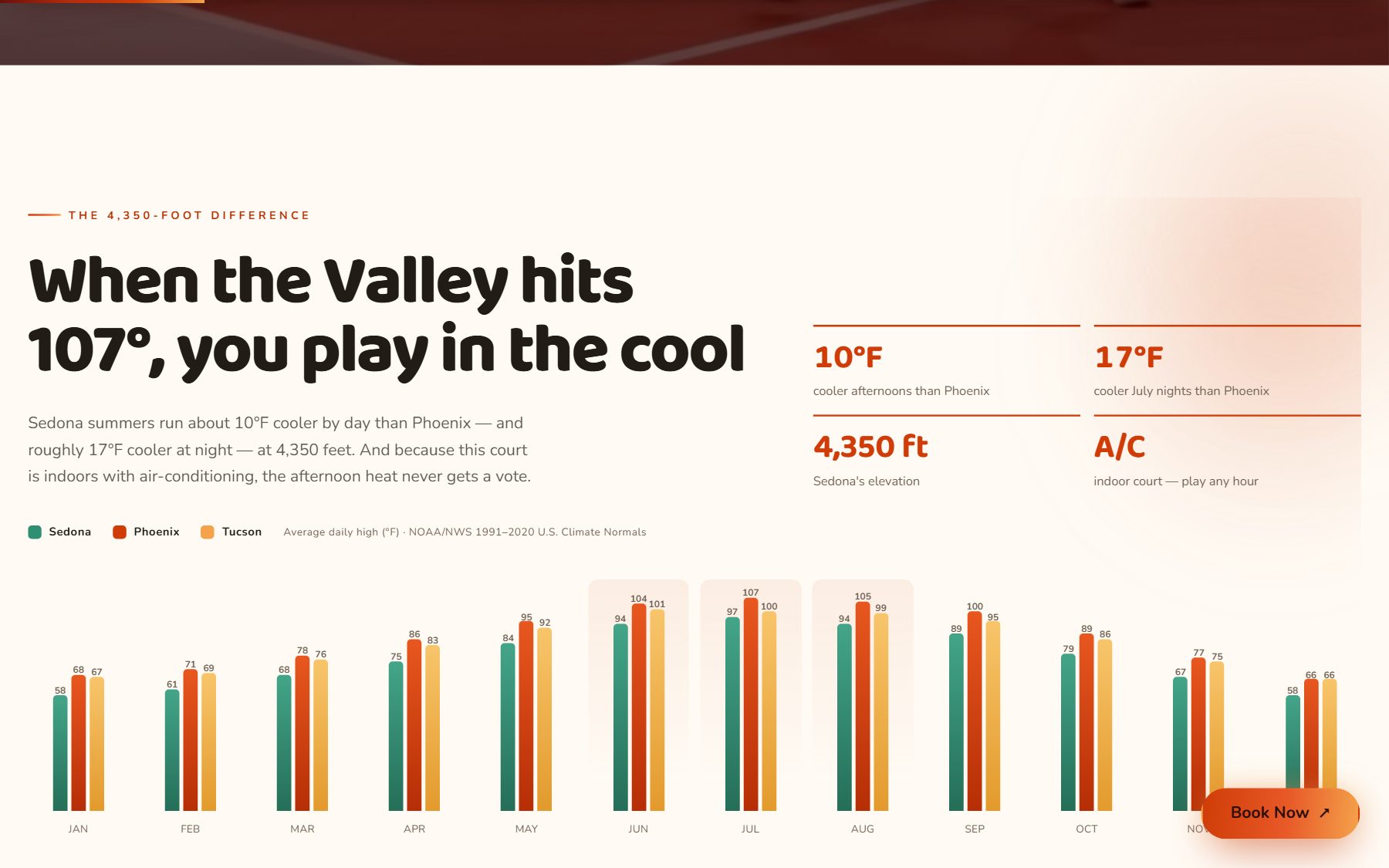
The first is weather. The house's site gives Sedona's elevation as 4,350 feet and publishes a chart of average daily highs that it labels as NOAA and National Weather Service climate normals for 1991 to 2020: 58 degrees in January and December, 75 in April, 79 in October and 97 in July. The same chart gives July averages of 107 for Phoenix and 100 for Tucson. Cooler than Phoenix is still 97 degrees on an average July afternoon. A court held at 68 is playable at any hour of any month. One guest who stayed in July 2026 wrote of “AC blasting a cool 68 degrees.”
The second half of the weather argument is commercial. The City of Sedona's tourism program publishes monthly lodging reports that include short-term rental figures scraped from Airbnb and Vrbo listings by the data firm Key Data. In its October 2025 report, Airbnb listings in the city's residential zones ran at 30.6% occupancy in August 2025, rising to 43.1% in September and 60.5% in October. Summer is the trough for Sedona rentals. The same report says Phoenix supplied 48.1% of the visitors counted that October, with no other city above 4%, and the house's site gives the drive from central Phoenix as about two hours, 116 miles up Interstate 17.
An air-conditioned court is therefore aimed at the weakest season and the nearest large market at once. Those are scraped listing figures for the whole market, and they say nothing about how this house has performed.
The second problem enclosure answers is sound, and it is the better documented of the two.
The neighbor question as a design input
Pickleball's liability is the sound of a hard paddle on a hard plastic ball, repeated. Charles Leahy, an attorney and retired mechanical engineer who has served on a homeowners association board, put a number on it at the joint meeting of the Acoustical Society of America and the Canadian Acoustical Association in Ottawa in May 2024. As Phys.org reported, he said each court generates “about 900 pop noises per hour” and that courts should be built “at least 600–800 feet away” from homes so that the sound can fade.
Local governments have written distances of that order into their own plans. When Sedona's City Council voted in July 2023 to fund the design of up to eight lit public courts at Posse Grounds Park, the Sedona Red Rock News reported that Assistant Public Works Director Sandra Phillips told the council the courts would be “more than 400 feet from the nearest home,” a distance at which she said the sound falls to about 58 decibels, roughly the level of normal conversation. The city planned a sound study as part of the design and had received no noise complaints about pickleball on its existing tennis courts. Park City, Utah, went further in an ordinance adopted in spring 2022: courts must sit 600 feet from property lines, or at least 150 feet where a sound study shows the city's noise limits will be met, KSL-TV reported in July 2023.
Where courts went in closer, the record is one of disputes. In north Scottsdale, the Stonegate Community Association converted a tennis court into two pickleball courts 65 feet from one couple's home. Gray Television's Phoenix station reported in February 2023 that the association limited playing hours after the couple complained, that it recommended two 12-foot walls at a cost of $140,000, and that homeowners voted the walls down. A noise specialist quoted in the same report advised keeping courts at least 150 feet from homes. In Falmouth, Massachusetts, six residents near the town's courts at the Lawrence School went to Barnstable Superior Court after about two years of asking for shorter hours or a sound barrier. WHDH reported in June 2023 that a judge ordered the courts closed for the time being. One of the residents lived 80 feet away.
| Place | Year | Distance from homes | What happened | Reported by |
|---|---|---|---|---|
| Sedona, Arizona: Posse Grounds Park public courts | 2023 | More than 400 feet | Council funded design of up to eight lit courts; an official put the sound at about 58 decibels at that distance and a sound study was planned | Sedona Red Rock News |
| Park City, Utah: city ordinance | 2022 | 600 feet from property lines, or at least 150 feet with a sound study | Setback written into city rules | KSL-TV |
| North Scottsdale, Arizona: Stonegate Community Association | 2023 | 65 feet | Tennis court converted to two pickleball courts; hours limited; two 12-foot walls at $140,000 voted down by homeowners | Gray Television |
| Falmouth, Massachusetts: Lawrence School courts | 2023 | 80 feet (one resident) | Six residents sought an injunction; Barnstable Superior Court ordered the courts closed for the time being | WHDH 7News |
| Charles Leahy, Acoustical Society of America meeting | 2024 | At least 600 to 800 feet recommended | About 900 pop noises per hour per court; enclosure listed among less desirable or costlier options | Phys.org |
None of these figures is a measurement of the Sedona Pickler building, for which no sound reading has been published.
Source: Sedona Red Rock News, 5 August 2023; KSL-TV, 7 July 2023; Gray Television, 13 February 2023; WHDH, 12 June 2023; Phys.org, 17 May 2024
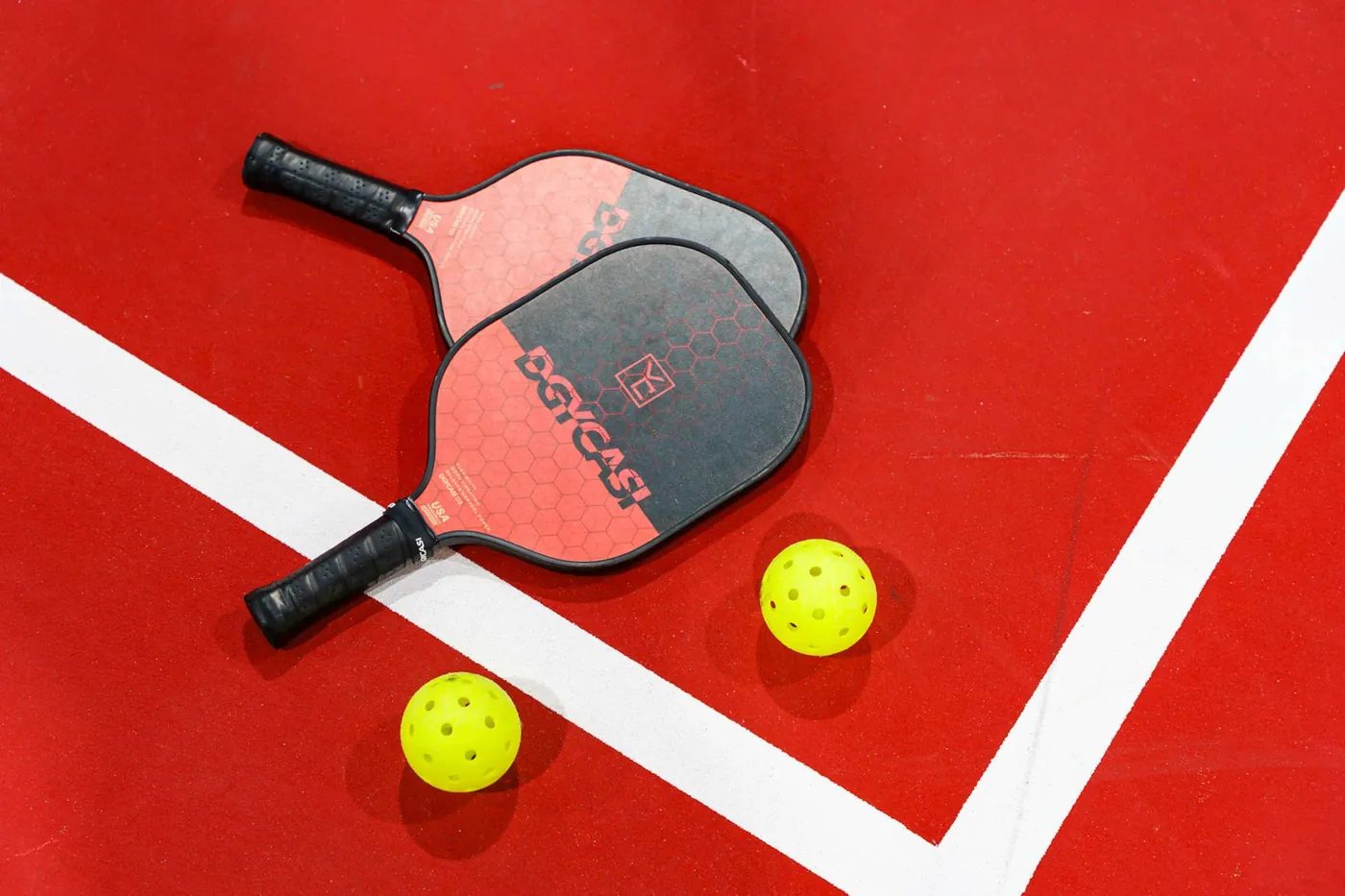
The sport's governing body has answered from the equipment side. USA Pickleball created a Quiet Category in September 2023 for paddles, balls, paddle covers and court screens that “deliver essentially 50 percent or less of the acoustic footprint of equipment commonly sourced and used in community parks.” Quieter equipment is one reason a host might supply the paddles, a point the house rules return to.
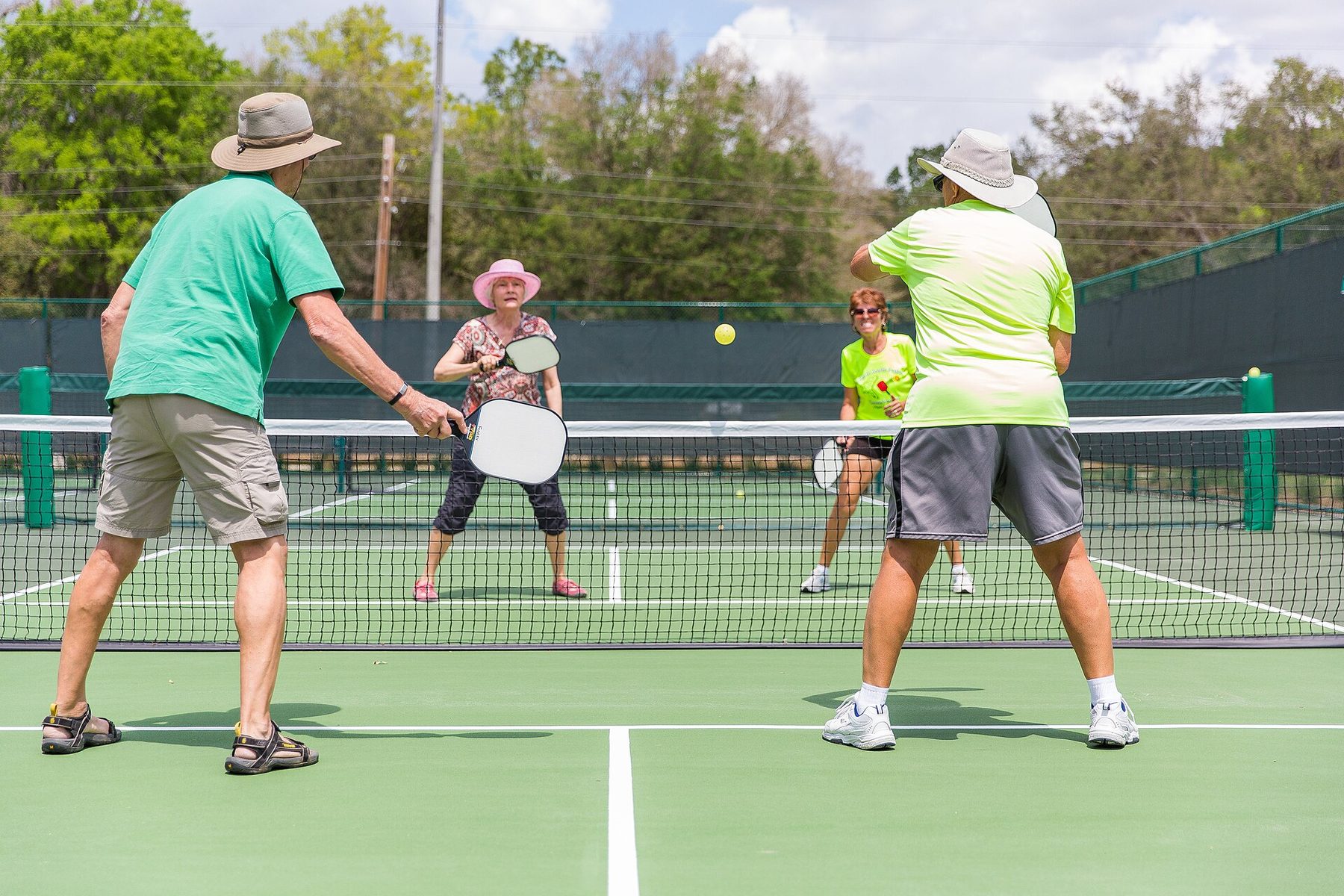
Read as a design brief, that record gives a host with neighbors a few hundred feet away three options: distance the lot does not have, a wall of the kind Stonegate's members declined to pay for, or a roof and four walls. Leahy's own list puts distance first and describes the alternatives, among them “enclosing the courts within a building,” as less desirable, or more difficult or costly. Enclosure is the recognized, and costlier, fallback when a lot is too small for distance.
What the Sedona building achieves in decibels is not on the public record. The house's site says the sound of play does not reach the neighbors. That is the owners' account, and no reading taken at the lot line has been published. An insulated metal building with curtains on every wall plausibly cuts the sound a great deal, and a host copying the design should budget for a measurement before and after.
What courts cost on the public record
Three public figures bracket the cost of a court, and none of them is for a building like this one.
The low end is the open home court. AvantStay, a vacation rental manager, wrote in an August 2026 post on court economics that “building a pickleball court costs $20,000 to $50,000 for a proper installation,” a range it links to the cost site HomeGuide. That range is for an outdoor court.
The high end is the municipal complex. Sedona's finance director estimated the Posse Grounds project in 2023 at $1.54 million to build, plus $81,880 for design, for up to eight lit courts, the Red Rock News reported. Divided evenly, the construction estimate alone comes to a little under $200,000 a court. That figure carries a public facility's lighting, shade structures and parking, and it is no guide to what a single private court costs.
The third figure is the price of mitigation after the fact: the $140,000 put on two 12-foot walls for Stonegate's pair of courts. That is almost three times the top of the home-court range AvantStay cites. On those numbers, fixing sound later can cost more than the court did.
For a single enclosed, insulated, air-conditioned court building at a private house, no reliable public cost figure was found.
The running costs can be listed even where they cannot be priced. The building encloses 2,376 square feet under a roof that rises to 19 and a half feet, held at 68 degrees through July afternoons that average 97 outside and through January days that average 58. It is lit by rows of overhead fixtures whenever anyone plays. An acrylic surface wears and has to be recoated. A building that guests use unsupervised has to be insured.
Arizona's rental law and its insurance floor
A fixed asset is only as safe as the right to rent the house it stands beside, so the statute book belongs in the business case. In Arizona that right is written into state law, and it is contested.
Senate Bill 1350, passed in 2016 and in force since the end of that year, says “a city or town may not prohibit vacation rentals or short-term rentals” and may not regulate them “based on their classification, use or occupancy,” with exceptions for health and safety and for ordinary nuisance rules applied to all homes alike. Counties are bound by the same words. Senate Bill 1168, passed in 2022, kept the ban on prohibitions and handed local governments a defined set of tools. A city, town or county may require a local permit or license, notice to neighbors before a house is first rented, and liability insurance. It may require the permit number, or failing that the state tax license number, on every advertisement. It may fine owners for verified violations and suspend a permit. The figures are in the table.
| Provision | Figure | Law |
|---|---|---|
| Ban on prohibiting short-term rentals | Effective from and after December 31, 2016 | SB 1350 (Laws 2016, ch. 208) |
| Local permit or license fee | Actual cost of issuing it or $250, whichever is less | SB 1168 (Laws 2022, ch. 343) |
| Liability insurance | At least $500,000 in the aggregate, or a platform that provides it | SB 1168 |
| Fines for verified violations within 12 months | Up to $500, $1,000 and $3,500, or one, two and three nights' advertised rent if greater | SB 1168 |
| Failure to provide an emergency contact | Up to $1,000 per 30 days | SB 1168 |
| Permit suspension | Up to 12 months after three verified violations in 12 months, or one grave one | SB 1168 |
| Time allowed to issue or deny a permit | Seven business days | SB 1168 |
| Cap on the number of rentals | No power granted | SB 1168 |
Whether a given city, town or county has adopted each tool is a matter of its own code.
Source: Arizona Legislature, Laws 2016, chapter 208 and Laws 2022, chapter 343
Two of those lines matter most to a host planning a large amenity. The insurance figure, cover “in the aggregate of at least $500,000” or a listing through a platform that provides it, is a floor a jurisdiction may demand. It was written with houses in mind, and a host adding a sports building should ask an insurer what a court does to the premium and to the exclusions. The suspension clause counts verified violations and sets aside only those concerning aesthetics, trash and parking. Noise is not on that short list. What the law does not contain is any power to cap the number of rentals.
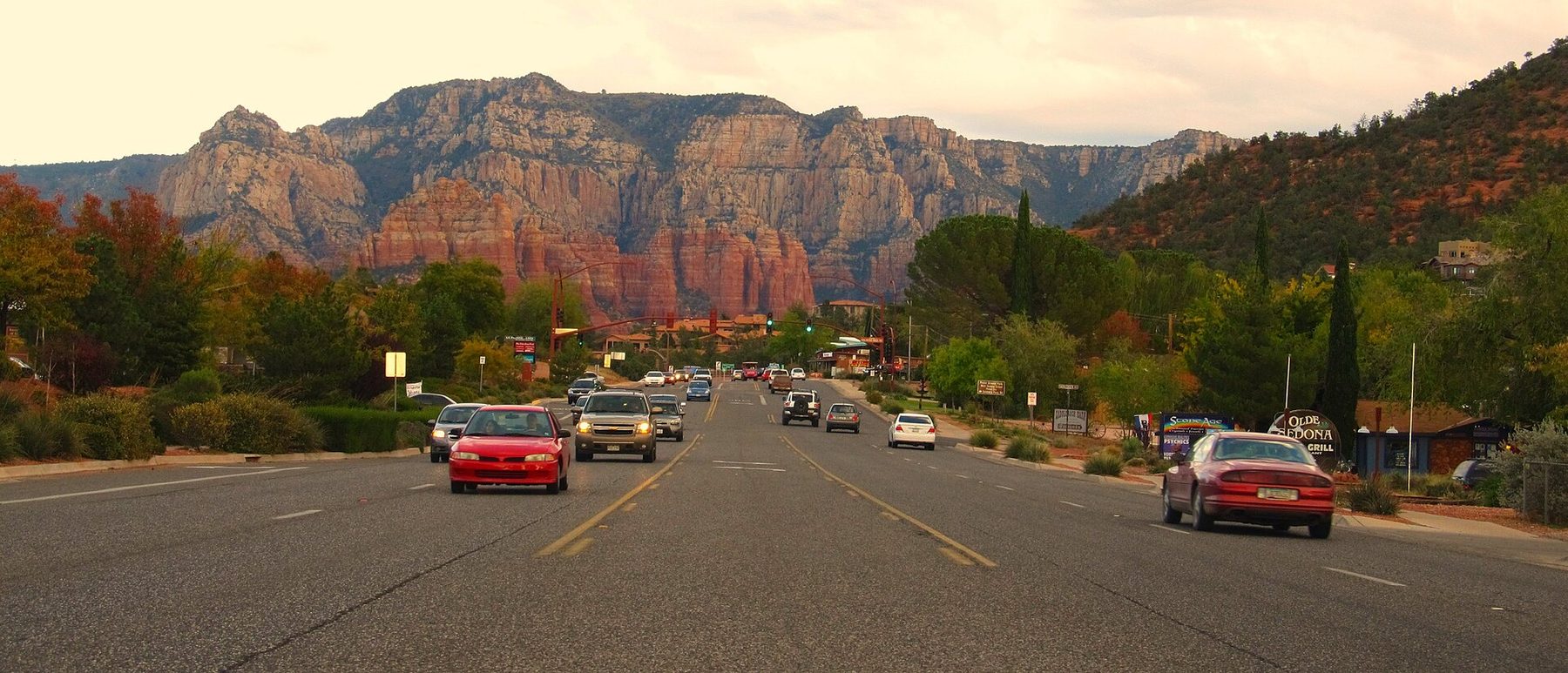
Sedona is where the argument over that missing power is loudest. AZFamily reported in February 2025 that the city's own count of short-term rentals stood at about 400 in 2020 and had passed 1,200 by the end of 2024. Scott Jablow, then the city's mayor, told the station that nearly 20% of the city's housing options were short-term rentals and that people living elsewhere owned 66% of them. “Let us enact a cap,” he said.
Operators answer that the rentals pay their way. Cameron Wylde, who runs 40 rentals as Wylde Vacation Rentals, told ABC15 in February 2025 that the bed tax they generate runs to tens of millions of dollars a year.
The 2026 session showed where the balance stands. House Bill 2429, sponsored by Rep. Selina Bliss of Prescott, set out to let cities limit the number of rentals and was cut back to a cap on overnight guests before it cleared the House in March 2026, Capitol Media Services reported on KJZZ. Two Senate committees then passed over it, the Red Rock News reported on April 25.
For an owner sinking money into a building, the reading is that Arizona's protection of short-term rentals held through another session, and that the pressure to change it is organized, local and persistent.
House rules that protect the asset
The rules published on the house's site read differently once the court is treated as the asset they protect. The maximum is eight guests. The guest who makes the reservation must be 25 or older. Pets, smoking, parties and events are barred. The minimum stay is two nights. Parking is four cars in the driveway and none on the street. A rental agreement with identification may be requested.
For the court itself the house's pages add three more: paddles and balls are provided, guests bring their own court shoes, and the court is for the reserved group only, with no reservations system and no per-game fee. The site does not give reasons, but each rule has an evident job. Supplied paddles and balls let an owner decide what equipment is used in the building. Court shoes keep street soles off an acrylic surface. Limiting play to the group in the house keeps the court from becoming a venue, which matters for wear, for insurance and for the neighbors.
The cap of eight deserves a second look, because the audiences the house addresses include pickleball clubs and company teams as well as families. Under the published rules, a club that takes the house is a group of eight staying overnight. It is not a tournament, a clinic with paying visitors or a party. That line is also where state law points. Arizona lets a jurisdiction act against a rental that is used as an event space. A host who builds an amenity that could draw a crowd needs rules that say in writing that it will not.
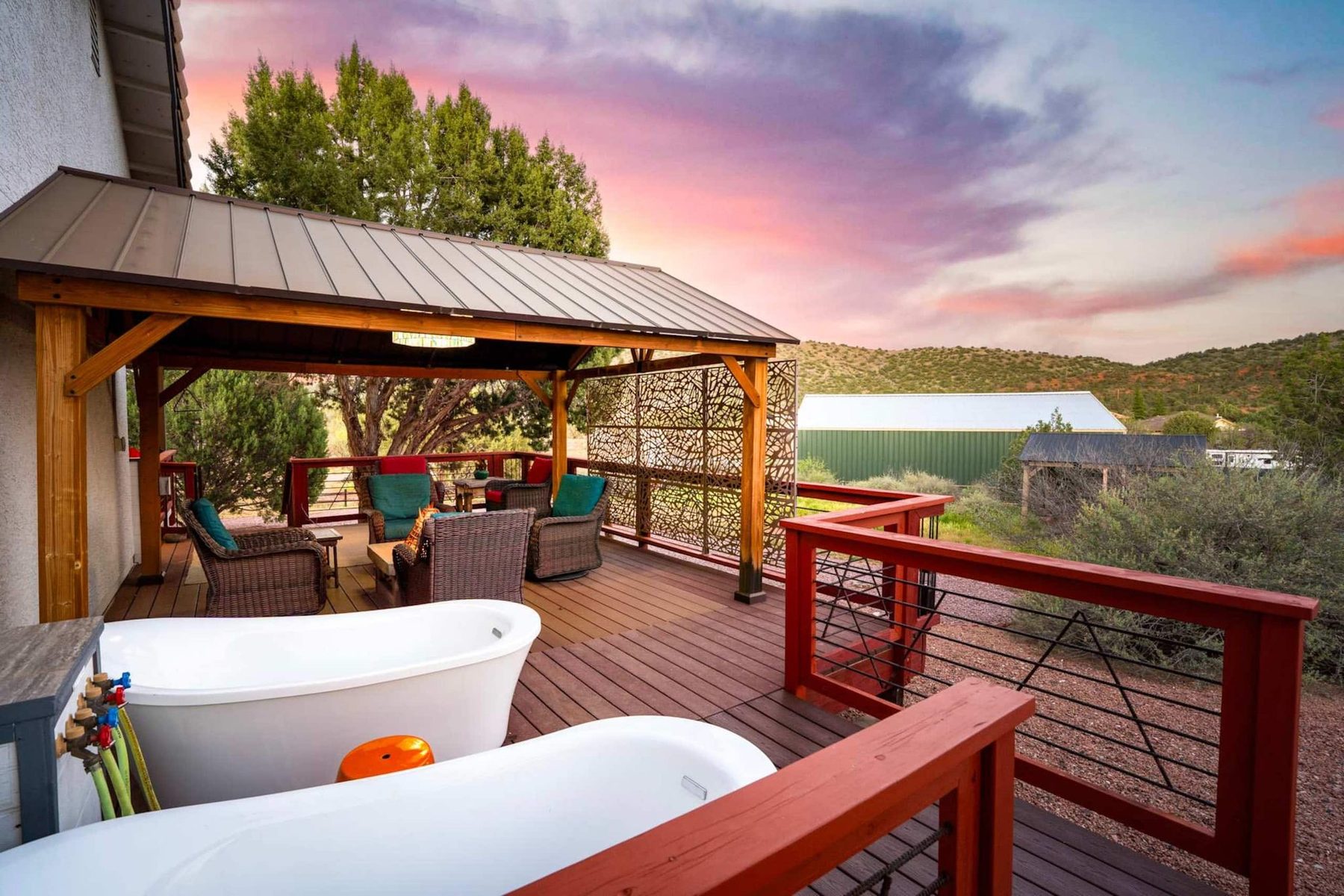
The practical limits belong here too, since an operator sizing up the model will want them. The site itself describes the sleeping arrangement as three true bedrooms plus a bunk game room, and there are two bathrooms for eight people. There is no pool; the outdoor water is two freestanding soaking tubs on the deck. The views from the house are of high desert, with the red cliffs in the distance. Restaurants and shops are a drive away. The list underlines how much of the proposition rests on the court.
A brand named for the court
The house is named for its amenity. That is the least reversible marketing decision in the case. A rental named after a view or a street can add or drop a feature without anyone noticing. A rental named after a sport has told the market what it is for.
The site built behind the name is large for a single property. Its sitemap listed 164 addresses on Oct. 11, 2026: a home page, a blog of 56 posts, 73 guides to things to do around Sedona, six pages written for drive markets, a ten-page section on escaping the desert heat, seven pickleball reference pages covering rules, scoring, court dimensions and ratings, and a page on quiet pickleball. There is a narrated film of one minute 48 seconds and a page written for AI assistants. Two further sites on their own domains present the same house to other audiences, one of them to groups and clubs.
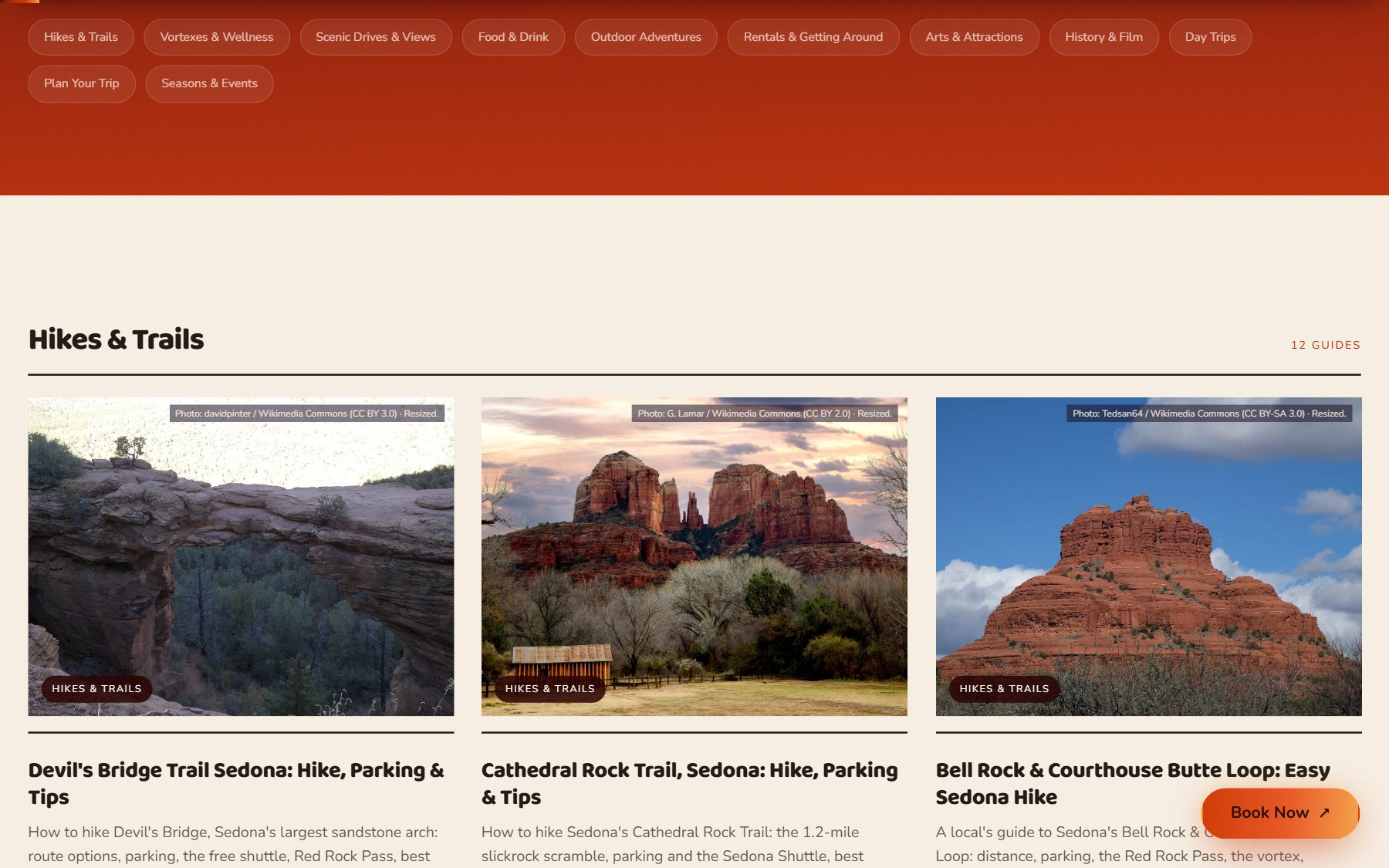
The structure follows the two arguments for enclosure. The heat pages speak to Phoenix and Tucson in summer. The pickleball pages speak to players wherever they live, on subjects such as rules, scoring and ratings that a player might search for with no trip in mind. The single amenity has been used to define the editorial plan as well as the product: who is addressed, in which season, and with what.
The trade-off is concentration. Every page that ties the house to pickleball makes it easier for a player to find and harder to reposition later.
Five channels and a brand site
The brand site does not take reservations. Its date panel collects check-in, check-out and guest count and passes them to an outside channel; the panel's own text says the dates “carry over to Airbnb, Vrbo, Booking.com and the direct booking site.” Airbnb is the primary button. Below it are Vrbo, Booking.com, a direct-booking site labeled HomeTeam VR, and CrewDogs, which the panel describes as a pickleball travel network.
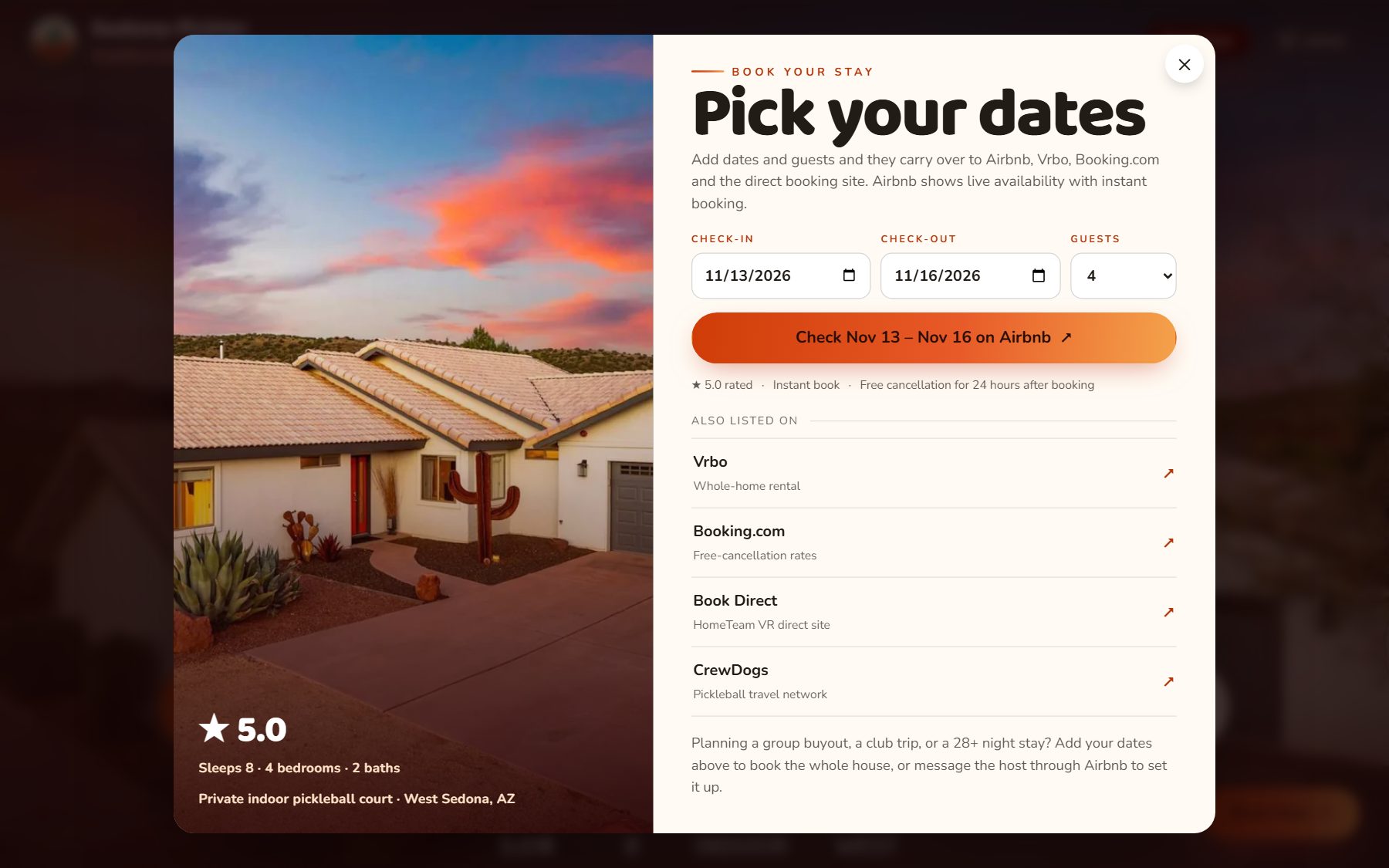
The direct site is hosted on the booking platform of Guesty, a property management system, and its page title carries the name Home Team Luxury Rentals. The house's published pages say it is run by its owners and their property manager. As far as the arrangement can be read from outside, it has three layers: the owners, a manager working in a mainstream management system that feeds the large platforms, and a brand site in front that sends each visitor to whichever channel that visitor prefers.
For a single-amenity rental that division of labor has a logic. The platforms supply reach, payment handling and reviews. The house's Airbnb rating, 5.0 across six reviews as of October 2026, is a small sample, but it is the kind of proof a new brand cannot generate alone. The brand site does the thing a platform listing has little room for, which is to explain a specialized amenity at length to the people most likely to want it. And the fifth channel, a marketplace for traveling players, is distribution that exists only because the amenity does.
The cost of the design is that the owner of the brand does not own the transaction. The reservation, and the guest relationship that comes with it, sits with whichever channel takes it.
The risk of resting on one sport
The demand behind the bet is large and still growing. The Sports & Fitness Industry Association, which surveys 18,000 Americans aged six and over each year, counted 24.3 million pickleball players in 2025, up from about 4.2 million in 2020. By its count the sport grew 171.8% from 2022 to 2025.
The curve has bent, though. SFIA reported growth of 45.8% for 2024 over 2023. For 2025 the rate was 22.8%, according to Pickleball.com's April 2026 report on the association's latest study: about 4.5 million new players, at about half the previous year's pace. The same report splits the total into 16.8 million casual players, with one to seven outings in the year, and 7.48 million core players, with eight or more. The traveler who picks a house for its court is likelier to be found in the second group than the first. That is an inference and no survey says so, but it puts the addressable market nearer seven million people than 24 million.
Supply is moving as well. USA Pickleball counted 68,458 courts at 15,910 locations at the end of 2024, with 18,455 of those courts added in that year alone. Outdoor courts are becoming ordinary, including in Sedona, where the city budgeted for up to eight public ones. The scarce thing is a private, climate-controlled court, and no public count of those at vacation rentals was found. Scarcity is the premise of the business, and nobody can say how long it lasts.
Destination risk sits on top of sport risk. HVS, the hospitality consultancy, reported in March 2026 that Sedona's hotels ran at occupancy in the high 60% range across 2023, 2024 and 2025, and that the big northern Arizona draws, Slide Rock State Park and the Grand Canyon among them, each lost 5% to 10% of their visitors in 2025.
What a single-amenity owner holds if tastes change is the last question. An outdoor court is a painted slab. An insulated, climate-controlled building with a clear floor is at least a large room, and large rooms can be put to other uses. That too is an inference, drawn from the photographs. The name on the door would be harder to convert than the building.
The Gazette Verdict
A host who builds around one amenity should spend first on containing its nuisance, and on that test the Sedona building was done in the right order. Both documented disputes in this piece involve an open court within 100 feet of a home. The one public project that planned for sound put more than 400 feet between its courts and the nearest house, and a private lot rarely has 400 feet to give. Arizona law lets a jurisdiction fine and suspend on verified violations, and walls added afterward were priced at $140,000 in Scottsdale. Enclosure costs more on the first day and removes the cheapest way to lose the asset. What it cannot do is underwrite the sport. With annual growth down from 45.8% to 22.8%, and 16.8 million of 24.3 million players casual, the court should be valued as a building that holds pickleball today.
The other side
The acoustics presenter this article relies on ranks enclosure below distance and calls it more difficult or costly, and no sound reading for this building is public. An open court is quoted at $20,000 to $50,000, while conditioning 2,376 square feet is a cost an open court never carries. Sedona has budgeted for public courts of its own. The sport's core is 7.48 million players. And in a market where the city counted about 400 rentals in 2020 and more than 1,200 four years later, and its then mayor asked for a cap, every investment that makes a house a better rental is, to the housing side of the argument, one more reason it will not return to the long-term market. A host can accept all of that and still build, but should do so knowingly.
What hosts should do now
The Sedona case comes with no price tag or payback period, so it cannot tell another host whether to build. It does show the order of the questions.
- Measure the distances first. Set the gap from the proposed court to the nearest home against the public record: 150 feet as one specialist's minimum, 400 feet in Sedona's plan, 600 to 800 feet from the acoustics presenter.
- Take a sound reading before and after. Sedona planned a baseline study before designing its public courts. A private host can do the same at the lot line and keep the result on file.
- Price the retrofit alongside the build. Stonegate's walls were quoted at $140,000 after its courts were in use. Compare that with enclosing from the start, using contractors' quotes.
- Read SB 1168 against the local code. Find out what neighbor notice and insurance the local permit requires, then ask the insurer in writing how a sports building changes the policy.
- Get the running costs quoted. Heating, cooling, lighting and resurfacing for a tall 2,376 square foot room are knowable numbers. Have them before the slab is poured.
- Write rules for the asset. A guest cap, a ban on events, supplied equipment and a footwear rule each protect the court, the policy and the peace with the neighbors.
- Choose the name last. Decide whether the house could still be sold under an amenity's name if the amenity lost its pull.
- Decide what the brand site is for. A site that explains the amenity and hands guests to outside platforms leaves the transaction, and the guest relationship, with the channel.
- Run the numbers on core players and slower growth. Plan on 7.48 million regular players and a growth rate that roughly halved in a year.
Sedona Pickler's court specifications, house rules and press facts are published on the house's own site. The statutes, city reports and surveys used in this article are listed below.
Common questions
How big is the court building at Sedona Pickler?
The house's press page gives the building as 66 by 36 feet, with an acrylic surface on a concrete slab. Its published pages give the walls as 16 and a half feet high and the ceiling as 19 and a half feet at the center.
Does putting a pickleball court indoors solve the noise problem?
It is a recognized way to reduce it, but nobody has published a sound reading for this building. An acoustics presenter quoted by Phys.org in May 2024 ranked distance of 600 to 800 feet first and listed enclosing courts in a building among the less desirable or costlier options.
What can an Arizona city or county require of a short-term rental?
Under SB 1168 of 2022 it may require a permit costing no more than $250, notice to neighbors, liability insurance of at least $500,000, and the permit or state tax license number in advertisements. It may fine and suspend for verified violations. It may not ban rentals or cap their number.
What does a pickleball court cost to build?
AvantStay, citing HomeGuide, puts an outdoor court at $20,000 to $50,000. Sedona estimated its eight lit public courts at $1.54 million plus $81,880 for design in 2023. No reliable public figure was found for a single enclosed, air-conditioned court building, and the owners have not published theirs.
Is pickleball still growing?
Yes, but more slowly. SFIA counted 24.3 million U.S. players in 2025. Year-on-year growth was 45.8% in 2024 and 22.8% in 2025, and 16.8 million of the 2025 total were casual players who played seven times or fewer.
Sources
- Sedona Pickler, Press page: facts for journalists and press photographs (October 2026).
- Sedona Pickler, Home page: house rules, guest reviews, climate chart, date panel and sitemap (read 11 October 2026).
- Phys.org, Pickleball courts in a legal pickle over the associated noise (17 May 2024).
- Sedona Red Rock News, Sedona approves pickleball courts at Posse Grounds Park (5 August 2023).
- KSL-TV, Noise, lights, crowds: Pickleball problems plague neighbors (7 July 2023).
- Gray Television (KPHO, carried by WFSB), Addition of pickleball courts pits neighbor against neighbor, leads to lawsuits (13 February 2023).
- WHDH 7News, Judge orders Falmouth pickleball courts closed after neighbor complaints (12 June 2023).
- USA Pickleball, USA Pickleball announces Quiet Category for pickleball products (25 September 2023).
- AvantStay, Pickleball Court ROI for Vacation Rentals: 2026 Cost Analysis and Profit Breakdown (17 August 2026).
- Arizona Legislature, Laws 2016, chapter 208 (Senate Bill 1350), online lodging (2016).
- Arizona Legislature, Laws 2022, chapter 343 (Senate Bill 1168), vacation and short-term rentals (2022).
- AZFamily, Short-term rentals could be to blame for Sedona housing shortage (3 February 2025).
- ABC15 Arizona, Sedona leaders say vacation rentals are driving a housing shortage emergency (3 February 2025).
- KJZZ (Capitol Media Services), Arizona short-term rental bill now goes after ‘repeat bad actors’ to limit overnight occupancy (11 March 2026).
- Sedona Red Rock News, Senate stalls Bliss' STR bill indefinitely (25 April 2026).
- City of Sedona Tourism Program, October 2025 Lodging and Spending Reports (Internet Archive capture of 11 May 2026) (October 2025).
- Sports & Fitness Industry Association, U.S. Pickleball Participation (2026).
- Sports & Fitness Industry Association, SFIA releases single sport reports for pickleball and from the team sports category (14 May 2025).
- Pickleball.com, SFIA report confirms over 24 million Americans playing pickleball (4 April 2026).
- USA Pickleball, 2024 USA Pickleball Annual Growth Report (14 January 2025).
- HVS, Sedona's Lodging Market: Resilience and Pricing Power (20 March 2026).
A note on this story: Stay Gazette's publisher works with Sedona Pickler on its marketing. The facts here come from the house's published pages and the public sources listed above. Sources were read on or before 11 October 2026. To report an error, write to the desk; see the corrections policy.

More features
 Case study · MarketsA St. Croix Brokerage Runs Home Sales and Villa Management From One OfficeBy Dana Whitfield · 20 min read
 Case study · WorldHow a Rio Brokerage Sells and Lets the Same ApartmentsBy Tomás Ferreira · 20 min read
 Case study · PlatformsHow One St. Croix Villa Built Its Own Booking ChannelBy Jesse Kohl · 20 min read