Airbnb Removes Quebec Listings Without Permits After Old Montreal Fire
Eight days after a fire killed seven people in an Old Montreal building that held prohibited short-term rentals, Airbnb agreed to remove Quebec listings that had no provincial permit. Within days, hosts were entering 123456 in the new field.
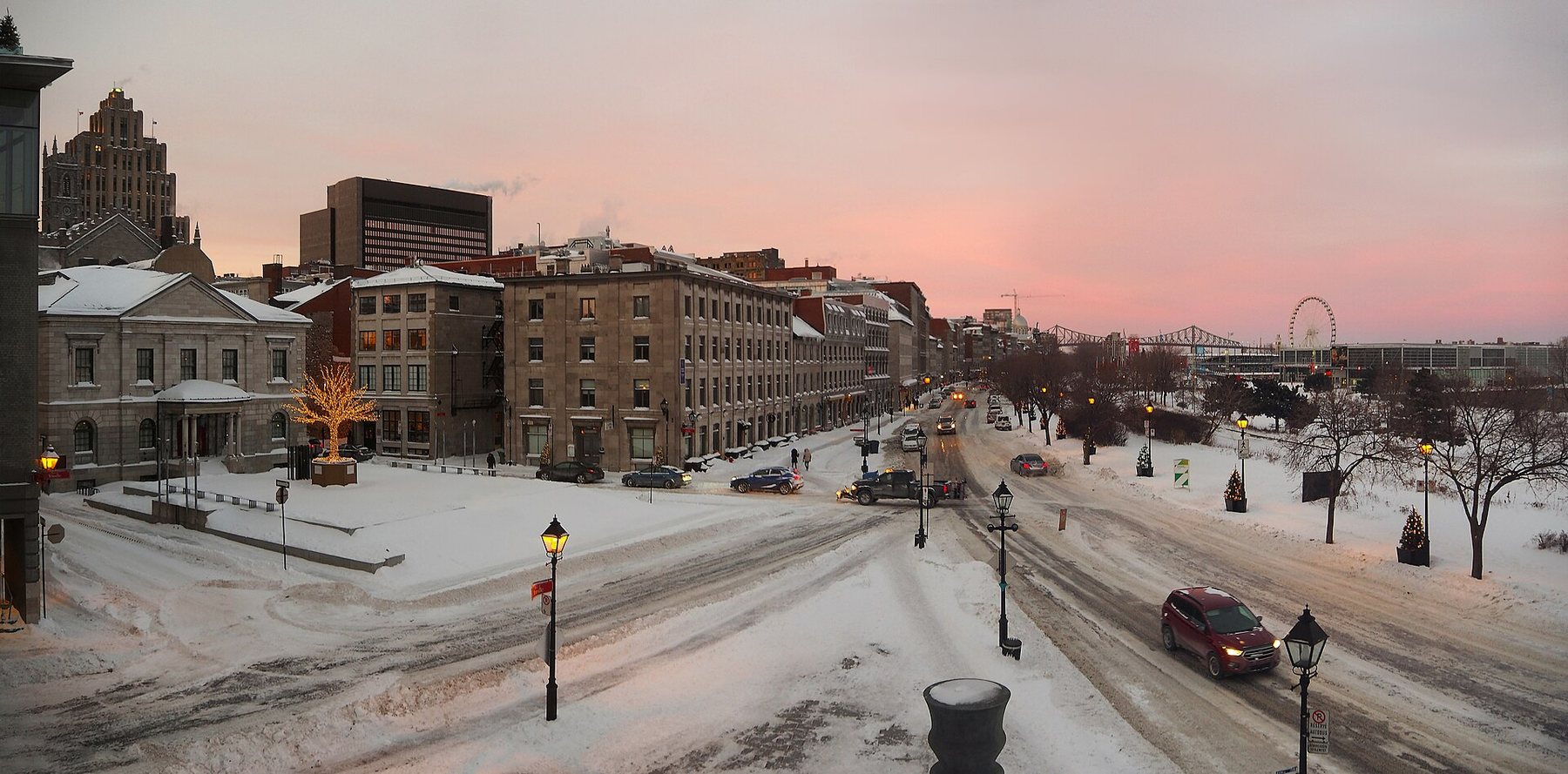
Rue de la Commune and Place d'Youville in Old Montreal, seen from the Pointe-à-Callière museum on 6 January 2018. A general view of the district, taken more than five years before the fire. Photo: Rue de la Commune et Place d'Youville, vue du musée Pointe-à-Callière, 2018-01-06 by Pierre5018, CC BY-SA 4.0, via Wikimedia Commons (resized).
From the record. This is a look back at March 2023. The desk wrote it on 11 October 2026 from sources published at the time; Stay Gazette opened in July 2026 and did not report this as it happened.
On 24 March 2023, Airbnb told Quebec's tourism minister in a letter that it would remove every listing in the province that had no provincial permit. The promise came eight days after a fire destroyed a heritage building in Old Montreal that held short-term rentals, in a part of the city where they were prohibited. Seven people died.
Four days later, on 28 March, Airbnb said all listings without a registration number would be disabled that day. Data from Inside Airbnb, a watchdog group, reported by CBC, showed Montreal listings falling from 14,289 to 6,987 between 16 and 29 March, a drop of over 50 per cent.
The change had a hole in it. By 30 March, reporters had found Montreal listings carrying the licence number 123456, and Airbnb said that enforcing the law was the province's responsibility.
The fire on Place d'Youville
The fire broke out early on 16 March 2023 at 224 place D'Youville, in a three-storey, mixed-use building of 15 units at the corner of St-Nicolas Street. The Canadian Press identified it as the Edifice William-Watson-Ogilvie, constructed in 1890. CBC News reported that nine people were taken to hospital that day, three of them with serious injuries.
On 24 March, four deaths had been confirmed and three people were still missing. By 30 March, CBC reported that all seven victims had been identified and that Montreal police had said the search was over.
The building held both long-term and short-term rentals, some of them listed on Airbnb. CBC reported that a bylaw adopted in 2018 prohibited such rentals in that part of Old Montreal. The Canadian Press reported that some of the missing had rented their accommodation on Airbnb.
Police said in March that it was too early to determine the cause, and the arson squad was investigating. The lawyer for the building's owner said, as CBC reported, that his client did not operate Airbnb rentals, that at least one tenant did, and that the owner had sent that tenant a lawyer's letter to end what the lawyer called illegal renting. That was the lawyer's account.
The rules that already existed
The province passed its Act respecting tourist accommodation establishments in 2021. Operators of short-term rentals had to register with the province through the Corporation de l'industrie touristique du Québec, the CITQ, and received a registration number.
The gap was on the listing. Global News reported that it was not mandatory for the number to appear there, and CTV reported that Airbnb had not required hosts to enter one when creating a listing. According to Inside Airbnb, as CBC reported, more than 90 per cent of the short-term rental units in Montreal listed on Airbnb were not authorized.
Enforcement was split. Cities and their boroughs set the rules on where short-term rentals were allowed. Mayor Valérie Plante said Revenu Québec needed more inspectors to investigate illegal operators, and the agency told CBC that applying municipal regulations was outside its mandate.
Eight days of pressure
On Monday 20 March, Plante called on the province and on Airbnb to act. “The solution is not only to hire inspectors paid for by taxpayers when Airbnb doesn’t even oblige their owners to have permit numbers,” she said, as CBC reported.
The same day, Tourism Minister Caroline Proulx said the province would legislate as soon as possible. Owners would have to show their permit numbers on listings, and both the owner and the platform could be fined if they did not. On Thursday 23 March she met two Airbnb employees in Quebec City and promised a revised law by June 9, The Canadian Press reported. Global News reported that Vancouver and Toronto had already made the removal of unregistered listings a condition for Airbnb to operate.
Airbnb's letter was sent the next day. The Canadian Press, which reported its contents, said it was signed by Nathan Rotman, the company's representative for Canada and the northeastern United States, and that it made three commitments:
- take down Quebec listings that lacked a permit from the agency administering the province's tourist accommodation law;
- make the permit number compulsory on new listings within days;
- open its City Portal to the provincial government, a tool the company said helped communities enforce their rules.
CBC noted that this could mean the loss of the vast majority of Airbnb's listings in Quebec. An Airbnb spokesperson's statement, quoted by CBC, said the CITQ registration system still needed to improve.
Proulx welcomed the move and kept her plan to legislate. “I am satisfied with Airbnb’s decision to comply with our legislation as I demanded yesterday during our meeting,” she said in a statement carried by The Canadian Press. She asked other platforms to comply, and her office said the announcement would not change the plan to strengthen the law.
The 123456 problem
The mandatory registration field was put in place on Tuesday 28 March, and listings without a licence number stopped showing availability.
CBC reported that on the afternoon of Thursday 30 March, 29 homes in Montreal were advertised with the licence number 123456. Radio-Canada found that Airbnb did not check whether a number matched an existing licence, and it was able to create a 30th advertisement with the same number. CTV reported that 123456 was the example Airbnb showed hosts when it asked for their number.
Airbnb's answer, in a statement to Global News, drew the line where the company wanted it: “the province issues the CITQ number directly to hosts, not Airbnb. As such, it’s the province’s responsibility to enforce their legislation.” CBC noted that the CITQ database was not public.
Others were not satisfied. A report by RCLALQ, a coalition of tenants' groups, carried by The Canadian Press on 28 March, said 79 per cent of the roughly 30,000 Quebec units available on Airbnb in February were not certified by the province. Airbnb called the data inaccurate. The coalition's spokesperson, Cédric Dussault, said the government should instead bar short-term rental companies from doing business in Quebec. Marc Tanguay, the interim Quebec Liberal leader, said the government needed to verify the licence numbers.
Proulx told the National Assembly she would change the regulations before the end of the parliamentary session, and her spokesperson said fake registration numbers would be addressed in the new legislation. CTV reported that the Plante administration had announced the week before that it would form a team of investigators against illegal short-term rentals by June.
The Gazette Verdict, looking back
Airbnb's promise was worth less than it sounded, and it still changed the market in four days. The law had required a registration number since 2021, and the platform had not asked for one. Once a minister demanded it, Montreal's listings fell by more than half between 16 and 29 March, on Inside Airbnb's count. That shows what one field on a listing form could do, and who had carried the cost of its absence: the inspectors paid for by taxpayers that Plante spoke of. The field checked nothing, so a host could enter 123456 and stay online. The hosts who gained were the ones already registered. The hosts who paid were those renting without a number, with fines promised for owner and platform alike. The lesson for a host was to get the number before the platform asked for it.
The other side
Airbnb's case was stronger than the 123456 reports allowed. The province, not Airbnb, issued the numbers, and CBC noted that the CITQ database was not public. The company agreed to the minister's demand the day after she made it, disabled listings without a number four days after that, offered the province its City Portal, and said in the statement CBC quoted that the registration system itself needed to improve so that Quebecers could supplement their incomes. On that reading, the failure belonged to governments that had split enforcement between them. The tenants' coalition attacked from the other direction: for it, certification was beside the point, because the harm was long-term housing turned over to tourists.
What it meant for hosts
For anyone hosting in Quebec at the end of March 2023, the practical position was this:
- No number, no bookings. A listing without a registration number no longer showed availability on Airbnb, and new listings had to carry one.
- The number came from the province. To get one, CTV reported, an applicant had to show the rental complied with municipal law, supply photos of the residence and prove it carried civil liability insurance.
- The city still decided where. Municipal and borough rules set the zones, and in that part of Old Montreal full-time short-term rentals were not allowed unless they had been active before 2018.
- A tougher law was promised. The minister had vowed to revise the law by June 9 so that listings carried the number, and had spoken of fines for owner and platform, and Montreal had said it would form a team of investigators by June.
The fire also put safety on the host's side of the table. CBC pointed out that Airbnb did not ask owners to prove they had working smoke and carbon monoxide detectors before a listing was approved. The cause of the fire had not been established in March 2023. Whatever it was, testing the alarms and checking the way out was something a host could do in any case.
Sources
- CBC News, All unauthorized Airbnb listings in Quebec to be removed from app, company says (24 March 2023).
- The Canadian Press (via Global News), Airbnb to pull listings that don’t have proper permits in Quebec (24 March 2023).
- CBC News, Mayor calls for crackdown on illegal Airbnb rentals after deadly fire in Old Montreal (19 March 2023).
- CBC News, Most Airbnbs in Montreal are illegal and few safety standards are enforced (22 March 2023).
- Global News, Quebec’s tourism minister meets with Airbnb officials after Old Montreal fire (23 March 2023).
- The Canadian Press (via CBC News), Removing illegal Airbnbs could help solve Quebec's housing crisis, tenants' association says (28 March 2023).
- CBC News, Airbnb landlords using fake licence numbers on Montreal short-term rentals (31 March 2023).
- CTV News Montreal, 123456: Are Quebec Airbnb hosts faking permit numbers to skirt new regulations? (30 March 2023).
- Global News, Are Quebec hosts skirting the new rules on Airbnb? (30 March 2023).
- CBC News, Here's what we know about the victims in the Old Montreal fire (30 March 2023).
- CBC News, At least 7 people missing after major fire in Old Montreal heritage building (18 March 2023).
Part of the Stay Gazette record for March 2023. Filed on 11 October 2026; every specific was checked against the sources above, which were read on or before that day. To report an error, write to the desk; see the corrections policy.

Also filed on March 2023
- CrackdownNew Orleans Limits Short-Term Rentals to One Per Square BlockThe City Council capped residential short-term rentals at one per square block, required an operator who lived on site and left the choice between neighbors to a lottery. The same day it let owners apply for a special exception, with no more than two in effect on a block.
- The recordMarch 2023, the whole month
- The recordEvery month on the record