Arizona Lets Cities License Short-Term Rentals Under a Three-Strike Law
Governor Doug Ducey signed Senate Bill 1168 on 6 July 2022. It let Arizona cities require a permit costing up to $250 for a short-term rental and suspend it for up to a year after three violations, and it limited the reasons a city could refuse one.
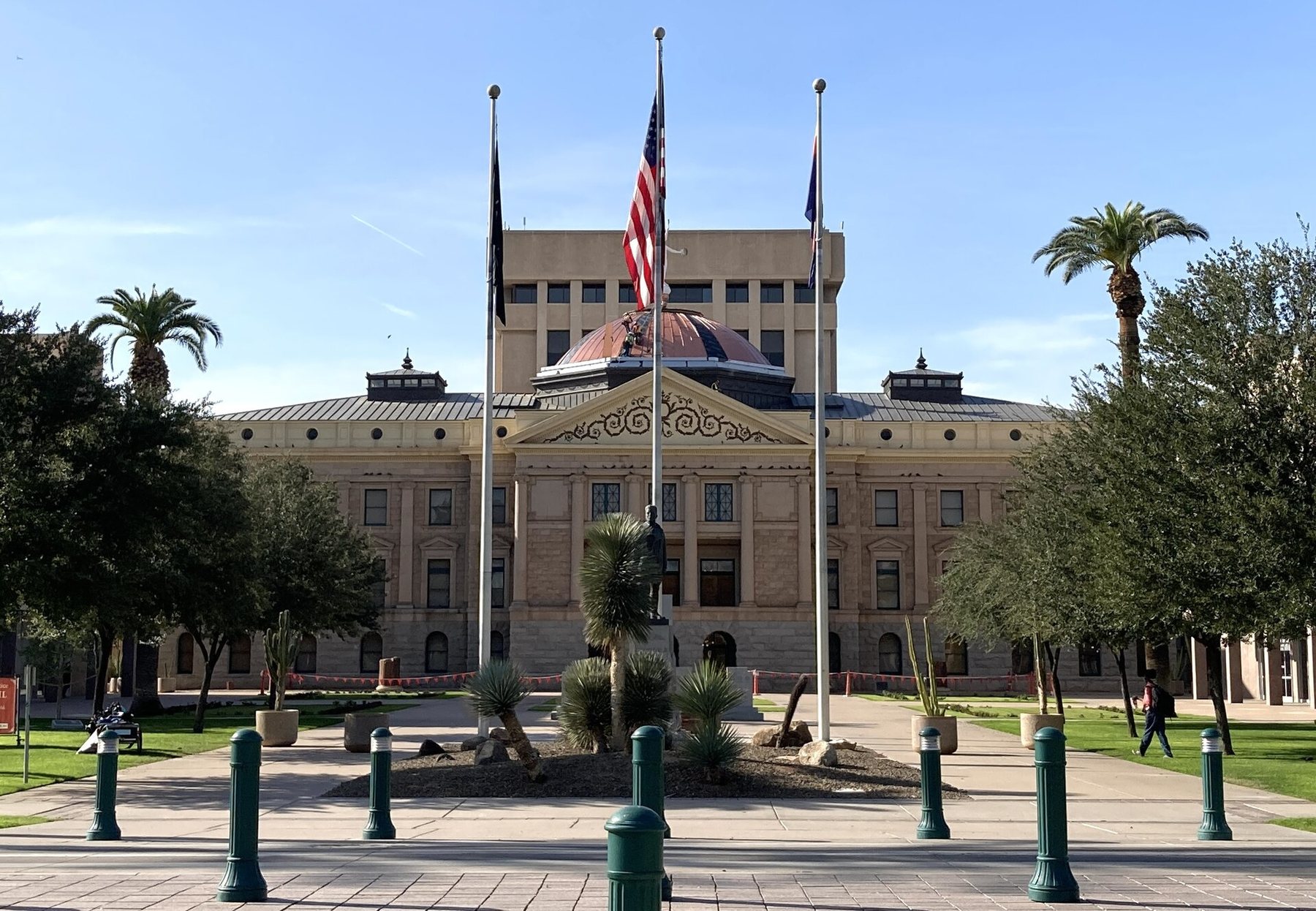
The front of the Arizona State Capitol in Phoenix, with its dome and the executive tower behind it, photographed in December 2021. Photo: Arizona State Capitol Daytime December 2021 by David Jiang, CC BY-SA 4.0, via Wikimedia Commons (resized).
From the record. This is a look back at July 2022. The desk wrote it on 11 October 2026 from sources published at the time; Stay Gazette opened in July 2026 and did not report this as it happened.
On 6 July 2022, Arizona Governor Doug Ducey signed Senate Bill 1168, a law that let the state's cities, towns and counties require a local permit or license for a short-term rental and suspend it for up to 12 months after three verified violations in a 12-month period. KJZZ had reported in March 2021 that the Legislature and the governor all but removed the cities' power to regulate the industry in 2016, and that the cities had since recovered part of it.
The Legislature's bill history shows the measure became Chapter 343. The Senate first passed it 22 to 6 on 23 February 2022. The House passed an amended version 41 to 9, and the Senate gave final approval 24 to 1 on 24 June 2022. The sponsors were State Senator J.D. Mesnard and State Representative Steve Kaiser, both Republicans. The Scottsdale Independent reported that the law would take effect on 24 September 2022.
What cities were allowed to require
A fact sheet prepared by Senate Research on 24 June 2022 set out the bill as the House passed it. The chaptered law, marked as approved by the governor on 6 July 2022, carried each provision described here. A city, town or county could require the owner of a short-term rental to do the following.
- Obtain and maintain a local regulatory permit or license. The application could ask only for the owner's or agent's contact details, the rental's address, proof of compliance with transaction privilege tax licensure, emergency contact information, an acknowledgement of an agreement to comply with the law, and a fee no higher than the actual cost of issuing the permit or $250, whichever was less.
- Notify the neighbors before offering the property for the first time: every single-family home adjacent to it and directly and diagonally across the street, or the residents on the same floor of a multi-family building. The owner had to give the local government an attestation of that notice.
- Carry liability insurance of at least $500,000 in the aggregate, or advertise and offer the rental through an online lodging marketplace that provided equal or greater coverage.
- Display the permit or license number on each advertisement the owner maintained.
- Provide an emergency point of contact, who had to respond to complaints or emergencies in person if public safety personnel required it.
Fines and the three-strike suspension
The law capped the civil penalty a local government could impose for verified violations at the same property within 12 months. At each step the ceiling was the greater of two figures: up to $500 or one night's rent as advertised for the first violation, up to $1,000 or two nights' rent for the second, and up to $3,500 or three nights' rent for the third and any later one.
A city that required permits had to adopt an ordinance allowing an administrative process to suspend one for up to 12 months after three verified violations in a 12-month period. Violations over aesthetics, solid waste disposal or vehicle parking did not count unless they were a serious threat to public health and safety, and several violations arising from the same response to one incident counted as one. Arizona's Family, a Phoenix television news outlet, described the trigger as three adjudicated health and safety violations at the same listing.
A single verified violation could bring the same suspension in a short list of serious cases, including a felony committed at or in the vicinity of the rental by the owner or the owner's designee.
A rental that failed to apply for a required permit within 30 days of the application process opening had to cease operation, and an owner who had still not applied 30 days after written notice could be fined up to $1,000 a month. An owner who failed to give the required contact information could be fined up to $1,000 for every 30 days, after 30 days' notice.
What stayed off limits
The same law fenced in what cities could do with the new power. A city that required a permit had to issue or deny it within seven business days of receiving the required information. It could deny one only for listed reasons, among them a failure to provide the required information or pay the fee, a suspended permit for the same rental, or false information on the application.
As the fact sheet described state law, a local government could not restrict or regulate a short-term rental based on its classification, use or occupancy, with exceptions for public health and safety, residential use and zoning ordinances, and certain specified uses. The bill's stated purpose was to add to those authorizations and to cap the civil penalties.
Mesnard pointed to those limits. In a statement carried by Arizona's Family and 12News, he said: “This meaningful compromise will help put a pause to misguided efforts to overregulate or outright ban short-term rentals in communities, which would threaten the state’s visitor economy and undermine Arizona’s record of supporting property rights”.
Who backed it and who wanted more
Airbnb supported the law. John Choi, its public policy director, said it showed that officials and community groups could agree on rules that answered neighborhood concerns and kept the economic benefits of the rentals. The League of Arizona Cities and Towns also supported the bill, Arizona's Family reported.
Scottsdale's mayor read the law as a return of authority. A Scottsdale Independent report, reprinted by the Scottsdale Area Association of REALTORS on 13 July 2022, said officials in Scottsdale and the Town of Paradise Valley planned to bring in licensing for short-term rentals inside their boundaries once the law took effect. Scottsdale Mayor David Ortega told the paper: “Passage of SB1168 allows the city of Scottsdale to regain local control. Our City Council is prepared to enact more stringent laws to assure our neighborhoods are safe and tranquil, the day SB1168 becomes law.” Officials called the permit the most important new tool, because it brought the ability to suspend one for up to a year.
Paradise Valley's town manager, Jill Keimach, was plain about how hard that would be: “While the bar is very high to suspend STRs, cities and towns do not take this new authority lightly, just as we do with all of our land use permits”. She said a local ordinance would need an additional 60 days, if not longer, to take effect after the Town Council approved it. The town's mayor, Jerry Bien-Willner, told Arizona's Family that the law was a step in the right direction.
The homeowner advocacy group Neighbors not Nightmares told Arizona's Family that the law did not go far enough: cities needed more funding so that police could respond to disturbances at rentals, because an owner could not be fined if no citation was issued.
The Gazette Verdict, looking back
Arizona's law was a good trade for the careful host and a hard one for the owner of a party house. The price of entry was small and written into statute: a fee of no more than $250, a short application, $500,000 of liability cover that a platform listing could satisfy, and a notice to the neighbors. In return a city had seven business days to answer and could refuse only for listed reasons, and the sponsor said outright that the compromise would help pause efforts to ban short-term rentals. The owner who paid was the one with repeat trouble: fines of up to $3,500 or three nights' rent, then up to 12 months without a permit. Platforms and compliant hosts kept their market. What a host should take from it: apply inside the 30 days, keep the paperwork, and treat every citation as one of three.
The other side
Neighbors and city halls had reason to think they got less than the headlines said. A suspension needed three verified violations in 12 months, with parking, trash and appearance excluded unless they threatened health and safety, and Paradise Valley's town manager, who would have to use it, called that bar very high. The neighborhood group's point was sharper still: a strike only existed if police had the funding to respond and write the citation. The peace may have been thinner than it looked for hosts as well. Scottsdale's mayor said in the same month that his council was prepared to enact more stringent laws on the day the bill took effect.
What it meant for hosts
The signing itself changed little for an Arizona host. The law gave cities powers that each one still had to adopt by ordinance, and it was reported to take effect on 24 September 2022. The work in July 2022 was to get ready for a local permit.
- Watch the city or county. Scottsdale and the Town of Paradise Valley said in July 2022 that ordinances were coming. Once a permit process opened, a rental had 30 days to apply or had to cease operation.
- Have the application file ready: contact details, proof of compliance with transaction privilege tax licensure, and an emergency contact able to respond in person.
- Check the insurance: $500,000 of liability cover, or a listing on a platform that provided as much.
- Budget for a permit fee of up to $250, a notice to the adjacent and facing neighbors, and the permit number on every advertisement.
Sources
- Arizona State Legislature, Bill Status Inquiry: Bill History for SB1168 (6 July 2022).
- Arizona State Legislature, Chapter 0343 - 552R - H Ver of SB1168 (Laws 2022, Chapter 343, Senate Bill 1168, House Engrossed) (6 July 2022).
- Arizona State Senate Republican Caucus, New Law Gives Cities and Towns Tools to Combat 'Party Houses' (7 July 2022).
- Arizona's Family (3TV/CBS 5), Airbnb bans parties in all short-term rental properties permanently (7 July 2022).
- 12News (KPNX), Ducey approves 3-strike rule for Arizona's rowdy short-term rentals (7 July 2022).
- Scottsdale Area Association of REALTORS (reprint from the Scottsdale Independent), Scottsdale & Paradise Valley Plan New STR Licensing, Ordinances (13 July 2022).
- Arizona State Senate, SB1168 - 552R - Senate Fact Sheet (Amended Fact Sheet for S.B. 1168, as passed by House) (24 June 2022).
- KJZZ, Arizona Lawmakers May Give Cities More Tools To Regulate Short-Term Rentals, But Probably Not What Cities Want Most (10 March 2021).
Part of the Stay Gazette record for July 2022. Filed on 11 October 2026; every specific was checked against the sources above, which were read on or before that day. To report an error, write to the desk; see the corrections policy.

Also filed on July 2022
- MarketsAirDNA Reports Falling Occupancy as US Rental Listings Reach 1.37 MillionAirDNA's review of June 2022, published on 21 July 2022, showed demand up 16.3% and occupancy down 9.2% as listings grew 25.4%. Hosts were warned that competition could force rates down.
- The recordJuly 2022, the whole month
- The recordEvery month on the record