Nevada Orders Clark County and Three Cities to License Short-Term Rentals
Assembly Bill 363 told Clark County, Henderson, Las Vegas and North Las Vegas to license short-term rentals under state limits: a two-night minimum for homes that were not owner-occupied, distance rules, occupancy of no more than 16 persons per home and room tax collected by platforms. Most of it was set to take effect on 1 July 2022.
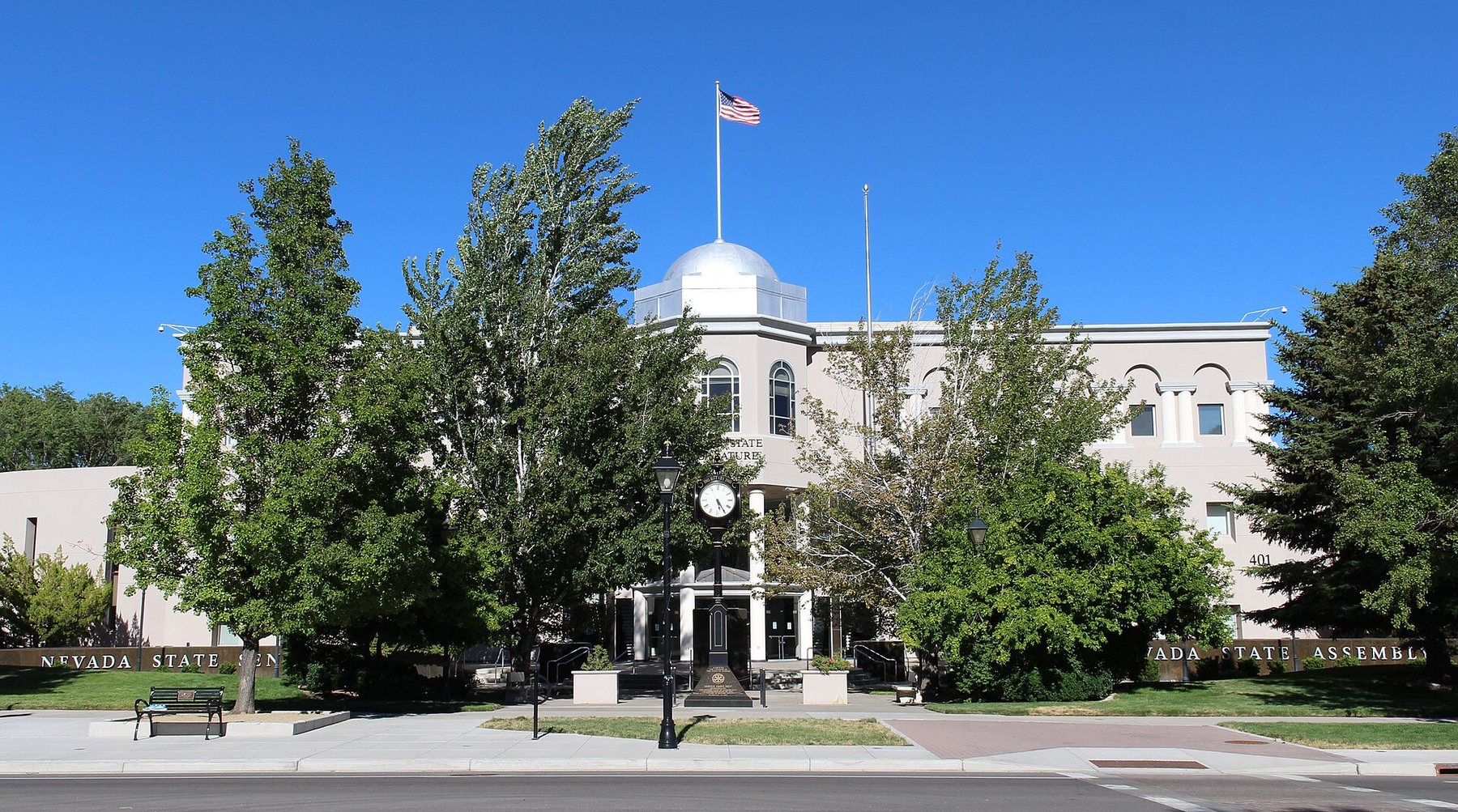
The Nevada Legislative Building in Carson City, photographed on 4 July 2020. Low walls at the street are lettered for the Nevada State Senate and the Nevada State Assembly. Photo: Nevada Legislative Building by Coolcaesar, CC BY-SA 4.0, via Wikimedia Commons (resized).
From the record. This is a look back at June 2021. The desk wrote it on 11 October 2026 from sources published at the time; Stay Gazette opened in July 2026 and did not report this as it happened.
On 4 June 2021, Nevada Governor Steve Sisolak signed Assembly Bill 363, a law requiring Clark County and the cities of Henderson, Las Vegas and North Las Vegas to license short-term rentals and to tax them as lodging. The law also barred those four governments from prohibiting the rentals completely, as unincorporated Clark County had done.
The law set state limits for the local ordinances, including a two-night minimum stay in a home that was not owner-occupied, and told the local governments to make booking platforms collect and remit the room tax. Most of the law was set to take effect on 1 July 2022.
Bloomberg Tax reported on 1 June 2021 that lawmakers had passed the measure late on Monday, which was 31 May. The Statutes of Nevada recorded it as Chapter 388 of 2021, a bill by Assemblymen Nguyen and Roberts, approved on 4 June. The Nevada Independent identified its sponsor as Assemblywoman Rochelle Nguyen, a Las Vegas Democrat.
What the law required
The law applied to a county of 700,000 or more people and to cities of 25,000 or more in such a county. The bill's digest named them as Clark County, Henderson, Las Vegas and North Las Vegas. Each had to adopt and enforce an ordinance regulating the rental of a home, or a room in one, as transient lodging, and regulating accommodations facilitators, the law's term for businesses that arrange those rentals for a fee, hosting platforms included.
None of the four could enact or enforce a complete prohibition, and the law declared any ordinance that did so null and void. Every person renting out a home or a room had to hold a local authorization and a state business license, and put both numbers in any listing or advertisement, including one created by a platform. Each local ordinance had to:
- Set a minimum stay of one night in an owner-occupied home and two nights in a home that was not owner-occupied.
- Keep rentals at least 660 feet apart, except for units in a multifamily dwelling, and at least 2,500 feet from a resort hotel.
- Set a maximum occupancy of no more than 16 persons per home, and prohibit parties, weddings and events.
- Prohibit rentals in apartment buildings, and refuse a permit that would put more than 10 percent of the units in a multifamily dwelling into short-term rental.
- Refuse a permit in a common-interest community unless its governing documents expressly authorized the rentals.
- Limit a person to no more than five authorizations per state business license.
For a permit holder or a platform that broke the ordinance, a civil penalty could not exceed $1,000 for a single violation or the nightly rental value of the home, whichever was greater. For renting with no permit, a local government could set a fine of at least $1,000 and no more than $10,000 for a single violation. Local governments could add stricter requirements, short of a complete prohibition.
The tax and the platforms
The county and the three cities had to include homes, and rooms in homes, in the definition of transient lodging they used for room taxes. Once a home held a permit, the local government had to require the platform that arranged the rental to collect and remit all taxes imposed on the gross receipts from it. Platforms also had to file a quarterly report on bookings, listings and revenue, with a copy to the Department of Taxation. A county or city could require a platform to verify that a home held a permit before arranging a rental.
Avalara, a lodging tax software company, wrote on 15 June 2021 that Airbnb and Vrbo did not collect lodging taxes for their hosts in Clark County, Las Vegas, Henderson or North Las Vegas, and that operators there had to collect the tax and file returns themselves. The Nevada Independent reported that Airbnb alone estimated it would have collected and remitted up to $14.5 million in hotel room taxes for Nevada-based hosts had the law been in effect in 2019, and that Nguyen estimated untaxed short-term rentals represented a loss of about $45 million in room tax revenue annually.
Why lawmakers acted
The Nevada Independent reported on 30 June 2021 that lawmakers passed the bill out of frustration with a ban in unincorporated Clark County that the outlet called ineffective, and with rules that differed from one municipality to the next.
“Local jurisdictions can be more restrictive, but they can't just bury their head in the sand and say 'Hey, we banned them' and not do anything about them,” Nguyen told the outlet.
The outlet reported that the bill's supporters included the Nevada Resort Association and the Culinary Union, and that it passed both the Senate and the Assembly with a two-thirds majority. Boulder City asked not to be included, Nguyen told the outlet, because officials wanted to keep the city's ban and felt they did not have the resources to write an ordinance.
How the platforms and critics responded
Bloomberg Tax reported on 5 June 2021 that a representative for Airbnb said the company supported tax collection agreements but opposed other changes in the measure. It said Expedia Group, representing Vrbo, opposed the legislation.
“We echo Hosts who were disheartened to see punitive, anti-competitive amendments included that made this bill a gift for resorts at the expense of regular Nevadans who share their homes,” Adam Thongsavat, Airbnb's public policy manager, said in a statement to the Nevada Independent. The outlet reported that Airbnb and other opponents had warned that night minimums and distance requirements near gaming properties could hinder Nevada's recovery from the pandemic.
The outlet wrote that the bill had been criticized both for going too far and for not going far enough, with opposition during the session from short-term rental owners, neighborhood associations and rental platform companies.
Vivek Sah, director of the Lied Center for Real Estate at UNLV, told the outlet there was not much research on short-term rentals and affordable housing. He added: “We're not getting rid of them. We're just regulating them.”
The Gazette Verdict, looking back
Nevada was right to replace a ban that was not working with a license, but it wrote the license on terms that suited resorts and tax collectors before hosts. The ban in unincorporated Clark County was reported as ineffective, and Airbnb and Vrbo were collecting no lodging tax there. The law answered both: a legal path for hosts, and platform collection that Airbnb itself estimated at up to $14.5 million for 2019. The price was in the limits: no new permit within 2,500 feet of a resort hotel, no one-night stays in homes that were not owner-occupied, and no more than five permits per state business license. The Nevada Resort Association backed the bill, and Airbnb called it a gift for resorts. A host should have checked the map and the permit cap before counting on a legal rental.
The other side
A license was not the only answer to a ban reported as ineffective, and critics said so from both sides. Boulder City, the sponsor said, asked out so it could keep its ban. The law took that choice away from Clark County, and neighborhood associations opposed the bill. From the other flank, Airbnb warned that night minimums and the distance rule around gaming properties could hinder the state's recovery, and a UNLV real estate director said there was not much research on short-term rentals and affordable housing. On that view the state overrode local choice on thin evidence.
What it meant for hosts
For a host in Clark County or the three cities, little changed on the day the law was signed. Under its final section, most of the law was in force before 1 July 2022 only for adopting regulations and other preparatory work.
The law told cities to protect hosts who already held a lawful permit. A city's ordinance had to let anyone the city had lawfully permitted before 1 July 2022 keep operating under the original authorization, even where the new location rules, including the minimum distance, would conflict. That did not pass to a later owner.
The law also gave a way in to owners who had rented against a county ban, which in the reports cited here meant unincorporated Clark County. Where a county had prohibited the use of a platform by ordinance on 1 June 2021, it had to accept applications from owners who had used one before that date, for six months after it adopted its new ordinance. It could not demand room tax or penalties from the earlier rentals as a condition of approval. The home still had to meet every requirement of the new ordinance, and the county's decision was final.
Other operators had until 1 July 2022 to check their property against the state limits, starting with the two distances and the two-night minimum. The costs to plan for were a state business license, an annual fee set by the local ordinance, insurance, and a local representative available 24 hours a day, seven days a week.
Sources
- Nevada Legislature, Statutes of Nevada (Wayback Machine capture of 9 November 2022), 2021 Statutes of Nevada, Chapter 388: Assembly Bill No. 363, Assemblymen Nguyen and Roberts (Approved: June 4, 2021) (4 June 2021).
- Bloomberg Tax, Nevada Lawmakers Pass Measure to Collect Airbnb Lodging Taxes (1 June 2021).
- Bloomberg Tax, Airbnb, VRBO to be Subject to Lodging Taxes Under New Nevada Law (5 June 2021).
- Avalara MyLodgeTax, New Nevada law requires Clark County to regulate, tax short-term rentals (15 June 2021).
- The Nevada Independent, The Indy Explains: Nevada's new short-term rental law and what it means for companies such as Airbnb (30 June 2021).
Part of the Stay Gazette record for June 2021. Filed on 11 October 2026; every specific was checked against the sources above, which were read on or before that day. To report an error, write to the desk; see the corrections policy.

Also filed on June 2021
- PlatformsAirbnb Asks the UK Government for a National Register of Short-Term LetsAirbnb proposed that every host need a registration number to list a home on any platform, and that homes let for more than 140 nights a year, outside areas with their own limits such as London, count as commercial. A week later the UK government said it would consult on a registration scheme for England.
- The recordJune 2021, the whole month
- The recordEvery month on the record