British Columbia Passes Law Limiting Short-Term Rentals to Principal Residences
The Short-Term Rental Accommodations Act received Royal Assent ten days after it was introduced. Its main limit, a host's own home plus one suite in communities of 10,000 people or more, was planned for 1 May 2024.
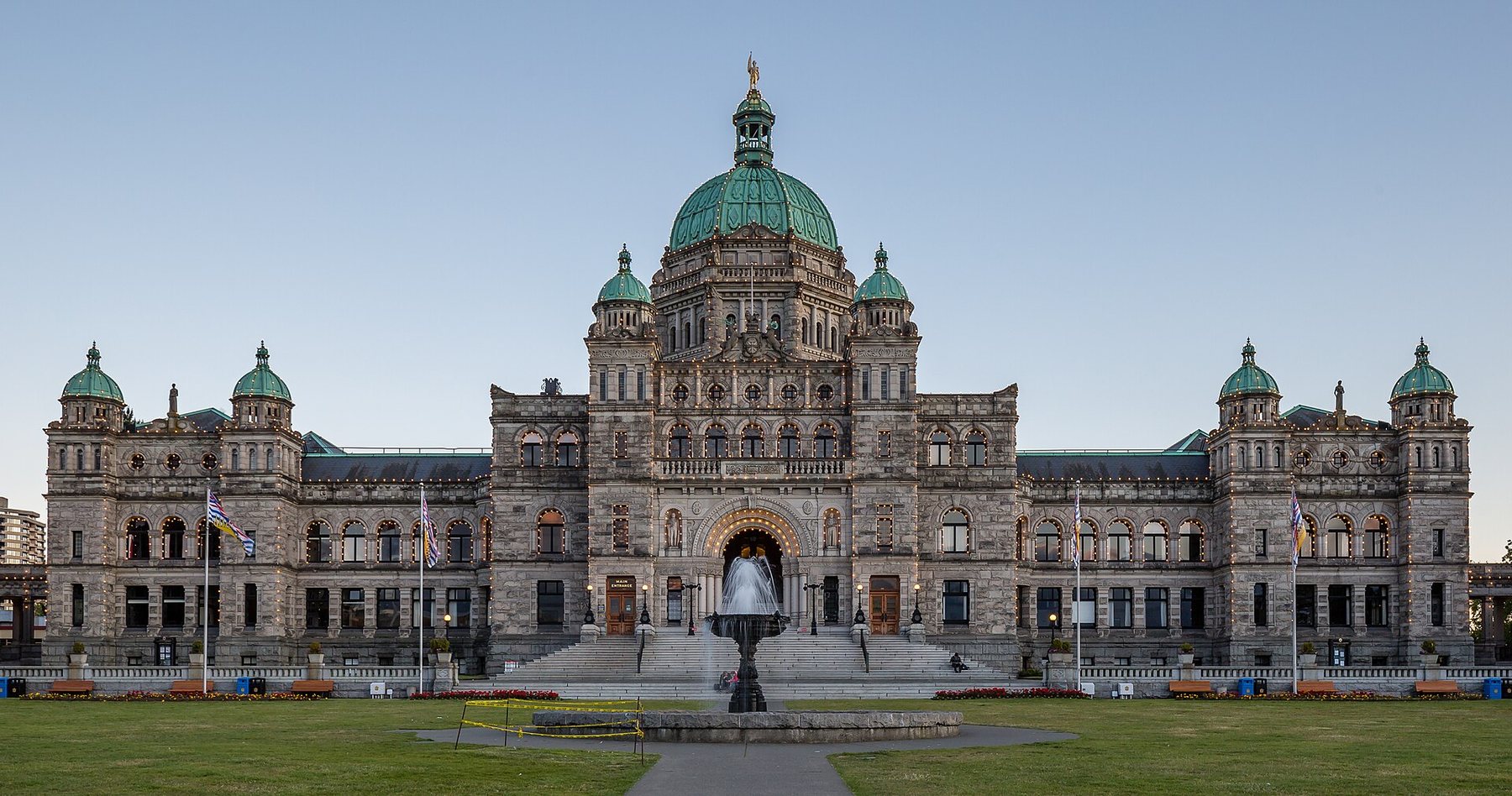
The British Columbia Parliament Buildings in Victoria, British Columbia, photographed on 10 June 2018. Photo: British Columbia Parliament Buildings in Victoria, British Columbia, Canada 01 by Michal Klajban, CC BY-SA 4.0, via Wikimedia Commons (resized).
From the record. This is a look back at October 2023. The desk wrote it on 11 October 2026 from sources published at the time; Stay Gazette opened in July 2026 and did not report this as it happened.
On 26 October 2023, British Columbia's legislature passed the Short-Term Rental Accommodations Act at third reading, and the Act received Royal Assent the same day. Housing Minister Ravi Kahlon had introduced it as Bill 35 on 16 October 2023, ten days earlier.
The centre of the law was a principal residence requirement. In municipalities with 10,000 people or more, a host would be allowed to offer short-term stays only in the home where the host lives, plus one secondary suite or other accessory dwelling unit. Around that limit sat higher local fines, new duties for booking platforms and a provincial registry.
The core did not take effect on assent. Under the Act's commencement section, sections 1 to 39, which held the principal residence requirement, the registry and the platform duties, were to come into force by regulation. The province's technical briefing set 1 May 2024 for the principal residence requirement.
Premier David Eby named the target in the government's news release: “That’s why we’re taking strong action to rein in profit-driven mini-hotel operators, create new enforcement tools and return homes to the people who need them.”
What the law set out
- Principal residence. The Act defined it as the home a person lives in for more of a calendar year than anywhere else. Short-term stays could be offered only there and in at most one secondary suite or other accessory dwelling unit, in a location to be set by regulation. The briefing said the requirement applied to homeowners and renters.
- What counts. The Act covered accommodation sold to the public for a stay of less than 90 consecutive days, or another period set by regulation.
- Where. The province said the requirement would cover municipalities of 10,000 people or more. Through regulations, it intended to exempt most municipalities under 10,000 people, though not those less than 15 kilometres from a larger one, along with electoral areas, the Gulf Islands among them, mountain resort areas and 14 resort municipalities. Exempt communities could opt in, and the province intended to let communities with a vacancy rate above 3 percent ask for an exemption.
- Fines. Through regulations, municipal ticket fines for hosts who break local bylaws were to rise from $1,000 to $3,000 per infraction, per day. Regional districts were to get business licensing powers and the power to set the same $50,000 maximum penalty as municipalities for severe contraventions.
- Platforms. Platforms would have to share information about hosts and listings with the province, show business licence and registration numbers where a local government requires them, and remove listings without them quickly.
- Registry and enforcement. The province planned a registry of all hosts and platforms, and an enforcement unit that would monitor compliance, make orders and levy penalties.
- Legacy rights. One section of the Act, not in force on assent, ended legal non-conforming use protection for short-term rentals. In Victoria, the briefing said, citing the city, there were approximately 1,600 units the city could not regulate because of it.
The Act did not apply to hotels and motels, and the province said communities on First Nations reserve land would be exempt.
When each part was due
The briefing of 16 October 2023 laid the changes out in four steps.
- On Royal Assent: higher fines for municipal bylaw infractions, with the increase itself to be made through regulations, and business licensing for regional districts.
- 1 May 2024: the principal residence requirement and the end of legal non-conforming use for short-term rentals. The briefing's timeline also put the display of business licences on platforms here.
- Summer 2024: data sharing by platforms.
- Late 2024: the provincial registry. Once it was active, platforms would have 3 months to register and hosts 6 months.
CBC News reported that the province gave no timeline or budget for the enforcement unit, and said its model would be the 10-member unit at the Residential Tenancy Branch.
Why the province acted
The province put the number of daily active short-term rental listings in B.C. at approximately 28,000, 20% more than a year earlier. Citing McGill University research, its briefing said more than 16,000 entire homes, meaning units listed for most of the year and booked for more than 90 nights in a calendar year, were being used as short-term rentals. It said 48.8% of all revenue went to the top 10% of hosts.
Kahlon put the argument in one line in the release: “Operators with multiple listings are taking homes off the long-term market to make big profits while people pay the price – it can’t go on like this.”
Local rules already existed. The province said approximately 30 municipalities had brought in bylaws and licence fees for short-term rentals, Vancouver, Victoria and Kelowna among them, and from a sample of 15 municipalities it estimated that about 40 to 50% of listings were non-compliant in 2023. The provincial requirement was to work as a floor under stricter local bylaws.
How Airbnb, mayors and the opposition reacted
Airbnb opposed the bill on the day it was introduced. Alex Howell, policy manager for Airbnb in Canada, said in a statement to Global News that the legislation would not ease B.C.'s housing concerns and would mean less tourist spending in places where a host's rental is often the only local place to stay. “We hope the B.C. government will pursue more sensible regulation and listen to the many residents – hosts, travellers and businesses – that will be impacted by the proposed rules,” Howell said.
CBC News reported that Airbnb said approximately 83 per cent of hosts in B.C. shared just one home and that its listings were less than one per cent of all dwellings in the province. The company disputed the province's claim about the revenue share of the top 10 per cent of hosts and pointed to a Conference Board of Canada report from the week before. As CBC described it, that report found Airbnb activity at its level then had brought no economically meaningful rise in rents in Canada's major cities.
The government release carried supporting statements from the mayors of Victoria, Vancouver, Kelowna and Tofino and from the Tourism Industry Association of British Columbia.
The Act passed third reading on a recorded vote of 51 to 23, the legislature's Hansard shows. Victoria News reported that the two BC Greens voted for it with the New Democrats, and that the votes against came from 22 members of the BC United caucus and Bruce Banman, the Conservative Party of B.C. House Leader. BC United tried and failed to amend the bill, the paper reported, to define a short-term rental as a stay of less than 30 days and to exempt medical travel and special events. Its housing critic, Karin Kirkpatrick, said the law in that form would be hard on students, nurses and other people who travel for work. In Vernon, the same paper reported, two councillors said the law would hurt tourism.
The Gazette Verdict, looking back
British Columbia picked the bluntest tool a province has and pointed it at one kind of host: the owner of a rental nobody lives in. A host could still rent the home they live in and one suite beside it, and 14 resort municipalities and most small towns were to stay outside the limit. The cost was set to fall on the owner of a second unit in a community of 10,000 or more, on the approximately 1,600 Victoria units that the province, citing the city, said ran on legacy rights, and on platforms, which were to take on data sharing and delisting. From assent on 26 October 2023 to the planned start on 1 May 2024 those owners had a little over six months. A host should take one thing from it: where the unit sits, and whether the host lives there, was about to decide whether the business had a future.
The other side
The case against is that the law charged hosts for a shortage they did not cause. Airbnb said its listings were less than one per cent of B.C. dwellings, and it cited the Conference Board of Canada report on rents. One population line of 10,000 treated a tourism city like a suburb, and in Vernon two councillors said the law would hurt tourism. BC United's housing critic said the law would hurt students, nurses and others who travel for work, and the party sought an exemption for medical travel. Airbnb did not accept the province's figure on host revenue.
Since then
Global News reported on 1 May 2024 that the restrictions took effect that day, in cities of 10,000 or more and in municipalities that opted in.
What it meant for hosts
For a host in British Columbia, October 2023 turned a debate into a deadline.
- Find the line. The requirement was aimed at municipalities of 10,000 people or more and small communities less than 15 kilometres from one. Resort municipalities and electoral areas were to be exempt unless they opted in.
- Decide before 1 May 2024. The briefing told hosts they could still rent out a vacation property in an exempt area, or turn a short-term rental into a long-term rental home. Stays of 90 consecutive days or more fell outside the Act's definition, unless a regulation set another period.
- Keep the local licence in order. Local bylaws could be stricter than the province's rule, fines were to rise to $3,000 per infraction, per day, and platforms were to remove listings without a required licence number.
- Expect to register. The provincial registry was planned for late 2024, with 6 months for hosts to register once it was active.
Sources
- Government of British Columbia, Legislation introduced to rein in short-term rentals, deliver more homes for people (16 October 2023).
- Government of British Columbia, Short-Term Rental Accommodations Act Technical Briefing (16 October 2023).
- Legislative Assembly of British Columbia, Official Report of Debates (Hansard), Monday, October 16, 2023, Morning Sitting, Issue No. 336 (16 October 2023).
- Legislative Assembly of British Columbia (BC Laws), Bill 35 – 2023: Short-Term Rental Accommodations Act (Third Reading) (26 October 2023).
- Legislative Assembly of British Columbia, Official Report of Debates (Hansard), Thursday, October 26, 2023, Afternoon Sitting, Issue No. 349 (26 October 2023).
- BC Laws (King's Printer), Short-Term Rental Accommodations Act [SBC 2023] Chapter 32 (26 October 2023).
- CBC News, B.C. increases violation fines, will require data sharing for short-term rentals (16 October 2023).
- Global News, B.C. cracking down on short-term rentals with increased fines, new enforcement (16 October 2023).
- Victoria News, B.C.’s new short-term rental regulations approved after colourful debate (27 October 2023).
- Global News, B.C.’s new short-term rental restrictions now in effect (1 May 2024).
Part of the Stay Gazette record for October 2023. Filed on 11 October 2026; every specific was checked against the sources above, which were read on or before that day. To report an error, write to the desk; see the corrections policy.

Also filed on October 2023
- CrackdownFTC Proposes Junk Fee Rule Covering Airbnb and Vrbo ListingsThe Federal Trade Commission proposed that any advertised price show the total, mandatory fees included, ahead of every other figure. Its notice said neither Airbnb nor Vrbo met that standard, and it estimated the hours a host would spend repricing.
- The recordOctober 2023, the whole month
- The recordEvery month on the record