New York City Starts Enforcing Its Short-Term Rental Registration Law
On 5 September 2023 the city began enforcing Local Law 18, which barred Airbnb and other platforms from processing bookings for unregistered short-term rentals. As of 28 August, the city had approved 257 of about 3,250 applications.
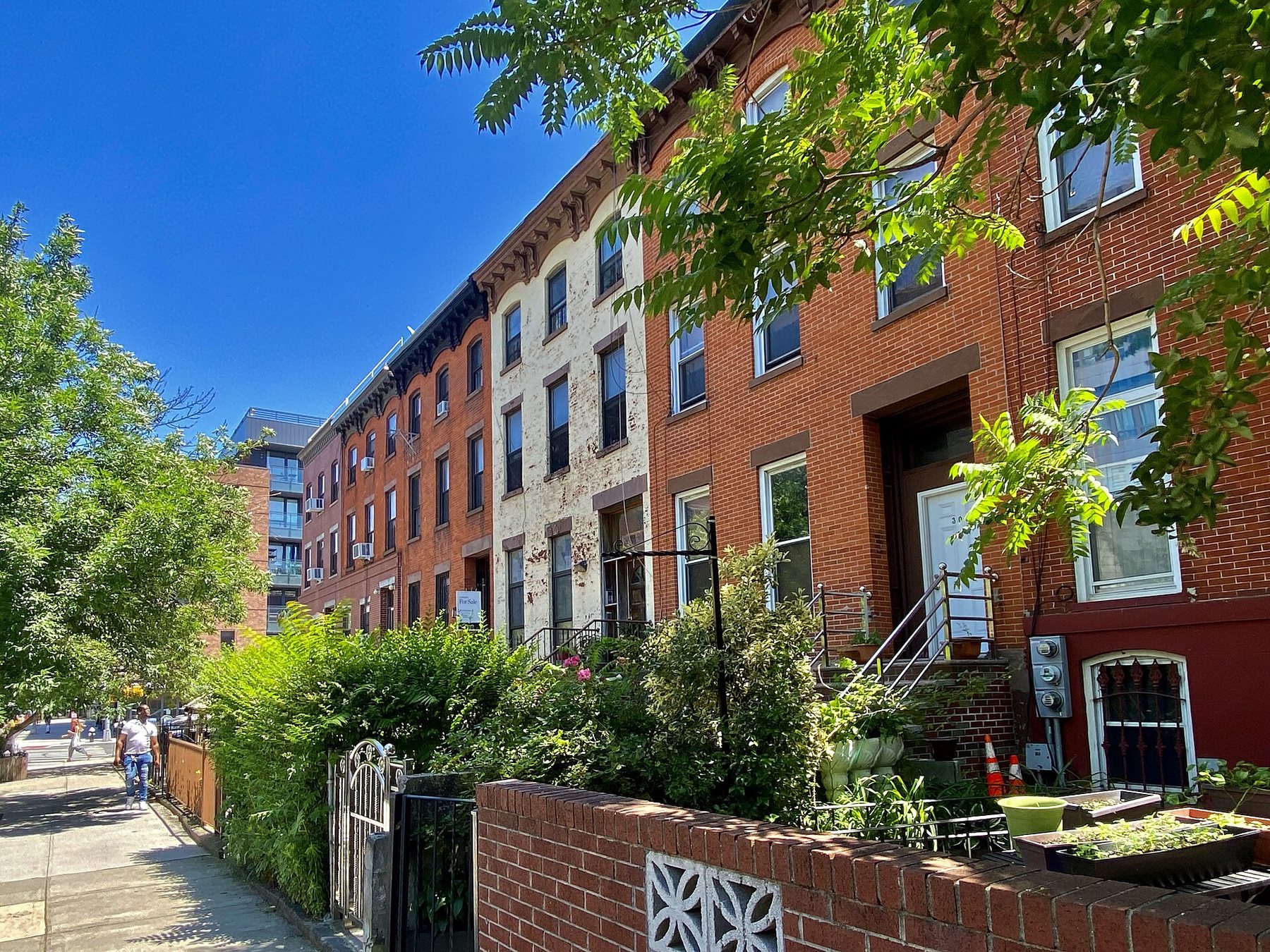
Row houses on Gates Avenue near Bedford Avenue in Bedford-Stuyvesant, Brooklyn, photographed in June 2022. Photo: Row houses on Gates Avenue, Bed-Stuy, Brooklyn - 20220617 by Andre Carrotflower, CC BY-SA 4.0, via Wikimedia Commons (resized).
From the record. This is a look back at September 2023. The desk wrote it on 11 October 2026 from sources published at the time; Stay Gazette opened in July 2026 and did not report this as it happened.
On 5 September 2023, New York City began enforcing Local Law 18, its Short-Term Rental Registration Law. The law barred booking platforms such as Airbnb, Vrbo and Booking.com from processing transactions for short-term rentals that were not registered with the city. The Mayor's Office of Special Enforcement, known as OSE, said its first phase of enforcement would concentrate on the platforms.
The registration desk was far behind the calendar. As of 28 August 2023 the city had received about 3,250 applications and approved 257, the New York Times reported. Airbnb, which by the Times's account had estimated in August that nearly 15,000 hosts had active short-term listings in homes across the city, called the rules a de facto ban. A state judge had dismissed its lawsuit against them on 8 August 2023.
What the law required
New York City adopted Local Law 18 on 9 January 2022. OSE's page for hosts said the final rules were published on 3 February 2023 and the law took effect on 6 March 2023. Enforcement started on 5 September, after the court challenges.
OSE was plain that the registration law did not change which rentals were legal. Under rules that predated it, no host, whether owner or tenant, could let a whole apartment or house to visitors for under 30 days. A shorter stay was allowed only when the host stayed in the same unit as the guests, with no more than two guests. Whole-unit short stays were permitted only in what the city called Class B multiple dwellings, a class that included hotels, lodging houses and boarding houses.
What the law added was a registry, and a duty on the platforms to check it. To register, a host had to be a natural person who was the unit's permanent occupant, supply one proof of identity and two proofs, from different categories, that the unit was their permanent home, and pay a $145 fee that was not refundable. OSE was required to tell a tenant's landlord that an application had been made. Its rules gave an applicant 90 days to fix an application that faced denial only on grounds that could be corrected.
- Not eligible: tenants in New York City Housing Authority, rent-controlled and rent-stabilized apartments, and in buildings whose owners had told the city that short-term rentals were not allowed.
- Exempt from registration: listings in Class B buildings, and any rental of 30 consecutive days or more. OSE counted the check-in date as day zero, so 29 nights was a short-term rental and 30 nights was not.
- Penalties, in the text of the law as OSE posted it: a person who offered a short-term rental without a valid registration faced a civil penalty, for each violation, capped at $5,000 or three times the revenue the rental brought in, whichever was less. A booking service that took a fee on a rental it had not verified faced a penalty capped at $1,500 a transaction, or at three times the fee where it could show the amount. Press accounts that week gave it differently: the New York Times wrote of fines of up to $5,000 for hosts who were repeat offenders, and Short Term Rentalz gave hosts a range of $1,000 to $5,000.
What Airbnb told its hosts
Airbnb's Help Center page for New York, as it stood on 7 September 2023, gave hosts two ways to keep a listing live: register with the city and add the registration details to the listing, or set the minimum stay to 30 nights or more. For everyone else it set out a timetable.
- From as early as 14 August 2023, Airbnb would block the calendars of listings with no registration number or exemption claim, to stop new short-term reservations for 5 September or later.
- On 5 September, those listings would be converted to long-term stays where the host's calendar settings allowed 30 nights or more, or deactivated.
- Reservations already made with check-in on or before 1 December would not be canceled, and Airbnb said it would refund all of its fees on those stays after check-in. Those with check-in on or after 2 December would be canceled and refunded.
- A host who asked to cancel a stay with check-in on or after 5 September could do so with no penalty and no effect on Superhost status.
On 4 September, CBS New York reported Airbnb as saying that the city's electronic system for verifying registered hosts was not yet operational.
The counts reported that month
Inside Airbnb, an advocacy group that tracks listings on the platform, counted more than 40,000 Airbnb listings in New York going in, of which 22,434 were short-term rentals as of June, Wired reported. The money was contested. The Times reported that a city official, in a court filing in July, had put Airbnb's 2022 net revenue from short-term rentals in New York City at $85 million and claimed that more than half of it came from illegal activity. Airbnb disputed the figure.
On 6 September 2023, one day into enforcement, Gothamist published a count based on Inside Airbnb's data. It found 3,400 New York City apartments still open to short-term bookings on Airbnb, nearly 9,000 fewer full-property rentals than a month earlier, and it put the overall fall in short-stay options at 15,000 listings. Airbnb had moved many of its unregistered listings over to long-term stays, and Murray Cox of Inside Airbnb estimated that about another 4,000 had been taken offline. Hundreds of the listings switched or removed, Gothamist reported, were shared-apartment rentals that met the legal test but had no registration yet.
The registration queue was the subject of a second, separate report. On 27 September 2023, Gothamist reported new figures from OSE: the office said it had approved 405 of the 4,624 applications received since its portal opened in March, rejected 214 and sent 758 back for corrections or more information. Most by far had yet to be reviewed, the agency said. An OSE report on the fiscal year that ended on 30 June put the average decision time at 50 days, and at 87 days where the agency had asked the applicant for more information or corrections.
OSE tied the pace of review to when the applications came in. Its page for hosts said the number of applications had more than doubled from the time the court upheld the law to the start of enforcement, and that this would slow the average review. On 6 September the office told Gothamist that close to half of the applications did not arrive until after August, the month a judge threw out the lawsuits. Gothamist's report of 27 September said 71% of all the applications had reached OSE after the end of June.
The case each side made
The city's case, as the Times reported it, was that short-term lets booked through Airbnb and its rivals had driven up rents and fed the housing shortage. “OSE’s initial phase of Local Law 18 enforcement has focused on collaborating with the booking platforms to ensure they are using the City’s verification system, and that legal activity remains and thrives on their sites,” said Christian Klossner, the executive director of OSE, in Gothamist's report of 6 September.
Airbnb said the rules would cost the city visitors. “The city is sending a clear message to millions of potential visitors who will now have fewer accommodation options when they visit New York City: you are not welcome,” said Theo Yedinsky, the company's global policy director, as quoted by the Times.
Restore Homeowner Autonomy and Rights, a group of New York homeowners, pressed for amendments that would let owner-occupied one- and two-family homes register and would drop the limit on guests, Wired reported.
By the end of the month Airbnb was blaming the city for the queue, and City Hall was defending its record. “Unfortunately, we continue to hear from hosts who are frustrated with the overly complicated registration process which has made it not only difficult for New Yorkers to register, but also for the city to manage,” said Nathan Rotman, Airbnb's regional lead, in Gothamist's report of 27 September. A City Hall spokesperson, Jonah Allon, said the fiscal-year report showed the city had gone beyond what the law required to help hosts fix their applications.
The Gazette Verdict, looking back
New York showed at the start of enforcement that a city can shut off unregistered short stays by going to the payment, not the front door, and showed in the same month that it was not ready for hosts who wanted to comply. By OSE's account the law made nothing illegal that was legal before. It moved enforcement to the platforms, and within a day Gothamist was reporting 15,000 fewer short-stay options on Airbnb. Airbnb's stake was New York net revenue that a city official's court filing, reported by the Times, put at $85 million for 2022. The hosts who paid for the gap were the lawful ones: $145 to apply, a 50-day average wait in the city's report on the year to 30 June, and, by Gothamist's count, hundreds of legal shared rentals switched or removed for lack of registration. For a host anywhere, once a platform must check a registry, the registration is the business. Apply early.
The other side
The city had a fair answer to the charge that it was not ready. Nothing about the legal test was new: OSE said the registration law left the old rules as they were, so a host who shared a home with up to two guests always had a path, and a host who rented out a whole apartment never did. The portal had been open since March. On Gothamist's figures, 71% of applications came after the end of June, and the agency said close to half came after August, when the lawsuits failed. Applicants with correctable faults got 90 days to fix them. On that reading, the queue was built by hosts and a platform that bet on the courts.
What it meant for hosts
In September 2023, what a New York host had to do depended on the kind of stay.
- A host renting out a whole apartment or house for fewer than 30 nights had no path to registration. Whole-unit short stays were allowed only in Class B buildings, which were exempt from registering. The choices were to set a minimum stay of 30 nights, since 29 nights still counted as short-term, or to stop.
- A host sharing a home with one or two guests could apply for $145 and had to budget for a wait: the city's average for the year to 30 June was 50 days, and OSE said the surge in applications before enforcement would slow reviews.
- Any listing added after registration had to be reported to OSE before it took a short-term booking.
Sources
- NYC Mayor's Office of Special Enforcement (Internet Archive capture of 7 September 2023), Registration Law - OSE (7 September 2023).
- NYC Mayor's Office of Special Enforcement (Internet Archive capture of 9 September 2023), Registration For Hosts - OSE (9 September 2023).
- New York City Council, text posted by the Mayor's Office of Special Enforcement as Local Law 18 of 2022 (Internet Archive capture of 24 September 2023), Int. No. 2309-A: A Local Law to amend the administrative code of the city of New York, in relation to requiring registration for short-term rentals (24 September 2023).
- Airbnb Help Center (Internet Archive capture of 7 September 2023), New York, NY - Airbnb Help Center (7 September 2023).
- The New York Times (via The Boston Globe), New York City’s crackdown on Airbnb is starting. Here’s what to expect. (5 September 2023).
- Wired, The End of Airbnb in New York (5 September 2023).
- Gothamist (Internet Archive capture of 6 November 2023), NYC loses thousands of unlicensed Airbnbs as short-term rental rule kicks in (6 September 2023).
- Gothamist (Internet Archive capture of 6 January 2024), NYC only has 405 legal Airbnb and other short-term rentals available after crackdown (27 September 2023).
- CBS New York, Sites like Airbnb about to feel the pinch of New York City's new law on short-term rentals (4 September 2023).
- Short Term Rentalz, New York City short-term rental restrictions take effect (8 September 2023).
Part of the Stay Gazette record for September 2023. Filed on 11 October 2026; every specific was checked against the sources above, which were read on or before that day. To report an error, write to the desk; see the corrections policy.

Also filed on September 2023
- The MoneyAirbnb Is Named to the S&P 500 IndexS&P Dow Jones Indices said on 1 September 2023 that Airbnb would replace Newell Brands in the S&P 500, effective before trading opened on 18 September. Airbnb's own results showed its listings growing faster than its nights booked.
- The recordSeptember 2023, the whole month
- The recordEvery month on the record