Hurricane Ian Hits Southwest Florida and Leaves Rental Refunds to Hosts
Hurricane Ian came ashore near Fort Myers on 28 September 2022 as a Category 4 storm and hit barrier islands dense with vacation rentals. Airbnb's and Vrbo's policies did not treat a Florida hurricane as grounds for an automatic refund, so the decision fell to each host and manager.
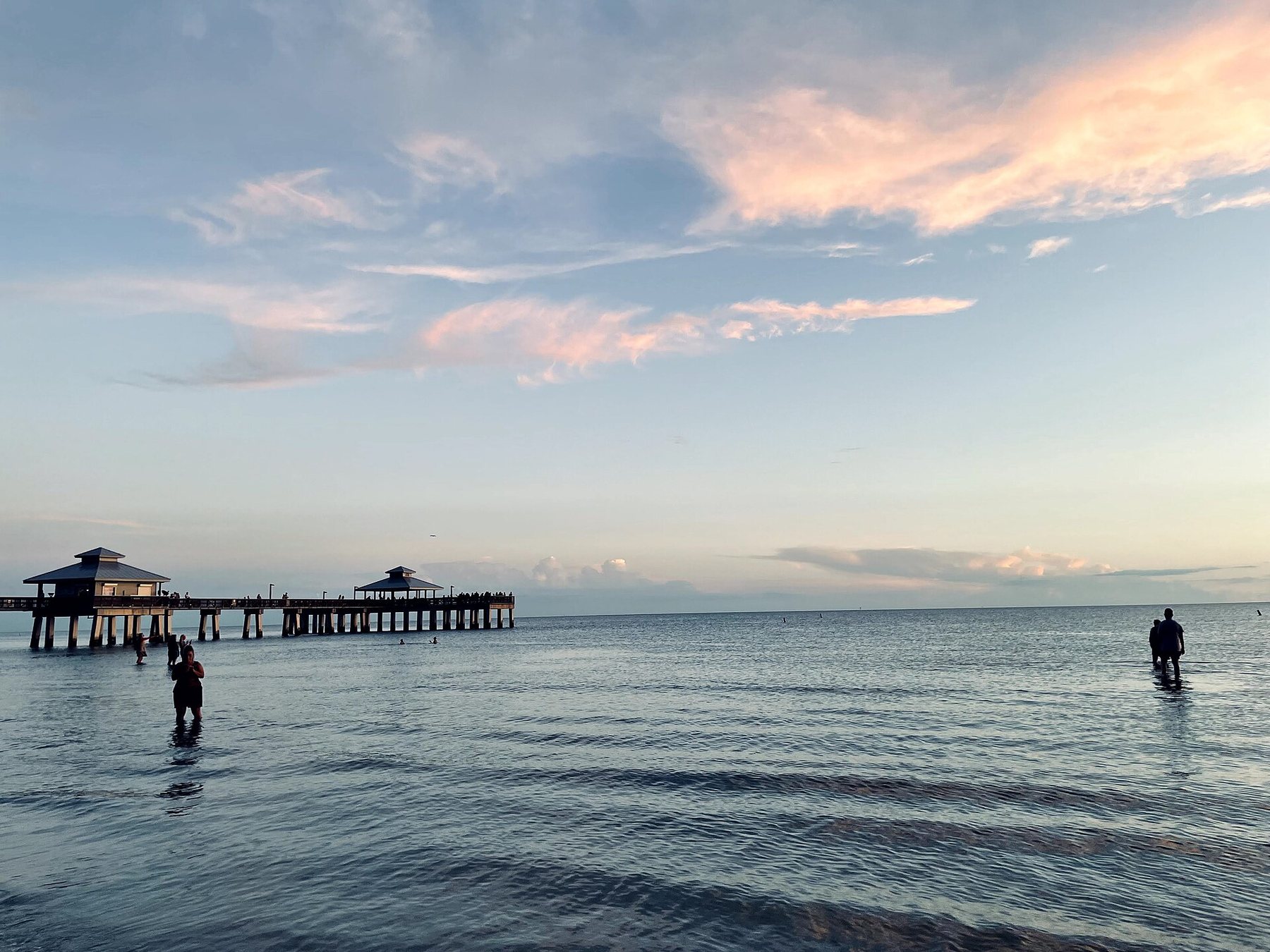
The pier at Fort Myers Beach, Florida, photographed on 11 August 2021, more than a year before Hurricane Ian. Photo: Fmpier by Ven-Lib, CC BY-SA 4.0, via Wikimedia Commons (resized).
From the record. This is a look back at September 2022. The desk wrote it on 11 October 2026 from sources published at the time; Stay Gazette opened in July 2026 and did not report this as it happened.
On 28 September 2022, Hurricane Ian came ashore in southwest Florida as a Category 4 storm, on a coast whose barrier islands were packed with vacation rentals. The National Hurricane Center said the eye made landfall near Cayo Costa around 3:05 p.m. EDT, about 20 miles west-northwest of Fort Myers, with maximum sustained winds estimated at near 150 mph. At 4:35 p.m. the center reported a second landfall on the mainland, just south of Punta Gorda.
Within two days, the people who ran rentals on Sanibel, Fort Myers Beach and the neighboring islands faced two problems. A manager on Fort Myers Beach could not get back onto the island to see what was left. And guests who had booked those homes wanted their money back, under platform policies that did not promise it.
What the storm did
Gov. Ron DeSantis toured southwest Florida on Thursday 29 September 2022 and described the impact on Sanibel Island as destruction, the News Service of Florida reported. He said the island had taken a storm surge that washed away roads and older structures. People who had not evacuated were being rescued by air, and part of the causeway that tied Sanibel to the mainland had been knocked out. DeSantis said it would be rebuilt, but not overnight.
By 2 p.m. that day, the state Division of Emergency Management said, rescuers had brought out more than 500 people in Lee and Charlotte counties. Short Term Rentalz, a trade publication, reported on 30 September that around 2.6 million homes and businesses had been left without power.
The count of the dead was still being established when the month ended. On the evening of 29 September the News Service of Florida reported that authorities had confirmed 12 deaths: six confirmed by officials in Charlotte County, five by officials in Lee County, and one reported by the Volusia County Sheriff's Office. On the morning of 30 September, Kevin Guthrie, the director of the Florida Division of Emergency Management, gave the state's own count: one confirmed death, in Polk County, and 20 other deaths that could potentially be a result of the storm, eight of them in Collier County and 12 in Charlotte County. Searches were still under way in Lee County. NPR reported that it was up to local medical examiners to decide whether a death was directly related to the hurricane.
On 29 September, FEMA announced that President Biden had approved a major disaster declaration for Florida. It made federal assistance, including grants for temporary housing and home repairs, available to people in nine counties, among them Lee, Charlotte and Collier.
The rental markets in the path
Rental Scale-Up, a trade publication, described the islands near Fort Myers as very dense vacation rental markets, open year-round and with high rates. On 30 September 2022 it published figures for them from PriceLabs, which it disclosed was its parent company:
- Fort Myers Beach: 2,680 Airbnb listings, average yearly revenue of $53,600 and a yearly market value of $143.7 million.
- Sanibel Island: 1,840 Airbnb listings and average yearly revenue of $68,400.
The same day, the publication carried an account from Steve Milo, the chief executive of VTrips, a Florida vacation rental management company. Most cell phone towers were down, he said, and VTrips was still trying to find out whether its employees and their families were safe. “No one is allowed on to Ft Myers Beach right now, and I am not sure when we will be allowed back on,” he said. He expected that some of the company's units could not be rented for a time.
What the platforms' policies said
Airbnb's Extenuating Circumstances Policy, in effect since 20 January 2021, covered unforeseen events that arose after booking and made a stay impracticable or illegal. Where it applied, it overrode the reservation's own cancellation policy: a guest could cancel for a cash refund or travel credit, and a host could cancel without adverse consequences. It covered natural disasters but excluded weather that was common enough to be foreseeable in a location, and the example it gave was “hurricanes occurring during hurricane season in Florida.” That was the wording on Airbnb's help page on 27 September 2022, the day before landfall.
Where an event was not covered, the policy said, the refund was set by the cancellation policy that applied to the reservation. Vrbo's position came to the same thing. A Vrbo spokeswoman told The New York Times, in a statement Short Term Rentalz reported on 30 September, that “natural disasters, such as hurricanes or wildfires, do not override the cancellation policy set by the host and agreed to by the guest when they book.”
Both platforms left one route open. Under Airbnb's and Vrbo's cancellation policies, Short Term Rentalz reported, a guest was due a refund or credit when the host cancelled first. Representatives of both companies told the Times they were trying to make that easier by waiving host penalties for cancellations in areas hit by the storm, the publication said.
Airbnb's newer guest products did not fill the gap. AirCover, the free protection Airbnb launched as part of its 2022 Summer Release, covered a host cancellation, a guest who could not check in and a listing that was not as advertised, and Airbnb's own description, quoted by Rental Scale-Up, said it was not travel insurance. Airbnb had sold guest travel insurance since July 2022, Rental Scale-Up reported, and the policy listed mandatory evacuations due to weather among its covered reasons to cancel. The publication concluded that Airbnb covered a hurricane only for guests who had bought it.
How managers handled the bookings
Milo set out the order VTrips planned to follow for units it could not rent. Guests who had bought travel insurance would be directed to RedSky and told how to claim a refund. Guests without insurance would be asked to move the trip to a future date or to a different market. A refund from the company came last, once the other options were exhausted.
Rental Scale-Up noted that managers in Florida routinely and strongly recommended travel insurance to guests who booked in hurricane season. Short Term Rentalz reported that people with bookings in the storm area were calling for help getting refunds for stays they could no longer take, and Rental Scale-Up called the storm a big test for Airbnb, whose AirCover guarantees did not cover a hurricane.
The Gazette Verdict, looking back
The refund rules worked as written in September 2022, and they put the decision on Ian's cancelled stays, and the cost of any refund, on hosts. Airbnb's policy excluded a Florida hurricane by name. Vrbo said a disaster did not override the host's terms. Then both said they were waiving the penalty for a host who cancelled, which was the one route that entitled the guest to a refund or credit. The platforms gave up a penalty. The host who cancelled gave up the booking, in a market where the average Fort Myers Beach listing brought in $53,600 a year, and in counties the president had just declared a disaster area. The managers with an answer ready were the ones who, like VTrips, had an order written down: insurance claim first, a new date or another market second, a refund last. A host in a storm zone should set that order before the season and state it at booking.
The other side
Airbnb and Vrbo had a fair case. Airbnb's exclusion had been in force since January 2021 and named hurricanes in Florida's hurricane season in plain words, so a guest who booked a Gulf island for late September had been told. Travel insurance that listed weather evacuations was on sale through Airbnb from July 2022, and Florida managers routinely urged guests to buy cover. Had Airbnb's policy applied, it would have overridden every host's own terms at once, including for owners whose homes were damaged and whose income had stopped. Leaving the terms with the host let an owner offer a new date before a refund.
What it meant for hosts
At the end of September 2022, a host or manager with a property in Ian's path had four things to settle.
- Bookings: on Airbnb and Vrbo, a guest's refund followed the listing's cancellation policy unless the host cancelled first. With both platforms saying they were waiving host penalties in the storm area, a host with an unusable property could cancel and the guest would get a refund or credit.
- Insurance: a guest who had bought travel insurance had a claim to file. VTrips planned to point those guests to it first, and to offer the rest a new date or another market before a refund.
- Access: no one was allowed onto Fort Myers Beach on 30 September, and part of the Sanibel causeway was out. Inspections had to wait until it was safe to return.
- Aid: residents and business owners in the declared counties could apply for federal disaster assistance at DisasterAssistance.gov or by calling 800-621-3362.
Sources
- National Hurricane Center (NOAA), Hurricane Ian Tropical Cyclone Update, 310 PM EDT Wed Sep 28 2022 (28 September 2022).
- National Hurricane Center (NOAA), Hurricane Ian Tropical Cyclone Update, 435 PM EDT Wed Sep 28 2022 (28 September 2022).
- FEMA, President Joseph R. Biden, Jr. Approves Major Disaster Declaration for Florida (29 September 2022).
- WLRN (News Service of Florida), DeSantis eyes Ian damage, death toll at 12 (29 September 2022).
- WUSF (NPR), Florida officials put the preliminary death toll at 21, with only 1 confirmed (30 September 2022).
- Short Term Rentalz, Guests count on host generosity for Hurricane Ian booking refunds (30 September 2022).
- Rental Scale-Up (Wayback Machine capture), Top US vacation rental markets hit by Hurricane Ian (maps), Steve Milo reports from Florida, Airbnb not to refund guests. (30 September 2022).
- Airbnb Help Center (Wayback Machine capture of 27 September 2022), Extenuating Circumstances Policy (20 January 2021).
Part of the Stay Gazette record for September 2022. Filed on 11 October 2026; every specific was checked against the sources above, which were read on or before that day. To report an error, write to the desk; see the corrections policy.

Also filed on September 2022
- WorldEdinburgh Becomes Scotland's First Short-Term Let Control AreaFrom 5 September 2022, letting an entire Edinburgh home that was not the owner's main residence needed planning permission. Before the month was out, the council also agreed a licensing policy that presumed against whole-flat lets in tenements and priced a one-year license for secondary letting at £653 and up.
- The recordSeptember 2022, the whole month
- The recordEvery month on the record