Michigan House Votes 55-48 to Stop Local Bans on Short-Term Rentals
In the early hours of 27 October 2021 the Michigan House passed House Bill 4722, which would bar local governments from zoning out short-term rentals while letting them cap the number. The bill went to a Senate committee and was not law.
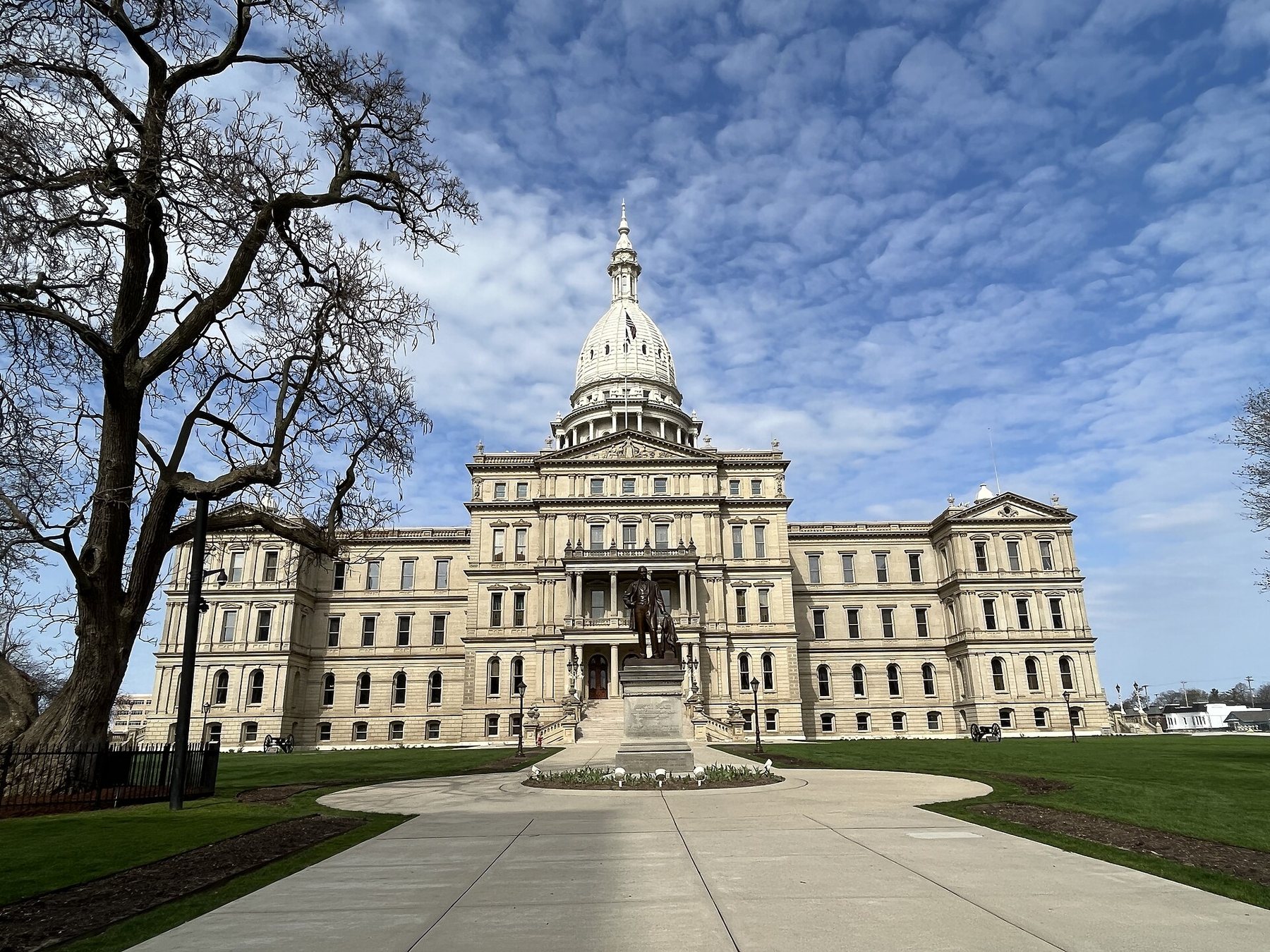
The Michigan State Capitol in Lansing, photographed on 29 April 2022. The picture was taken after the House vote of 27 October 2021 and does not show it. Photo: Lansing - Michigan State Capitol - 20220429102223 by Riis2602, CC BY-SA 4.0, via Wikimedia Commons (resized).
From the record. This is a look back at October 2021. The desk wrote it on 11 October 2026 from sources published at the time; Stay Gazette opened in July 2026 and did not report this as it happened.
In the early hours of Wednesday 27 October 2021, the Michigan House of Representatives passed House Bill 4722 by 55 votes to 48. The bill would make short-term rental a residential use permitted in every residential zone in the state, and would bar a local government from adopting or enforcing zoning that has the effect of prohibiting it.
The House sent the bill to the Senate the same day, and the Legislature's bill history shows it was referred there to the Committee on Regulatory Reform. ABC12 News reported that if the Senate passed it, the bill would go to Governor Gretchen Whitmer, who would decide whether to sign it.
Bridge Michigan reported that House Speaker Jason Wentworth, a Republican from Farwell, kept lawmakers in session until 2 a.m. while he and other Republican leaders gathered votes for a bill the outlet described as pushed by the Michigan Realtors, an interest group. Nine Democrats voted for it and ten Republicans voted against it, Bridge reported.
Two roll calls on the House record
The Legislature's history of the bill dates every step of the floor action to 27 October 2021. The House did not adopt the substitute its committee had recommended, labeled H-1, and adopted a different one, H-11. On Roll Call 502 the bill passed with 55 yeas and 47 nays, and 7 members not voting. The next entry reads: vote reconsidered. On Roll Call 503 the bill passed again with 55 yeas and 48 nays, and 6 not voting, and the entry adds that it was given immediate effect.
Representative Sarah Lightner, a Republican from Springport, had introduced the bill on 27 April 2021. The House Committee on Commerce and Tourism reported it with the H-1 substitute on 25 May 2021.
What the bill would allow and forbid
The text the House passed adds one section, 206b, to the Michigan Zoning Enabling Act. For zoning purposes it treats the rental of a dwelling, short-term rental included, as a residential use that is permitted in all residential zones, that is not a commercial use, and that cannot be put through a special use or conditional use permit or procedure that other dwellings in the same zone do not face.
The central rule is one sentence: “A local unit of government shall not adopt or enforce zoning ordinance provisions that have the effect of prohibiting short-term rentals.”
The bill then sets out what a local government could still do:
- apply zoning rules on noise, advertising, traffic or any other condition that may create a nuisance, if they are applied on a consistent basis to rental and owner-occupied residences;
- inspect a residence under a public health and safety ordinance that is not a zoning ordinance and does not have the effect of prohibiting short-term rentals;
- collect taxes otherwise authorized by law;
- limit the number of short-term rental units under common ownership, to no fewer than 2;
- limit the total number of short-term rental units, to no less than 30% of the existing residential units in that local unit, applied without regard to where the dwellings are.
A short-term rental, in the bill's definition, is the rental of a single-family residence, a dwelling unit in a one-to-four-family house, or any unit or group of units in a condominium, for terms of not more than 30 consecutive days. The act would take effect 90 days after the date it is enacted into law.
Bridge Michigan reported that language adopted early on Wednesday would let communities that already regulated rental units through overlay districts keep enforcing those policies, and that it was not immediately clear how many local governments would be forced to revise their ordinances. The bill ties that carve-out to provisions as they existed on 11 July 2019.
The pressure behind the bill
Bridge Michigan wrote that the debate in Michigan had often focused on tourist destinations. One example it gave was New Buffalo, a city of 2.2 square miles on Lake Michigan near Indiana, which in May 2020 enacted a temporary moratorium on any new short-term rentals, having licensed 150 of them by then.
The Realtors had made their case in the spring. On 8 May 2021, Michigan Capitol Confidential, a news site published by the Mackinac Center for Public Policy that describes its reporting as having a free-market perspective, carried the argument of Brian Westrin of the Michigan Realtors Association, which supported the bill. He said local governments were trying to use zoning regulation to take away property rights.
On 26 October 2021 the Michigan Municipal League posted an urgent notice asking members to contact their state representatives that night. It said it was hearing that the House could vote that evening on a bill that did not include compromises with local government groups.
What each side said
Lightner described her revised bill as a compromise that would give property owners certainty and leave local governments some flexibility, Bridge Michigan reported. “The blanket bans some communities have issued against short-term rentals completely disregard the private property rights of Michigan citizens,” she said in a statement quoted by Bridge. ABC12 reported a further argument from her: that the bill would restrict corporations from buying homes in tourist areas in large numbers and running them like hotels without paying lodging taxes.
The Michigan Municipal League is an interested party: it advocates for the member communities whose zoning powers the bill would cut. Its statement of 27 October 2021, attributed to its chief executive and executive director, Dan Gilmartin, called the after-midnight vote an attack on families and their communities, said the bill would open every block in every community to unregulated commercial-style rental units, and asked the Senate to reject it. The statement also said: “This bill will pour lighter fluid on an already red-hot housing market should it become law, making it even harder for families to put roofs over their heads.”
ABC12 reported that Justin Winslow, president and chief executive of the Michigan Restaurant & Lodging Association, said the bill hurt hotels that were already reeling from revenue losses during the coronavirus pandemic. He called it a handout to mostly out-of-state corporations and said it would erode neighborhoods, increase crime and cost jobs. Those were his claims. Winslow also said earlier surveys had shown 70% of Michiganders opposed to limits on local control of short-term rentals. His association is an interested party too: his statement named fair competition as one of the issues.
None of the reports cited here quotes Airbnb or Vrbo on the vote.
The Gazette Verdict, looking back
The House vote was worth less to Michigan hosts in October 2021 than its headline, and the bill behind it left towns more than its critics allowed. Nothing became law: a 55-48 vote, reached on a second roll call in a session that Bridge Michigan reported ran until 2 a.m., sent the bill to a Senate committee. The text would have ended zoning bans, a gain for owners who rent a home for extra income and for the Realtors who backed it. But it also wrote local caps into its own text, as low as two units for one owner, and it kept taxes, inspections and nuisance rules. Local governments stood to lose zoning power, and the lodging association said hotels would be hurt. A host should have kept to the local ordinance in force and counted the units held under one name.
The other side
The strongest answer starts from the Municipal League's objection that the bill would open every block to unregulated commercial-style rentals. A cap that cannot be set below 30% of a town's homes cannot protect one street or one neighborhood, and a floor of two units per owner does nothing about many owners holding two each. On that reading the bill would take away a town's power to prohibit short-term rentals through zoning and offer ceilings in exchange. Supporters would object from the other direction: the vote was no small thing, because a bill reported from committee in May cleared the House with votes from both parties, by Bridge Michigan's count, and its sponsor said it would end blanket bans.
What it meant for hosts
For a Michigan host at the end of October 2021, the vote changed no rule. The bill had passed the House and been referred to a Senate committee. It still needed the Senate and the governor.
A host could read the House-passed text against their own operation:
- A host in a town that used zoning to prohibit short-term rentals stood to gain the most, because the bill would forbid zoning provisions with that effect.
- A host with more than two units in one town had a risk to weigh. A local government could limit units under common ownership, with a floor of 2, and the bill defined common ownership as ownership in whole or in part by the same individual, individuals or legal entity.
- Nuisance rules, health and safety inspections and taxes would all remain, and a town could cap the total number of short-term rental units.
Unless the Senate passed the bill and the governor signed it, the ordinance of the city, village or township where the home stood was still the rule a host answered to.
Sources
- Michigan Legislature (bill history; the page carries no publication date, the entries cited are dated 10/27/2021 or earlier; read in Wayback Machine captures of 5 February 2022 and 19 April 2024), House Bill 4722 of 2021 (27 October 2021).
- Michigan Legislature (the document is headed HB-4722, As Passed House, October 27, 2021; read in a Wayback Machine capture of 29 October 2021), Substitute for House Bill No. 4722 (27 October 2021).
- Bridge Michigan, Michigan House votes to bar Airbnb bans (27 October 2021).
- ABC12 News (WJRT), Bill limiting local control over short-term rentals passes State House (27 October 2021).
- Michigan Municipal League (press release), MML Opposes Disastrous HB 4722 on Short-Term Rental Issue (27 October 2021).
- Michigan Municipal League (Inside 208 blog), URGENT – Contact Your State Representatives Tonight to Oppose Harmful Short-Term Rental Legislation (26 October 2021).
- Michigan Capitol Confidential (Mackinac Center for Public Policy), Cities Across Michigan Are Banning Airbnb — This Bill Would Stop Them (8 May 2021).
Part of the Stay Gazette record for October 2021. Filed on 11 October 2026; every specific was checked against the sources above, which were read on or before that day. To report an error, write to the desk; see the corrections policy.

Also filed on October 2021
- WorldAirbnb Listings in Amsterdam Fall From 16,648 to 2,924 After Registration DeadlineThe six months Amsterdam hosts had to put a city registration number on their listings ended on 1 October 2021, and Airbnb said it was removing every listing without one unless it was exempt. The city counted 2,924 Airbnb listings on 4 October, against 16,648 in March.
- The recordOctober 2021, the whole month
- The recordEvery month on the record