Lisbon's Safe Rent Program Draws 45 Short-Term Rentals in Its First Call
Lisbon offered to lease homes from their owners for five years or more and sublet them at affordable rents. On 6 July 2020 the city council counted 177 completed applications, 45 of them for homes that had been short-term rentals, while the headline on an article by the mayor set off a dispute with the trade.
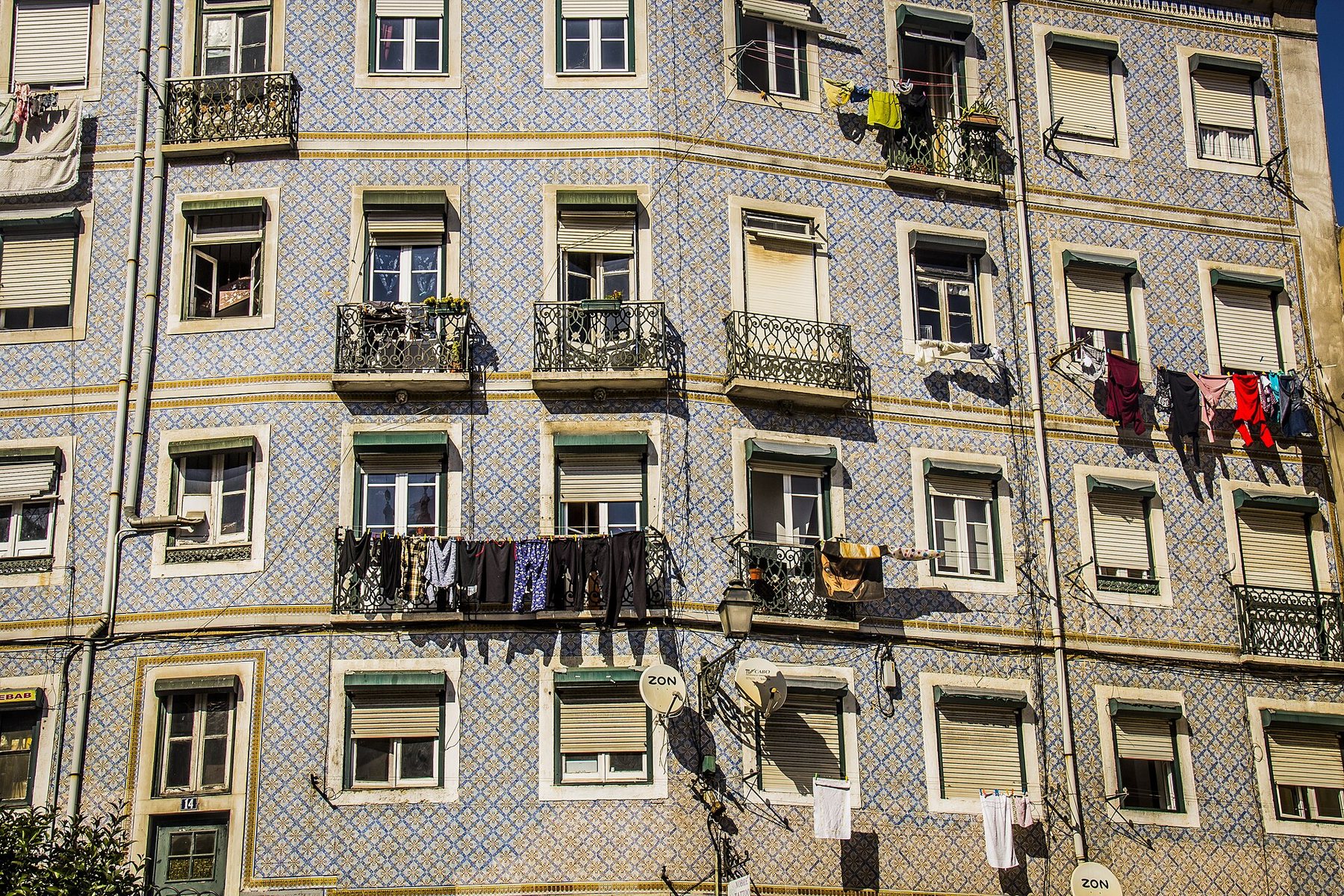
An apartment building faced in blue and white tiles, with laundry hung from its balconies, in the Alfama neighborhood of Lisbon, photographed in May 2018. Photo: Alfama 0004 by Dieglop, CC BY-SA 4.0, via Wikimedia Commons (resized).
From the record. This is a look back at July 2020. The desk wrote it on 11 October 2026 from sources published at the time; Stay Gazette opened in July 2026 and did not report this as it happened.
On 6 July 2020, Lisbon city council reported the result of its first call to property owners under Renda Segura, or safe rent, a program in which the city rents homes from private owners and sublets them through its Affordable Rent Program. The council counted 177 completed applications to rent. Of those homes, 45 were coming out of alojamento local, Portugal's registered short-term rentals.
The figures arrived in the middle of an argument. Over the weekend of 4 and 5 July, the British newspaper The Independent had published an opinion article by the mayor, Fernando Medina, under a headline that said Lisbon was getting rid of Airbnb. Portugal's short-term rental association demanded a clarification, and by the end of Monday 6 July the newspaper had changed the headline.
What the city offered owners
The contracts had to run five years or more, according to the council statement reported by the Portuguese magazine Executive Digest.
Euronews, reporting on 8 July 2020, described the pitch to landlords. Those who signed up were guaranteed a monthly income for five years, the municipality said, and would be exempt from income tax on the rent. The city hoped to enroll 1,000 properties before the end of 2020.
The Real Deal, citing Bloomberg, reported on 12 July 2020 that the city was in effect taking on the risk of being a landlord. The rents it paid owners were capped at levels considered affordable and were below market value, the report said, and the city found the tenants. That report described the tax break differently, as an exemption from property and capital gains taxes.
Medina put the offer in one sentence in The Independent: “We’re offering to pay landlords to turn thousands of short-term lets into ‘safe rent’ homes for key workers.” He described it as a strategy that offered landlords long-term, stable incomes.
The first call in numbers
The first call closed on Friday 3 July 2020. The council's count, as Executive Digest reported it:
- 338 entries on the program's platform, from 188 different owners;
- 177 completed applications to rent, of which 45 homes came from alojamento local and 83 were furnished;
- applications from all 24 parishes of the city, led by Santa Maria Maior and São Vicente with 21 homes each;
- 72 two-bedroom homes and 42 one-bedroom homes, the two largest groups;
- an average rent requested from the council of 723 euros a month.
The council said 78 of the homes had been inspected and 45 more inspections were scheduled. Rent had been negotiated with more than 60 owners. The next phase was to conclude the contracts so that the homes could go into the next Affordable Rent competition, which the council intended to open before the end of July.
The wording mattered. Executive Digest's headline said the council was renting 177 homes, and The Real Deal wrote that 177 units had been approved. The council's own statement, as quoted, counted completed applications and placed the signing of contracts in the next phase.
Why the mayor said the city was doing it
Medina's article set out the reasoning. Lisbon had benefited enormously from tourism, he wrote, and had paid a social price. By his account, vacation rentals in the style of Airbnb had taken over a third of the properties in the city center, pushing up rents while essential workers and their families were forced out. He put the city at 500,000 citizens and more than 4 million visitors a year. The one-third share was the mayor's own figure, given in an opinion article.
He also wrote that none of this meant the city did not want tourism. “It’s simply time we do things differently and visitors will ultimately benefit,” he wrote.
The offer reached owners in a weak market: The Real Deal, citing Bloomberg, reported 25,000 apartments registered as vacation rentals in Lisbon, and bookings for the week of 13 July down 76 percent from the same week of 2019.
The headline, the association and the Social Democrats
Rádio Renascença reported that the article first ran under a title saying that, after coronavirus, Lisbon was getting rid of Airbnb and turning short-term holiday rentals into homes for key workers.
ALEP, the association that represents the short-term rental sector in Portugal, said it was greatly surprised. In a Facebook post reported by Renascença, it said the position was very different from the one the mayor had presented to the association a few weeks earlier, and that before any reaction it needed him to confirm or deny the headline. Its president, Eduardo Miranda, said the problem was in the title.
The mayor's office gave its clarification the same day, according to the Portuguese outlet ECO. ECO, which gave Expresso as its source for the statement, reported the office as saying that nowhere in the text was there any talk of ending Airbnb in Lisbon or abolishing alojamento local. The mayor's advisers, ECO reported, said the title he had sent spoke of replacing some Airbnbs and had been changed by the newspaper's editors. Late on 6 July, Renascença reported that The Independent had acknowledged the error and changed the headline, which now said Lisbon was replacing some Airbnbs.
The Social Democrats (PSD) went beyond the headline. Luís Newton, the party's leader in the Lisbon Municipal Assembly, said in a statement carried by the Lusa news agency that the mayor had lost his bearings on housing and was now acknowledging the failure of housing policies he was responsible for. Newton said the mayor could not demonize people who had invested in renovating the city and needed short-term rentals to secure their families' income.
Airbnb defended its hosts in a statement reported by Euronews. It said 60 percent of local hosts said the additional income from hosting meant they could pay the bills and support their families. “We take local concerns seriously, which is why we already work with the government to help hosts follow the rules and pay tax,” the company said.
The Gazette Verdict, looking back
Lisbon's first call was a small result that showed a workable idea: a city can bid for short-term rentals instead of ordering them closed, and some owners will consider the bid when bookings fall. The money was plain. Owners asked the council for 723 euros a month on average, on contracts of five years or more, while The Real Deal reported Lisbon bookings for the week of 13 July at 76 percent below the same week of 2019. An owner who took the offer would swap a thin calendar for a fixed rent, and the city would carry the rent and the risk. The scale was modest: 45 homes that had been short-term rentals, against 25,000 apartments registered as vacation rentals. A host should measure a city's offer against the bookings they can count on, and read a program's terms before reacting to a headline about it.
The other side
The first call proved very little. Forty-five of the applications were for short-term rental homes, in a city with 25,000 apartments registered as vacation rentals, against a target of 1,000 properties by the end of 2020, and the council reported no signed contract. Owners applied while tourism was depressed, so the count may say more about the pandemic than about the program. ALEP said the mayor's published position was very different from the one he had given it weeks earlier, and Luís Newton said the mayor could not demonize people who had invested in renovating the city. A capped rent for five years or more asked an owner to give up whatever a tourist season might bring back.
What it meant for hosts
For an owner with a registered short-term rental in Lisbon in July 2020, the news was an option and no more than that. None of the reports described a rule that closed a rental or canceled a registration, and the mayor's office, as ECO reported it, said the article never spoke of abolishing alojamento local.
An owner weighing the offer had these terms to go on, from the council's statement and the reports of the time:
- the tenant was the city, on a contract of five years or more;
- the rent was negotiated with the council, and owners in the first call had asked for 723 euros a month on average;
- homes were inspected, 78 of the 177 by 6 July;
- furnished homes were in the pool, 83 of the 177;
- a tax break came with it, described by Euronews as an exemption from income tax on the rent.
The comparison to make was with bookings as they stood, which The Real Deal reported at 76 percent below the same week of 2019 for the week of 13 July. An owner who expected tourists to come back had reason to wait, and the mayor himself wrote that the city still wanted tourism.
For hosts outside Portugal, the month showed that a city in a downturn could compete for their properties with a guaranteed lease. When the headline appeared, ALEP's first move was to ask the mayor to confirm or deny it before reacting.
Sources
- The Independent (opinion article by Fernando Medina, Mayor of Lisbon), After coronavirus, Lisbon is replacing some Airbnbs and turning holiday rentals into homes for key workers (6 July 2020).
- Executive Digest, Renda Segura: Câmara de Lisboa arrenda 177 casas por um valor médio de 723 euros (6 July 2020).
- Rádio Renascença, Alojamento local vai acabar? Associação exige esclarecimentos a Medina (6 July 2020).
- Rádio Renascença, "The Independent" assume erro. Medina não disse que queria acabar com o Airbnb em Lisboa (6 July 2020).
- Rádio Renascença (Lusa), Lisboa vai livrar-se dos Airbnb? PSD acusa Medina de “desnorte” na habitação (6 July 2020).
- ECO, Afinal, Medina não quer “livrar-se” do Airbnb. Só de alguns alojamentos locais (6 July 2020).
- Euronews, Lisbon mayor floats plans to turn Airbnb rentals into homes for key workers (8 July 2020).
- The Real Deal, Lisbon might have solved its Airbnb problem (12 July 2020).
Part of the Stay Gazette record for July 2020. Filed on 11 October 2026; every specific was checked against the sources above, which were read on or before that day. To report an error, write to the desk; see the corrections policy.

Also filed on July 2020
- MarketsAirbnb Guests Book One Million Nights in a Day for the First Time Since MarchAirbnb said on 14 July 2020 that 8 July was its first day of more than 1 million nights booked since 3 March. The nights were close to home, outside cities and low-priced, and the company said its business had not recovered.
- The recordJuly 2020, the whole month
- The recordEvery month on the record