Airbnb Agrees to Drop Its Lawsuit and Give New York City Host Data
Airbnb settled its federal case against New York City on 12 June 2020 and agreed to a narrower reporting law that the City Council had yet to pass. Hosts were told to consent to sharing their details or stop listing short-term rentals.
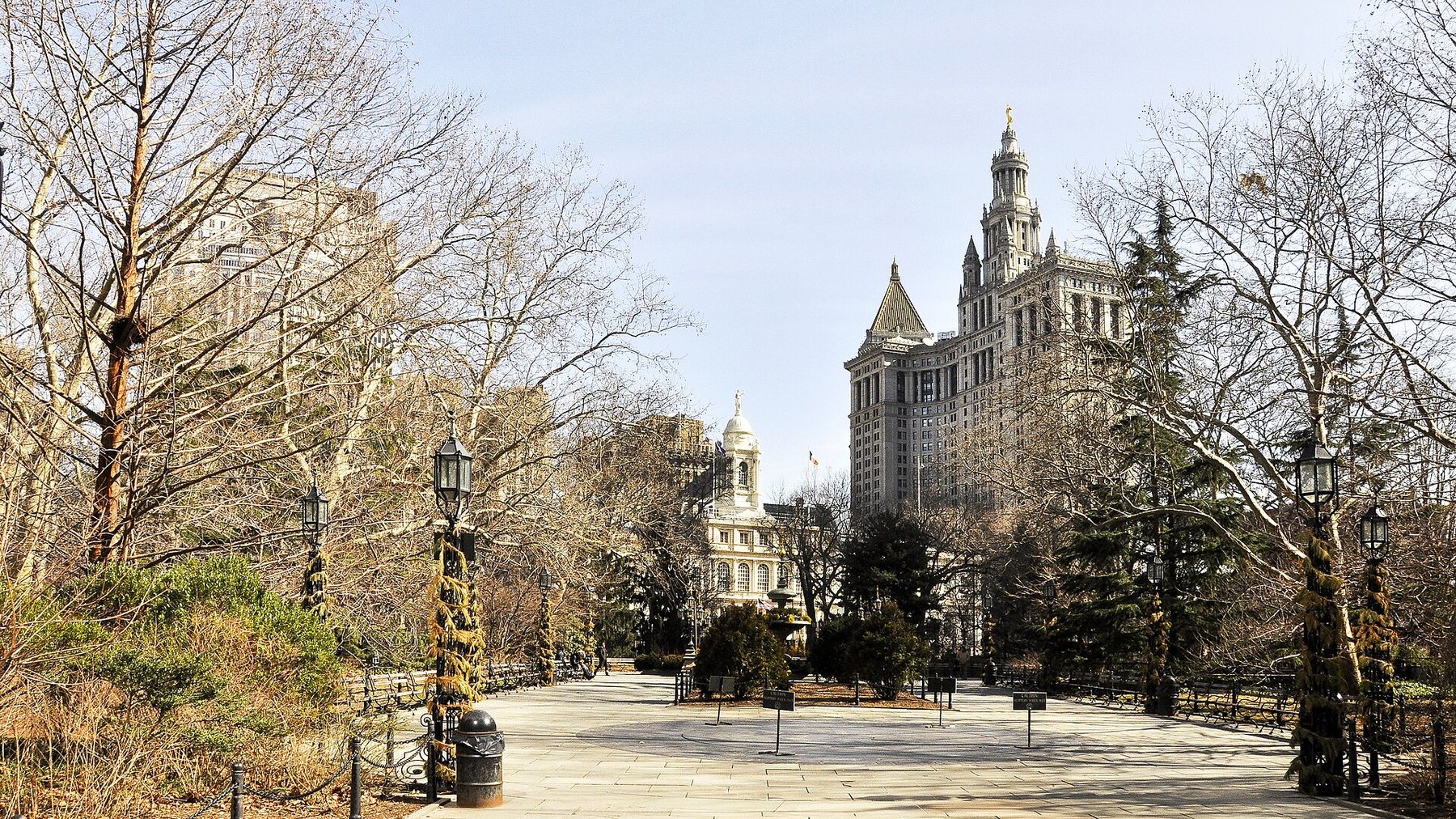
City Hall Park in Lower Manhattan, with New York City Hall in the distance and the Manhattan Municipal Building on the right, photographed on 1 March 2016. Photo: New York City Hall - City Hall Park en rechts Manhattan Municipal Building 1-03-2016 10-36-14 by Paul Hermans, CC BY-SA 4.0, via Wikimedia Commons (resized).
From the record. This is a look back at June 2020. The desk wrote it on 11 October 2026 from sources published at the time; Stay Gazette opened in July 2026 and did not report this as it happened.
On 12 June 2020, Mayor Bill de Blasio and Airbnb announced that the company had settled its federal lawsuit against New York City over a law that required short-term rental platforms to hand over information about their listings. Airbnb agreed to dismiss the case. The City Council was to introduce a narrower version of the law, with reports due every quarter and some listings left out.
Airbnb co-founder and Chief Strategy Officer Nathan Blecharczyk emailed the company's New York City hosts the same day, and Airbnb published the message in its newsroom. It told them information would be provided only for hosts who had consented, and that hosts who did not consent would not be able to list their home as a short-term rental.
Nothing changed for hosts that day. The city said the settlement was premised on the existing law being amended. When CityLand reported on the deal on 18 June 2020, the amendments had been heard in a Council committee and had not been adopted.
What the settlement said
The city's announcement described the law the Council would take up. Platforms would report to the city on a quarterly basis. A report would cover every listing that generated five or more nights of bookings in a quarter, provided the listing offered an entire home or allowed three or more guests to stay at one time.
Three groups of listings would stay out: private or shared rooms with a capacity of two or fewer guests, listings rented for fewer than five nights in a quarter, and listings in qualifying traditional hospitality locations, on a list the city said it would publish.
For every listing that qualified, the city said the report would have to include:
- the physical address of the listing;
- the host's name, physical address, phone number and e-mail address;
- the name, number and URL of the listing;
- whether the rental was for an entire unit or part of one;
- the total number of days booked;
- the amount the host received for each transaction, with the account name and an anonymized account identifier for those payments.
The Associated Press reported that the 2018 law had required platforms to provide detailed data on all their listings, and to do it monthly.
The case Airbnb agreed to drop
The law was Local Law 146 of 2018. CityLand reported that Airbnb and the other parties to the suit had argued it violated the First and Fourth Amendments of the United States Constitution, the Stored Communications Act and the New York State Constitution, and that Airbnb was awarded a preliminary injunction on January 3, 2019.
The Real Deal reported that the city had enacted the data law under pressure from the hotel industry and affordable housing advocates, to help enforce a state law: the ban on rentals of fewer than 30 days in buildings with three or more units when no owner or tenant is present.
Blecharczyk gave hosts two reasons for settling. The first was that the exceptions and confidentiality provisions in the amended ordinance would help safeguard the personal information of many hosts. The second, which he called the most important, was that the amended ordinance would build the trust needed for further reform of New York State's short-term rental rules.
“We hope that our willingness to be transparent enables the State and the City to feel reassured that short-term rentals can be effectively regulated without blunt prohibitions,” Blecharczyk wrote.
What the city and its critics said
The mayor presented the deal as a tool against illegal hotels. “Illegal hotel operators who flout the law at the expense of working New Yorkers have no place in our neighborhoods,” de Blasio said in the city's statement.
Christopher Lehane, Airbnb's Senior Vice President for Global Public Policy and Communications, said in the same statement that the company had long wanted to work with the city on a regulatory framework that included information sharing.
Christian Klossner, Executive Director of the Mayor's Office of Special Enforcement, said the agreement gave the city a tool to detect people who hide behind fake accounts. He also said the revised law would not change the existing laws on whether short-term rentals and their advertisements are legal.
One of Airbnb's opponents pressed that second point. State Senator Liz Krueger, a Manhattan Democrat whom The Real Deal described as the company's primary foe in the legislature, pushed the 30-day law through the Senate in 2010. “There’s nothing related to this lawsuit that increases the possibility of Airbnb getting anything like that,” she told The Real Deal, speaking of a weakening of that law.
Bradley Green, a partner at the law firm Cohen, Hochman and Allen, read the deal more kindly. He told CityLand that the settlement struck a better balance between the city and the platforms.
What the settlement left alone
CityLand noted that the settlement did not mention the state Multiple Dwelling Law's prohibition on un-hosted rentals of less than thirty days in Class A buildings, which it described as essentially buildings occupied by three or more families as permanent residences. The Mayor's Office of Special Enforcement could fine building and unit owners up to $2,500 per day for violations, CityLand reported.
The Real Deal reported that the account identifier attached to each transaction would let the city see whether money from rentals that looked unrelated was flowing to the same place, so that running several Airbnb profiles would no longer hide a large operation.
The timetable was loose. Blecharczyk told hosts the new requirements would not take effect until approximately six months after the ordinance passed, and that information sharing would apply only going forward, not to past activity on the platform. The City Council Committee on Housing and Buildings held a public hearing on the proposed amendments on June 17, 2020. CityLand reported that the Mayor's Office of Special Enforcement testified, that there were no questions or comments, and that the law was not expected to take effect until 2021.
The Gazette Verdict, looking back
Airbnb gave up a court win in New York for a hope, and its hosts were the ones asked to cover the bet. The company held a preliminary injunction against the 2018 law. It agreed to drop the case for a narrower law that would still send the city each qualifying host's name, address, phone number and the amount received for each transaction, and it told hosts to consent or stop listing. What Airbnb told hosts it hoped for, reform of the state's short-term rental rules, was not in the deal, and the senator who carried the 30-day rule said the settlement made a change no more likely. The city gained an enforcement tool. The exposure sat with hosts: fines of up to $2,500 per day under a law the settlement left untouched. When a platform settles with a city, a host should read what the city will learn before reading what the platform hopes to win.
The other side
A preliminary injunction is not a final ruling. Airbnb could have lost the case and been left with the 2018 law in full: monthly reports on every listing. The settlement cut that down. A host renting a private or shared room to two or fewer guests, or hosting fewer than five nights in a quarter, dropped out of the reports, and reporting would apply only going forward. Airbnb also answered the question The Real Deal said its representatives often heard first from state lawmakers: why it did not show the city more about its bookings. For a host renting within the rules, that was a fair trade.
What it meant for hosts
For a New York City host in June 2020, the settlement worked as a notice period. The first job was to work out which side of the reporting line a listing fell on. An entire home, or a listing that took three or more guests, would be reported once it reached five nights of bookings in a quarter. A private or shared room for two or fewer guests would not.
The second job was the consent decision. Airbnb had told hosts that anyone who did not agree to information sharing would not be able to list a short-term rental. A host who agreed would be putting a name, a physical address, a phone number, an e-mail address and the amount received for each transaction in front of the city every quarter.
The third was to check the listing against the rules the settlement did not touch, starting with the thirty-day rule and its fines of up to $2,500 per day.
Hosts had some time. Airbnb said the requirements would start approximately six months after the ordinance passed. It pointed hosts to its Help Center, promised a webinar during the week of June 29, and said it would contact them about how to help it press for new short-term rental laws before the information sharing requirements took effect.
Sources
- City of New York, Office of the Mayor, City of New York and Airbnb Reach Settlement Agreement (12 June 2020).
- Airbnb Newsroom, A Message to Our New York City Hosts (12 June 2020).
- Associated Press (as published by FOX 5 New York), Airbnb, NYC agree to end their fight over host data-sharing (12 June 2020).
- The Real Deal, Why did Airbnb give in to de Blasio? (15 June 2020).
- CityLand (New York Law School), Airbnb and City Settle Lawsuit About Reporting User Information (18 June 2020).
Part of the Stay Gazette record for June 2020. Filed on 11 October 2026; every specific was checked against the sources above, which were read on or before that day. To report an error, write to the desk; see the corrections policy.

Also filed on June 2020
- WorldAmsterdam Bans Holiday Rentals in Three Central DistrictsThe city confirmed on 25 June 2020 that homes in three districts of the old center could not be rented to tourists from 1 July. Hosts everywhere else in Amsterdam needed a permit and stayed limited to 30 nights a year.
- The recordJune 2020, the whole month
- The recordEvery month on the record