Australian Court Orders Airbnb to Pay A$15 Million Over US Dollar Prices
The Federal Court of Australia ordered Airbnb Ireland on 20 December 2023 to pay a A$15 million penalty for showing some Australian users prices in US dollars behind a bare dollar sign. Airbnb admitted the conduct and gave the regulator an undertaking to offer compensation to about 63,000 consumers.
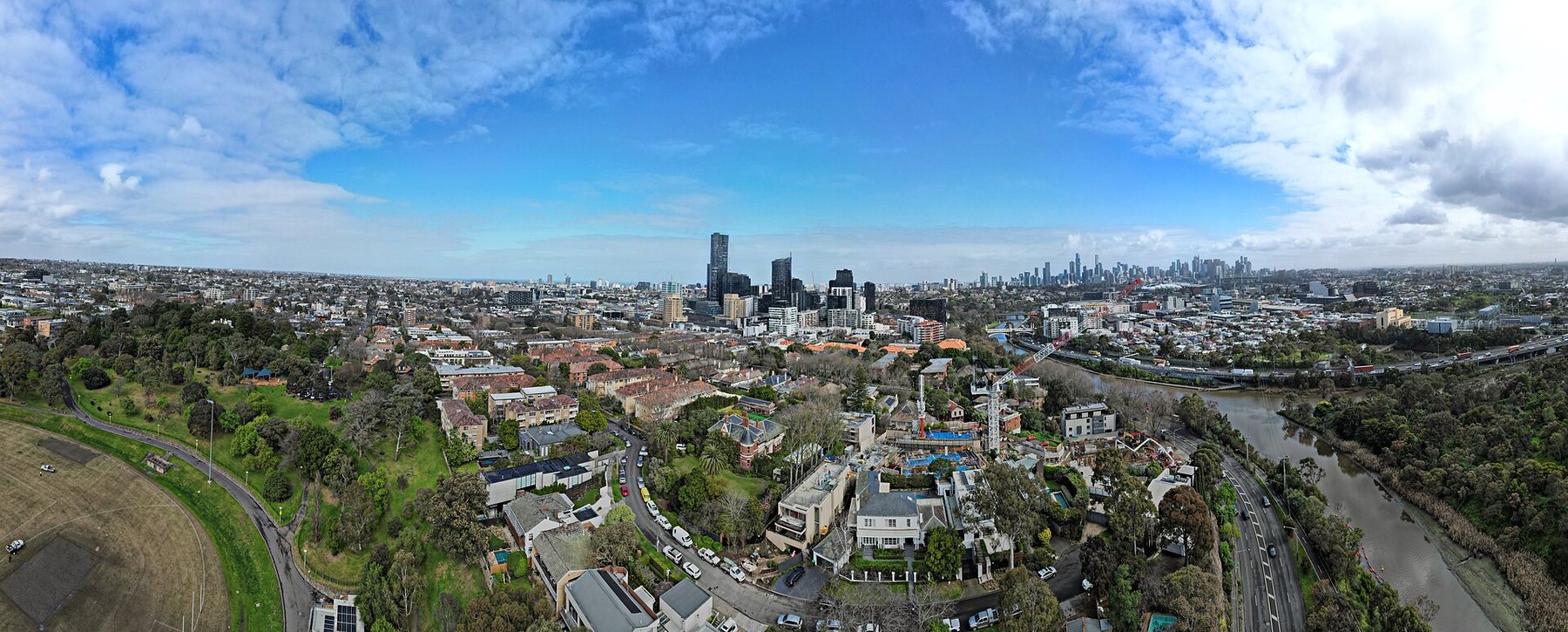
An aerial view across South Yarra, Victoria, toward the Melbourne skyline, photographed in 2023. The Federal Court's judgment in the Airbnb case lists its registry as Victoria. Photo: Aerial panorama of South Yarra facing the Melbourne skyline. September 2023 by Bob Tan, CC BY 4.0, via Wikimedia Commons (resized).
From the record. This is a look back at December 2023. The desk wrote it on 11 October 2026 from sources published at the time; Stay Gazette opened in July 2026 and did not report this as it happened.
On 20 December 2023, the Federal Court of Australia ordered Airbnb Ireland UC to pay a penalty of A$15 million for showing some Australian users the price of Australian accommodation in US dollars behind a bare dollar sign. Airbnb admitted the conduct, the penalty was a figure it had agreed with the regulator, and the court made its orders by consent.
The case was brought by the Australian Competition and Consumer Commission, the ACCC. Alongside the penalty, Airbnb gave the ACCC a court-enforceable undertaking to offer compensation to about 63,000 consumers, a scheme the regulator said could be worth as much as A$15 million. The judge, Justice McElwaine, wrote: “This is a serious case involving multiple breaches affecting tens of thousands of consumers by a well-known and easily recognisable corporation.”
What the court ordered
The court's declarations covered two representations. The first was that between 1 January 2018 and 30 August 2021 Airbnb Ireland showed some users in Australia a total price for Australian accommodation marked with a dollar sign, with nothing nearby before the checkout page to say which currency it was, when the amount was in US dollars. Under the Australian Consumer Law that was misleading or deceptive conduct and a false or misleading representation about price.
The second was that Airbnb Ireland told some users who complained about a US dollar charge that they had selected that currency themselves, when some of them had made no such selection. The orders, all in Australian dollars, followed:
- A pecuniary penalty of $15,000,000, payable to the Commonwealth of Australia within thirty days.
- The ACCC's costs, fixed at $400,000, payable within thirty days.
- A consumer law compliance program, set up within 90 days and kept for three years, including a complaints handling system for Australian consumers and staff training at least once a year.
Only the price display carried a penalty. The false answers to people who complained did not, though the judge said he could take them into account as context.
How the prices went wrong
The platform was designed so that an Australian user who had not chosen a currency would see Australian dollars. For some users it showed US dollars instead. The judge said nobody had pinned down exactly why the software malfunctioned.
Australian consumers made approximately 9 million reservations for accommodation within Australia in the period, and approximately 144,000 of them, or approximately 1.6%, were made in US dollars. The judge found approximately 63,000 affected users had made approximately 77,000 reservations. That group left out approximately 8,000 users who had already been refunded the full price of their stay, at an aggregate cost to Airbnb of approximately AUD 9.4 million. The ACCC's media release put the number of consumers shown US dollar prices at about 70,000.
The judge gave the example of 30 April 2018, when one Australian dollar bought 0.7570 US dollars, and he put the total price difference on the affected reservations at approximately AUD 16.8 million, his best estimate of the loss.
The judge said the US dollar denomination was noted at the foot of each of the first three pages of a booking and, somewhat more prominently, on the fourth and final page, where the user confirmed and paid. Airbnb accepted that, viewed as a whole, the display was misleading.
Approximately 2,088 users complained to customer support: 711 in 2018, approximately 610 in each of 2019 and 2020, and 155 between 1 January and 30 August 2021. Some were told they had picked US dollars, which was false. The ACCC opened an investigation in July 2021. From 31 August 2021, US dollar prices on the platform carried the abbreviation USD. The ACCC took the matter to court in June 2022.
Why the judge accepted the figure
The judge found that the display was not deliberate, and that nothing showed the answers to complainants were part of a plan to mislead. He found that standard form replies went to complainants without proper investigation, and put that down to incompetence on the part of customer service staff and the people who trained them.
The fault he identified was a lack of controls. Airbnb had too few procedures to monitor the platform and catch programming glitches, he said, and then failed to investigate when the complaints arrived. If the people who complained had not been brushed off, he wrote, the malfunction would likely have been found early and the conduct would likely have been significantly smaller in scale.
He also inferred, while noting there was no precise evidence, that Airbnb likely gained a financial advantage over rivals, because the exchange rate made its rates for comparable accommodation appear cheaper.
Against that, Airbnb had cooperated, admitted the conduct early and had no earlier court finding of similar conduct against it. The judge said that without the cooperation the penalty was likely to have been somewhat larger.
The compensation and what Airbnb said
The compensation was not a court order. It rested on an undertaking Airbnb Ireland gave the ACCC, which the regulator could enforce in court. The judge said it was not to be treated as an additional penalty, since it was money properly owed to consumers for their loss.
Under the undertaking, Airbnb was to open a claims portal hosted by Deloitte within 30 days. The ACCC said Airbnb would contact affected consumers by email and text message by Monday, 5 February 2024. Each payment was to cover the gap between the Australian dollar price the consumer expected and what the exchange rate made them pay, plus any foreign currency fees. The ACCC expected the average payment to be about A$230 per consumer.
“We took this case to send a strong signal to large digital platforms like Airbnb that they must comply with the Australian Consumer Law and not mislead consumers,” ACCC Chair Gina Cass-Gottlieb said.
Airbnb answered through Susan Wheeldon, its country manager for Australia and New Zealand. Her statement said the currency display was put right promptly after the company learned of it, and that before the change the US dollar code had appeared only on the final booking page. The statement added: “While only a very small percentage of Australian guests are believed to have been impacted, we are disappointed that this happened. Airbnb would like to apologise to those guests.”
Short Term Rentalz headlined the outcome as a fine of up to A$30m. Half of that was the penalty. The other half was a ceiling on a compensation scheme whose deadlines ran into 2024.
The Gazette Verdict, looking back
Airbnb earned this penalty at its complaints desk more than in its code. The judge accepted that nobody set out to mislead. What he could not excuse was approximately 2,088 complaints, 711 of them in the first year, some of them answered with a standard line that blamed the customer, and a fix that arrived on 31 August 2021, the month after the regulator began investigating. By the court's best estimate the affected guests lost approximately AUD 16.8 million. Airbnb's bill was a A$15 million penalty, A$400,000 in costs and up to A$15 million in compensation, on top of approximately AUD 9.4 million already refunded. The orders took nothing from hosts, but it was their guests who paid more than they expected. A host should look at a listing the way a guest sees it, currency included, and treat the same complaint arriving twice as a fault to chase.
The other side
Airbnb's case deserves its best form. The fault was a software error that the court found was not deliberate, and it touched approximately 1.6% of Australian reservations. The US dollar code was on the final page, where the guest confirmed and paid, and the judge allowed that many users may have noticed it and been content to go on. Airbnb had refunded approximately 8,000 users in full before the orders were made, cooperated with the regulator, admitted the conduct early and agreed the figure. The judge called that early acknowledgement commendable. A penalty of A$15 million beside up to A$15 million in compensation, against an estimated loss of AUD 16.8 million, is a heavy price for a display error.
What it meant for hosts
The penalty, the costs and the compliance program fell on Airbnb Ireland alone, and the compensation was its own undertaking. The court dismissed the proceedings against the second respondent, Airbnb, Inc. Nothing in the orders asked a host to repay a guest or change a listing.
The lesson was about who controlled the price a guest saw. The court found that Airbnb Ireland was responsible for publishing the pages shown to users in Australia. The currency a nightly rate appeared in was the platform's work, and for about three and a half years some guests of Australian hosts paid more than the figure on their screen led them to expect. At the rate the judge cited for 30 April 2018, 0.7570, a stay shown at $500 and charged in US dollars would have cost an Australian guest about A$660.
A host with guests who booked between January 2018 and August 2021 might hear from them after Airbnb contacted affected consumers, which the ACCC said it would do by 5 February 2024. The ACCC warned consumers about people posing as Airbnb or Deloitte, and said the safest way into the claims portal was the link in the guest's own Airbnb account.
Sources
- Australian Competition and Consumer Commission, Airbnb to pay $15m in penalties and up to $15m compensation for misleading consumers (20 December 2023).
- Federal Court of Australia, Australian Competition and Consumer Commission v Airbnb Ireland UC [2023] FCA 1633 (20 December 2023).
- Australian Competition and Consumer Commission, undertakings register, Undertaking to the Australian Competition and Consumer Commission given under section 87B of the Competition and Consumer Act 2010 (Cth) by Airbnb Ireland UC (20 December 2023).
- Airbnb Newsroom (Australia), Airbnb responds to ACCC court decision (19 December 2023).
- Short Term Rentalz, Airbnb fined up to A$30m for “misleading” pricing in Australia (20 December 2023).
Part of the Stay Gazette record for December 2023. Filed on 11 October 2026; every specific was checked against the sources above, which were read on or before that day. To report an error, write to the desk; see the corrections policy.

Also filed on December 2023
- CrackdownDallas Judge Blocks Enforcement of the City's Short-Term Rental OrdinancesA Dallas County district court signed a temporary injunction on 6 December 2023 that stopped the city enforcing the two short-term rental ordinances its council had passed in June, days before enforcement was due to start. Under the order, hosts in single-family neighborhoods could keep operating through a trial set for June 2024 unless the court ordered otherwise.
- The recordDecember 2023, the whole month
- The recordEvery month on the record