Dallas Votes to Bar Short-Term Rentals From Single-Family Neighborhoods
The Dallas City Council voted 12 to 3 on 14 June 2023 to treat short-term rentals as lodging and keep them out of single-family zoning, and adopted a registration ordinance with a $404.00 annual fee at the same meeting. Operators got six months before enforcement, and rentals already registered and paying hotel occupancy tax got no exemption.
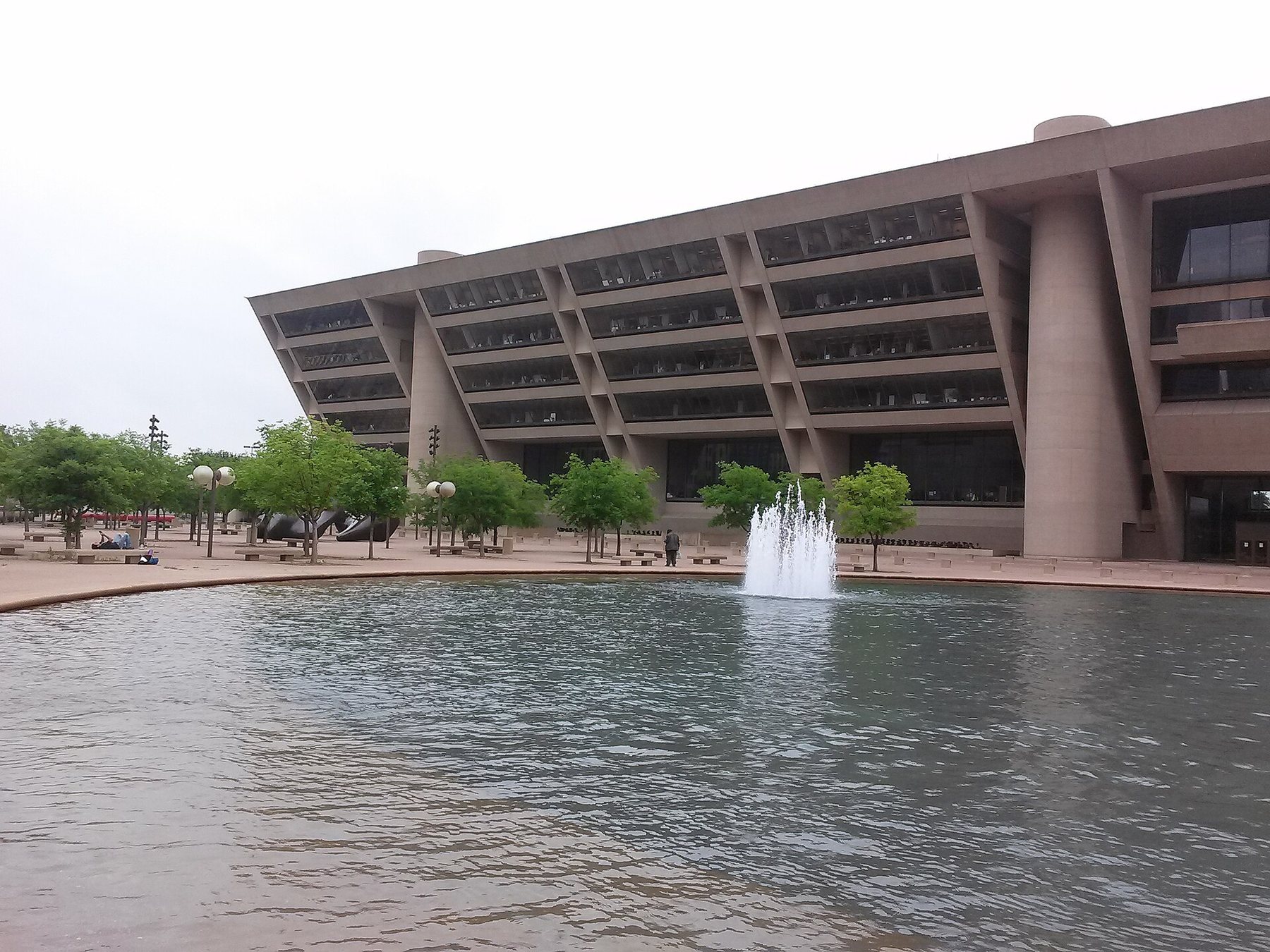
Dallas City Hall, photographed on 23 May 2015. The City Council met there on 14 June 2023 and adopted two short-term rental ordinances. Photo: Ayuntamiento de Dallas by Frj, CC BY-SA 4.0, via Wikimedia Commons (resized).
From the record. This is a look back at June 2023. The desk wrote it on 11 October 2026 from sources published at the time; Stay Gazette opened in July 2026 and did not report this as it happened.
On 14 June 2023, the Dallas City Council voted 12 to 3 to zone short-term rentals out of the city's single-family neighborhoods. The ordinance defined a new land use, short-term rental lodging, and permitted it only in multifamily districts and a list of non-residential ones. The City Secretary's minutes show the meeting opening at 9:22 a.m. and adjourning at 11:45 p.m.
At the same meeting the council adopted a second ordinance that set the terms for the rentals that stayed legal: registration with the city at $404.00 a year, an occupancy limit, a two-night minimum stay and caps inside apartment buildings. D Magazine reported that the zoning made 1,154 short-term rentals in single-family residential neighborhoods illegal. Operators got six months before enforcement.
What the two ordinances did
Ordinance No. 32482 defined short-term rental lodging as a full or partial rentable unit rented to occupants for fewer than 30 consecutive days per rental period. It permitted that use by right in MO(A), GO(A), multifamily, central area, mixed use, multiple commercial and urban corridor districts. Single-family districts were not on the list. A violation carried a fine of up to $2,000.
Ordinance No. 32473 added Chapter 42B, Short-Term Rentals, to the Dallas City Code. Its main terms:
- Registration: each rental registered separately, for $404.00 a year including the first inspection. A registration lasted one year or until the property changed owner.
- Paperwork: a hotel occupancy tax registration number, and a local responsible party who had to arrive at the property within one hour of being told of an emergency.
- Limits: three people per bedroom up to a total of 12, a minimum stay of two nights, and no amplified sound audible beyond the property line between 10:00 p.m. and 7:00 a.m.
- Apartment buildings: in a structure with more than 20 units, no more than three percent of units in multifamily zoning or 20 percent in nonresidential zoning. None in a structure with 20 units or fewer.
- Advertising and platforms: every public listing had to carry the city registration number, and hosting platforms could not collect a fee for booking an unregistered rental.
- Penalties: a fine of up to $500, with each day counted as a separate offense.
Both ordinances took effect immediately on passage and publication, with enforcement action no earlier than six months after passage.
How the votes went
According to the minutes, Councilmember Chad West first moved to accept the city staff's recommendation with an effective date of December 14, 2023. Councilmember Paul Ridley answered with a motion to accept the City Plan Commission's recommendation. An amendment by Councilmember Adam Bazaldua, that the use be permitted by right in all multifamily districts, passed 14 to 1.
Bazaldua then moved to let a rental keep operating, for as long as it stayed current on its taxes and its registration, if on June 14, 2023 it was registered under Chapter 44 of the city code and its hotel occupancy taxes were paid up. On a record vote seven members voted yes and eight voted no, and the city secretary declared the motion failed. The final record vote was 12 to 3, with West, Jaime Resendez and Casey Thomas voting no.
The council took no action on a separate resolution, which the minutes show offered up to $991,095.00 if the plan commission's recommendation was accepted or up to $1,652,712.00 if it was rejected. D Magazine reported that the money was for enforcement and that the city would decide how to pay for it at a later meeting.
Why the council acted
In the ordinance, the council found that short-term rentals in single-family neighborhoods were detrimental to residents' peaceful enjoyment of their homes, citing nuisances such as noise and overparking. It also found that Dallas was experiencing a housing crisis and that the rentals removed needed housing stock. The text recorded that the city began examining short-term rentals in 2019 and that the plan commission, after a public hearing on December 8, 2022, recommended prohibiting them in residential zoning districts.
Supporters called that approach the Keep It Simple Solution, or KISS, D Magazine reported, and Ridley was its champion on the council.
“It is time to take decisive action to preserve the quality of life in Dallas neighborhoods and not to delay any longer what our residents tonight and previously have been clamoring for,” he said, D Magazine reported.
Members of the Dallas Neighborhood Coalition, which led the effort against the rentals, said houses run as short-term rentals had brought them trash, parking overflow, noise and more crime, the Dallas Observer reported. City staff had recommended, late in the process, that the rentals be allowed under added regulations, and D Magazine reported that the recommendation largely failed.
The numbers
- 1,154: short-term rentals in single-family residential neighborhoods made illegal by the zoning, D Magazine reported.
- More than 1,700: rentals registered in Dallas as of March 2023, according to the city as cited by the Dallas Observer.
- As many as 3,000: rentals that D Magazine reported could be operating in the city without proper registration, beyond the 1,154 in single-family neighborhoods and the roughly 300 in multifamily areas that it counted.
- $1.4 million a year: what city staff told the council in an April briefing a ban would require for nine new code enforcement employees, D Magazine reported. It reported that the ban would generate $40,000 in fees and taxes.
- More than $2 million: what Dallas had collected from short-term rental operators in the previous seven months, according to the city controller as cited by D Magazine.
CultureMap reported that neither the city's zoning department nor its code enforcement department favored the new rule.
What operators and Airbnb said
West and Bazaldua argued that operators who ran their rentals responsibly were paying for what a few bad ones had done, D Magazine reported, and that the city would be better off financially keeping those owners and their fees and taxes.
“I don’t think it will stand up in federal court and there’s a strong chance the state legislature will pass laws in [2025] overturning STR bans,” West said, according to D Magazine.
Operators reminded the council that the city had asked them to pay hotel occupancy taxes and that they had paid, D Magazine reported. Lisa Sievers, who sat on the board of the Dallas Short-Term Rental Alliance, spoke to the Dallas Observer about what would follow.
“We have legal counsel on retainer, and we’re going to be talking about next steps immediately,” she said.
Luis Briones, Airbnb's public policy manager, said in a statement sent to the Observer that the company was disappointed, and that the vote would stop responsible residents from renting out their homes to add to their income.
Since then
The Lakewood/East Dallas Advocate reported on 10 January 2024 that a temporary injunction was approved on 6 December 2023 by Dallas County District Judge Monica Purdy, in a lawsuit that short-term rental operators had brought against the city. Enforcement had been scheduled to begin in December and was delayed because of the injunction, and the City of Dallas asked a state appeals court on 26 December to reverse it.
The Gazette Verdict, looking back
Dallas chose the rule that was simplest to write and hard to carry out, and it fell on the operators who had followed the city's instructions. Owners who had registered and kept up their hotel occupancy tax were refused an exemption by one vote, 7 to 8, and given six months. D Magazine reported that city staff had put the cost of a ban at $1.4 million a year for nine new code enforcement employees and that the ban would bring in $40,000 in fees and taxes, in a city that had collected more than $2 million from operators in seven months. The council then left the enforcement money unvoted. A host should treat a city registration and a tax number as a record of compliance, never as a right to keep operating.
The other side
The council did what years of study had not. The city had examined short-term rentals since 2019 and heard hundreds of speakers. More than 1,700 rentals were registered as of March, by the city's count, and D Magazine reported that as many as 3,000 could have been operating without proper registration. A zoning rule is one a code officer can apply from a map and a listing, with no need to catch a party in progress. The council found a housing crisis on top of the noise and parking complaints. Six months was fair notice for a use the development code had never recognized.
What it meant for hosts
For anyone operating in Dallas in June 2023, the first job was to check the zoning of each property.
- In a single-family district, the use was no longer permitted. The Dallas Observer reported that the city said it would begin enforcing the zoning in six months and that operators would need to look at options such as long-term renting or selling.
- In multifamily and the listed non-residential districts, a rental could continue under Chapter 42B: register each unit, pay $404.00 a year, pass inspection, supply a hotel occupancy tax registration number, name a local contact who could arrive within one hour, and provide one off-street parking space per rented bedroom.
- In apartment buildings, the caps decided it: nothing in structures of 20 units or fewer, and three percent or 20 percent of units in larger ones, depending on the zoning.
- A registration was issued only if the owner and host were not delinquent in hotel occupancy taxes owed to the city.
The council's refusal to exempt registered rentals meant a clean record with the city bought no extra time.
Sources
- City of Dallas, Office of the City Secretary, Minutes of the Dallas City Council, Wednesday, June 14, 2023 (14 June 2023).
- City of Dallas, Ordinance No. 32482 (file 23-0844), amending Chapters 51 and 51A of the Dallas Development Code to regulate short-term rental lodging (14 June 2023).
- City of Dallas, Ordinance No. 32473 (file 23-0833), adding Chapter 42B, “Short-Term Rentals,” to the Dallas City Code (14 June 2023).
- D Magazine, After Almost 5 Hours of Short-Term Rental Debate, Council Votes to Keep It Simple, Sort Of (15 June 2023).
- CultureMap Dallas, Dallas City Council enacts new ban on certain short-term rentals (15 June 2023).
- Dallas Observer, What’s Next, Now That Dallas Kicked Most Short-Term Rentals to the Curb? (21 June 2023).
- Lakewood/East Dallas Advocate, AirBnb or no? City files appeal to reverse judge’s injunction blocking short term rental ban (10 January 2024).
Part of the Stay Gazette record for June 2023. Filed on 11 October 2026; every specific was checked against the sources above, which were read on or before that day. To report an error, write to the desk; see the corrections policy.

Also filed on June 2023
- PlatformsAirbnb Sues New York City Over Short-Term Rental Registration RulesAirbnb and three of its New York City hosts filed separate lawsuits on 1 June 2023 to stop the rules that carried out Local Law 18, which Airbnb called a de facto ban on short-term rentals. On 9 June the city told the court it would hold off enforcement until 5 September. The delay covered the summer's bookings, and the registration requirement stayed.
- The recordJune 2023, the whole month
- The recordEvery month on the record