Airbnbust Tweet Sets Off a Fight Over Falling Host Bookings
A screenshot of worried Superhosts spread on Twitter on 16 October 2022. AirDNA's September figures showed demand up 24.0% and listings up 23.2%, which left less for each host.
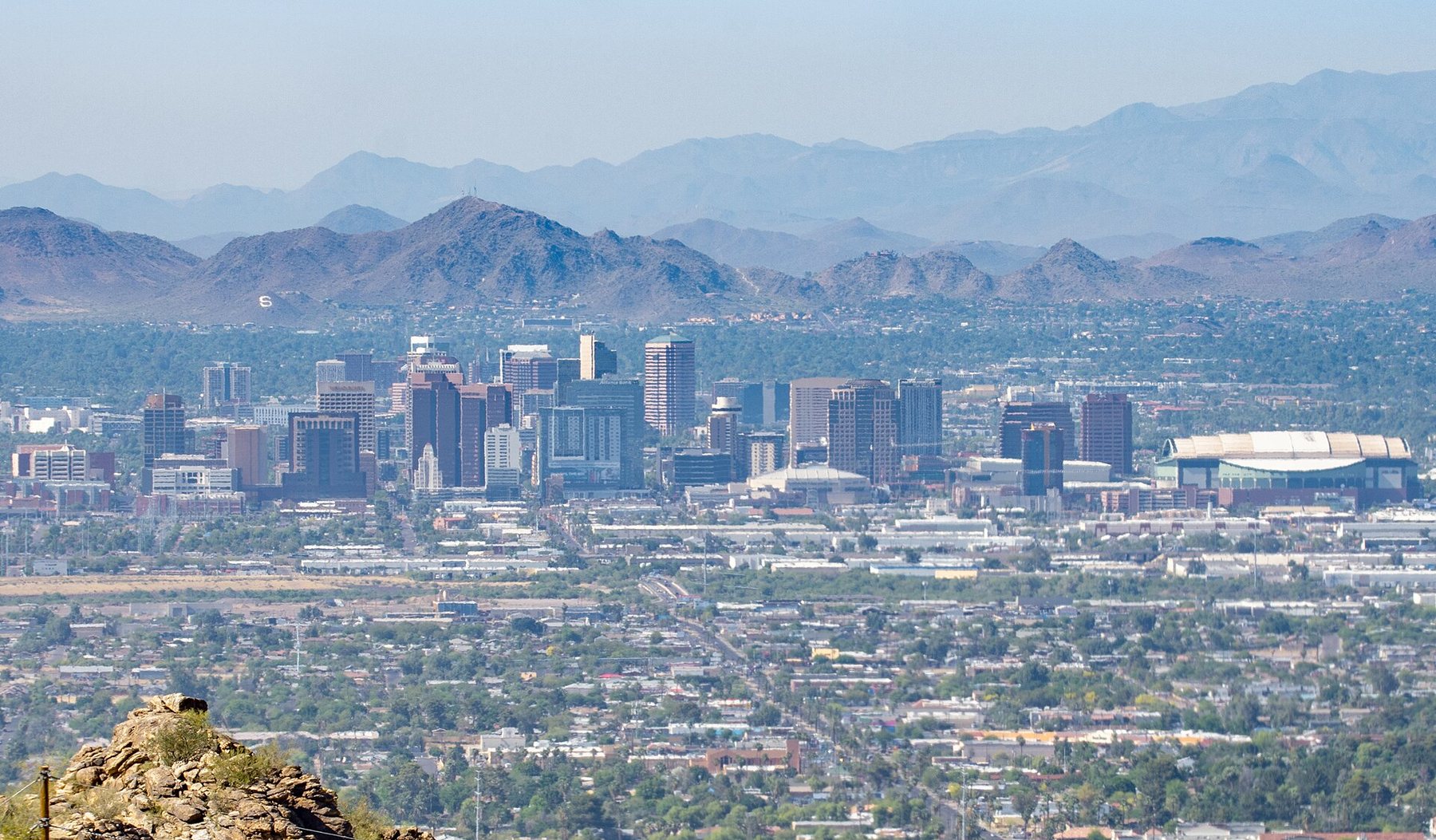
The Phoenix skyline and Maricopa County, Arizona, photographed on 6 May 2020. AirDNA counted 43.9% more short-term rental listings in the Phoenix/Scottsdale market in September 2022 than a year earlier. Photo: Phoenix Maricopa County Arizona (cropped) by Amine Abassir, CC BY-SA 4.0, via Wikimedia Commons (resized).
From the record. This is a look back at October 2022. The desk wrote it on 11 October 2026 from sources published at the time; Stay Gazette opened in July 2026 and did not report this as it happened.
On 16 October 2022, a Twitter account called Texas Runner DFW posted a screenshot from a Facebook group for Airbnb Superhosts under the words “The Airbnbust is upon us” and the hashtag #Airbnb. In the screenshot, a host asked whether others had also watched bookings drop sharply over three to four months. “We went from at least 50% occupancy to literally 0% the last two months,” the host wrote, in the version BuzzFeed reproduced on 19 October.
By the end of the month the word had a hashtag, a run of news reports and an answer from the data firm AirDNA. Its review of September, published on 19 October, put demand for U.S. short-term rentals 26.6% above September 2019 and counted 23.2% more listings than a year earlier. Its vice president of research, Jamie Lane, compressed the argument in an episode of the company's podcast published on 27 October: “So are bookings down? No. Is occupancy down? Absolutely.”
What hosts and guests said
News.com.au, in a report the New Zealand Herald carried on 25 October, said the screenshot came from a private Facebook group, that the host who asked the question had a property in Palm Springs, California, and that the account that shared it described itself as a Texas-based housing analyst. BuzzFeed reported that thousands of people who used Airbnb, or had stopped, replied to the tweet with reasons of their own for a drop in bookings. Many were about price and work: cleaning fees, service fees and checkout chores.
One reply, described by news.com.au, showed a five-night booking that came to US$2,252.50, including a US$195 cleaning fee, a US$251.15 service fee and US$222.35 in occupancy taxes and fees. Travelers in the thread said that with fees like those, and chores on top, a hotel had become the better deal.
MarketWatch published a report on 21 October in which the Palm Springs host behind the Facebook post described going from 80% occupancy to zero, and owners said the decline had come suddenly in the summer months. Its headline tied the complaints to an influx of new vacation rentals and to rising prices. Travel Noire, summing up that report on 25 October, listed two causes: higher fees on the app, and supply and demand.
Not every host agreed. One who replied to the tweet said they were 100% booked through December and put it down to geography and property quality. Another, who charged no cleaning fee, said they were booked through the year.
What the September numbers showed
AirDNA's review, three days after the tweet, counted 18.4 million nights stayed in U.S. short-term rentals in September 2022. Total demand was up 24.0% from a year earlier and 26.6% above September 2019.
Supply had grown too. AirDNA counted 1.38 million available listings, 23.2% more than a year earlier and 8.7% more than in 2019. September alone brought more than 70,000 new listings, the fifth month in a row to do so.
The result for the average host was a small step down from a high level. Occupancy was 58.1%, which AirDNA described as 1.2% lower than a year earlier and 11.1% higher than in 2019. In August the year-over-year decline had been 4.4%. Average daily rates rose 5.6% to $265, the first month since April in which rate growth beat the consumer price index, which stood 5.4% higher. Revenue per available rental grew 4.3%, its first gain since April after negative readings throughout the summer.
Where the new listings landed
The national figure hid large local gaps. Listings in the 50 largest markets were up 17.9% year over year. In smaller markets they were up 27.8%. Among the big markets, Phoenix/Scottsdale had 43.9% more listings than a year earlier, Houston 43.2%, San Antonio 42.7% and Las Vegas 36.4%. All four had lower occupancy than a year earlier. Houston was down 8%.
Coastal and mountain markets went the other way. Supply there grew more slowly, at 15.8% and 19.1%, and occupancy in September topped 2021 levels.
Season mattered too. Lane said on the podcast that September demand was down 20% from the July high, a drop AirDNA expected and one he said would go further. Of the 1.38 million listings the firm tracked, he said, 150,000 did not get a booking in September. Short Term Rentalz, reporting on the review on 20 October, said the markets with the biggest supply gains saw sharper falls in occupancy than the national average.
What AirDNA and Airbnb answered
Lane's case was that the hosts in the screenshot were describing occupancy, which is bookings per available listing, and that total bookings were well above the year before. He told hosts that holding July's rates into the fall would leave them without bookings, and that guests expected to pay less once summer demand passed.
He also took up the fee complaints. Cleaning fees were rising 8% to 9%, he said, a little faster than nightly rates, which he tied to the cost and shortage of cleaning labor. Hosts who folded the cleaning fee into the nightly rate were telling him they saw more bookings. A study AirDNA did with the hotel data firm STR, he said, found the average one-bedroom or studio rental in urban areas was still 20% cheaper than the average hotel room.
Airbnb's reply was its own numbers. Asked for comment by news.com.au, a spokesman pointed to the second-quarter results the company published in August: more than 103 million nights and experiences booked, its largest quarterly number ever. Third-quarter results were due early in November. Lane said AirDNA expected Airbnb to report 104 million nights booked for that quarter, up 31% year over year.
The review carried one warning. Nights booked in September for future travel were up 19.3% year over year, against growth of 29% in August. Bookings for January, February and March 2023 were ahead by 8.2%, 11.4% and 9.1% as of the beginning of October, and AirDNA wrote that forward booking growth looked less optimistic for 2023.
The Gazette Verdict, looking back
The Airbnbust of October 2022 was a supply story, and the hosts who raised the alarm were right about their own calendars and wrong about the market. Demand in September was up 24.0%. What changed was the number of hosts sharing it: 23.2% more listings, with more than 70,000 added in each of five straight months. Where supply grew fastest the pain was real, with occupancy down 9% in Phoenix/Scottsdale after listings rose 43.9%. The platform did not pay for that. Airbnb's latest reported quarter was its largest ever, with more than 103 million nights and experiences booked. The cost fell on individual hosts, whose revenue per available rental fell year over year through the summer, and, by Lane's account, on those who held July prices into the fall. The lesson for a host: track listing growth in your own market, because the national average will not tell you when a neighbor has become a competitor.
The other side
The hosts were not imagining it. A host whose occupancy fell to zero is not helped by a national average, and AirDNA's own count found 150,000 listings without a single booking in September. Guests replying to the tweet said fees and chores had pushed them back to hotels, and one strong September does not disprove a price complaint that takes time to show up in bookings. AirDNA's review also saw slower growth in bookings for early 2023, and Lane said the chance of a recession kept getting higher. The bust talk was about where the business was heading, and on that the data firm had doubts of its own.
What it meant for hosts
For a host in October 2022 the practical reading was local. Listing growth over the previous twelve months ranged from 17.9% in the 50 largest markets as a group to more than 40% in Phoenix/Scottsdale, Houston and San Antonio.
- Price for the season. Lane's advice was to bring rates down from summer levels instead of waiting for July demand to return.
- Look at the fee line. With guests posting their totals, hosts who moved the cleaning fee into the nightly rate reported more bookings, according to Lane.
- Budget for cleaning. Cleaning fees were rising 8% to 9% while average daily rates rose 5.6%.
- Compare with 2019 as well as 2021. AirDNA called 2019 the most salient comparison for 2022 because 2020 and 2021 were outlier years.
- Watch the first quarter. Nights on the books were 14.4% ahead for October, 17.2% for November and 14% for December, but only 8.2% to 11.4% ahead for the first three months of 2023.
Since then
A Business Insider story that Entrepreneur republished on 23 March 2023 reported, citing AirDNA, that nights booked and total revenue at U.S. short-term rentals both reached record highs in 2022, and that occupancy fell year over year in 31 of the 50 largest U.S. markets in the third quarter of 2022. AirDNA's blog of 14 November 2022 noted that on 1 November Airbnb had announced its most profitable quarter ever.
Sources
- AirDNA, U.S. Market Review: Occupancy Gap Tightens as Rates Meet Inflation (19 October 2022).
- AirDNA (STR Data Lab podcast, episode 4, with transcript), Using Data to See if the AirbnBUST is Really Happening (27 October 2022).
- Podbay (episode listing for STR Data Lab by AirDNA, with the posting date), Using Data to See if the AirbnBUST is Really Happening (27 October 2022).
- BuzzFeed, An Airbnb Host Complained About Their Bookings Being Low, And People Responded With A List Of Reasons Why They Refuse To Use The Service (19 October 2022).
- The New Zealand Herald (news.com.au), Airbnb hosts panic as bookings drop across the US (25 October 2022).
- MarketWatch (Wayback Machine capture of 24 October 2022), Airbnb hosts say bookings ‘fell off a cliff’ amid influx of new vacation rentals and rising prices (21 October 2022).
- Travel Noire, AirBnBust? Some Hosts Are Noticing Serious Decline In Bookings On The App (25 October 2022).
- Short Term Rentalz, AirDNA: US rental occupancy tightens gap with last year’s highs (20 October 2022).
- AirDNA, Beating the #Airbnbust: 5 Tips for Improving Your Bookings (14 November 2022).
- Entrepreneur (republished from Business Insider), The ‘Airbnbust’ Proves the Wild West Days of Online Vacation Rentals Are Over (23 March 2023).
Part of the Stay Gazette record for October 2022. Filed on 11 October 2026; every specific was checked against the sources above, which were read on or before that day. To report an error, write to the desk; see the corrections policy.

Also filed on October 2022
- CrackdownFederal Judge Blocks Honolulu’s 90-Day Minimum Rental RuleTen days before Ordinance 22-7 took effect, a federal court barred Honolulu from enforcing its ban on 30 to 89 day home rentals. Fines of up to $10,000 a day stayed in place for shorter stays.
- The recordOctober 2022, the whole month
- The recordEvery month on the record