New York City Council Passes a Short-Term Rental Registration Bill
The Council approved a bill to set up a city registry for short-term rentals and to make booking services verify a listing before taking a fee. Airbnb said the bill's intent was to hurt middle-class families in the outer boroughs.
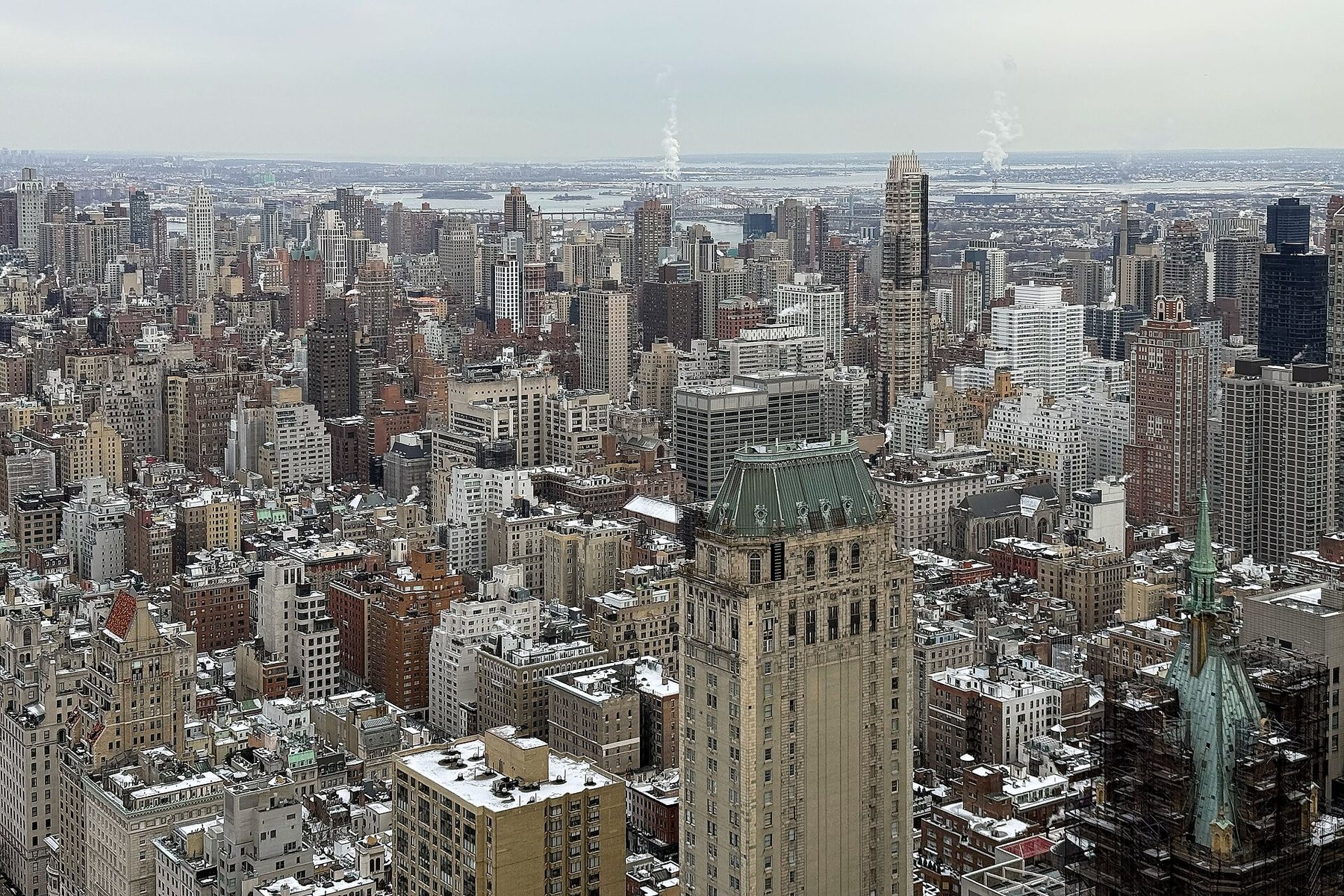
A view northeast across Lenox Hill on Manhattan's Upper East Side from the roof of the Solow Building, with the East River and Queens in the distance, photographed on 21 January 2025. Photo: NYC Upper East Side aerial view by Quintin Soloviev, CC BY 4.0, via Wikimedia Commons (resized).
From the record. This is a look back at December 2021. The desk wrote it on 11 October 2026 from sources published at the time; Stay Gazette opened in July 2026 and did not report this as it happened.
On 9 December 2021, the New York City Council passed a bill that would make it unlawful to offer a home in the city for stays of fewer than 30 consecutive days without a city registration number. The bill, Int. 2309-A, was sponsored by Council Member Ben Kallos. It also put a duty on booking services such as Airbnb: a service would not be allowed to take a fee on a short-term rental until it had checked the listing against a city verification system.
The Council's legislative record listed the bill as approved by the Council on 9 December, with the result Pass, and as sent to the mayor the same day. Commercial Observer reported on 16 December 2021, citing a representative for the mayor's office, that the bill would become law within 30 days whether or not the mayor signed it. The bill was written to take effect 12 months after becoming law, with its penalties for hosts and booking services starting 16 months after becoming law.
What the bill required of hosts
The bill defined a short-term rental as a rental for fewer than 30 consecutive days of a dwelling unit in a private dwelling or a Class A multiple dwelling, which CityLand described as typically a building with three or more permanent residential units. A person who owned, managed, occupied or otherwise controlled a unit could not offer it for short-term rental unless the unit was registered with the Mayor's Office of Special Enforcement and held a valid registration number.
The conditions were specific:
- The applicant had to be a natural person, not a company, and a permanent occupant of the unit: either its owner, or a tenant who certified that no lease or other agreement prohibited them from hosting.
- The applicant had to describe the parts of the premises a guest could use and give the web address or listing identifier of every existing listing.
- The agency had to find no uncorrected code violations that would endanger occupants, and confirm that the building was not on a list of prohibited buildings.
- The applicant had to pay an application or renewal fee, in an amount the agency would set by rule.
Some homes could not be registered at all: rent-regulated units, units in New York City Housing Authority developments and rooming units. The agency was to keep and publish a prohibited buildings list of addresses whose owners, including co-op and condominium boards, had notified it that no short-term rental was permitted there. It also had to notify the owner of record when it received a complete first application.
A registered host would have to post in the unit a diagram of the exit routes and a copy of the registration certificate, put the registration number in every advertisement, and keep a record of each short-term rental for at least seven years.
What it required of booking services
A booking service could not charge, collect or receive a fee in connection with a short-term rental unless it had used the city's electronic verification system. For a registered unit, the check had to show that the registration number was valid, that the listing's web address or identifier was tied to that number, and that the host's full legal name and the unit's full address matched the city's information. The system would return a unique confirmation number, and the service would have to report each transaction to the agency every month.
The penalties and the fee
The bill text set these civil penalties:
- For offering a short-term rental without a valid registration: not more than the lesser of $5,000 or three times the revenue generated by the rental, for each violation.
- For a registered host who violated the chapter or the agency's rules: not more than $5,000 for each violation. For a material false statement on an application: not more than $1,000, in addition to revocation.
- For a booking service that took a fee without the verification: not more than $1,500 for each transaction, or not more than three times the fee if the service could establish its amount.
The registration fee was left to agency rule. CBS New York reported that Kallos said the fees needed to be finalized but would range from $20 to $100.
Why the Council acted
Kallos's office said state law allowed rentals of less than 30 days only where the resident was home at the time, and that legal challenges to the existing reporting requirements, among other issues, had made that law practically impossible to enforce in New York City.
Kallos's office put the number of Airbnb listings in New York City at 37,274, 19,782 of them for entire homes, and said many of those might be illegal. The figures were the sponsor's.
Kallos said in the Council's release for the meeting: “Housing should be for New Yorkers. Hotels should be for tourists.” He thanked Tenants PAC and the Coalition Against Illegal Hotels for their help in getting the bill drafted and introduced.
The record showed the bill was introduced on 12 May 2021, and amended and approved by the Committee on Housing and Buildings on 8 December 2021, the day before the full Council's vote.
What Airbnb and hosts said
Airbnb objected on the day of the vote. Alex Dagg, its Northeast policy director, said in a statement reported by The Real Deal that “the intent of outgoing Council Member Kallos’ bill is to hurt middle-class families in the outer boroughs looking to make a little extra money” and called it especially puzzling when the city was trying to revive tourism.
CBS New York reported that Airbnb said it already gave the city information on who used its platform, and that the majority of its rentals were in the outer boroughs, where hotels were not as convenient. In a statement reported by Commercial Observer, Dagg said the company's New York City hosts, many of whom depended on home-sharing income to stay in their homes, had spoken out with great concern about the bill.
A homeowner who said she legally rented out two of her apartments in central Harlem on Airbnb told CBS New York: “It definitely helps me get by.”
Commercial Observer summed up the critics' argument: the paperwork would keep hosts from listing spare rooms and apartments, and that would take more affordable places to stay off the market while tourism was badly weakened.
The Gazette Verdict, looking back
The force of this bill was at the checkout, and that made it a harder rule than the ones it was written to back up. Under the bill text, a booking service that took a fee on an unverified rental would face a penalty of up to $1,500 a transaction, or up to three times the fee. A host without a valid registration would face up to the lesser of $5,000 or three times the rental's revenue. The people set to pay were the hosts behind the 19,782 entire-home listings Kallos's office cited, many of which it said might be illegal, and every lawful host who would owe paperwork and a fee the sponsor put at $20 to $100. Building owners stood to gain a veto through the prohibited buildings list. A host should take one thing from it: confirm that the home can be registered at all before counting on the income.
The other side
Airbnb's case was that the bill hit the wrong people at the wrong time. The company said the bill's intent was to hurt middle-class families in the outer boroughs who hosted for a little extra money, just as the city was trying to bring tourism back. It said most of its rentals were in the outer boroughs, where hotels were less convenient, and that it already gave the city information on who used its platform. The listing counts came from the sponsor, who said only that many entire-home listings might be illegal. A lawful host would still carry the fee, the paperwork and seven years of records.
What it meant for hosts
For a New York City host in December 2021, nothing had to be filed on the day of the vote. The bill had passed the Council and gone to the mayor, and it was written so that its registration rules would start 12 months after it became law and its penalties 16 months after.
A host could hold the bill text against their own home that month:
- Only a permanent occupant could register, as owner or as a tenant whose lease allowed it. The text gave a host who did not live in the unit no route to a registration.
- Rent-regulated apartments, public housing and rooming units were excluded, and a building's owner or board could put the address on the prohibited list.
- The fee was not set. CBS New York reported that Kallos said it would range from $20 to $100.
The agency's rules, including the application form and the fee, were still to be written, and the bill told the agency to adopt them before the effective dates.
Sources
- New York City Council (press release), Council Votes on Historic Municipal Voting Rights Legislation (9 December 2021).
- Office of New York City Council Member Ben Kallos (press release), 37,000 NYC Homes on Airbnb Will Need to Register Under New Law to Stop Illegal Short-Term Rentals (9 December 2021).
- New York City Council, legislative record (Wayback Machine capture of 18 December 2021), File #: Int 2309-2021, Requiring registration for short-term rentals (history of actions and text of Int. No. 2309-A) (9 December 2021).
- The Real Deal, Law will require Airbnbs to register with the city (9 December 2021).
- CBS New York, City Council Passes Bill Requiring NYC Homeowners, Tenants Who List Properties For Short-Term Rentals To Register With City (9 December 2021).
- CityLand, City Council Votes to Require Short-Term Rental Registry (13 December 2021).
- Commercial Observer, What to Know About NYC’s New Short-Term Rental Registration Law (16 December 2021).
Part of the Stay Gazette record for December 2021. Filed on 11 October 2026; every specific was checked against the sources above, which were read on or before that day. To report an error, write to the desk; see the corrections policy.

Also filed on December 2021
- The MoneyVacasa Starts Trading on Nasdaq and Falls 10.4 Percent on Its First DayThe Portland vacation rental manager reached the stock market through a blank-check merger that brought in over $340 million in gross proceeds, less than the up to $485 million it had described in the summer. Its shares closed the first day at $9.84.
- The recordDecember 2021, the whole month
- The recordEvery month on the record