England's Roadmap Sets 12 April as the Earliest Date for Holiday Lets to Reopen
Boris Johnson's four-step plan put self-contained holiday lets in step two, no earlier than 12 April 2021 and for one household at a time. Hotels, hostels and B&Bs were placed in step three, and every date depended on the data.
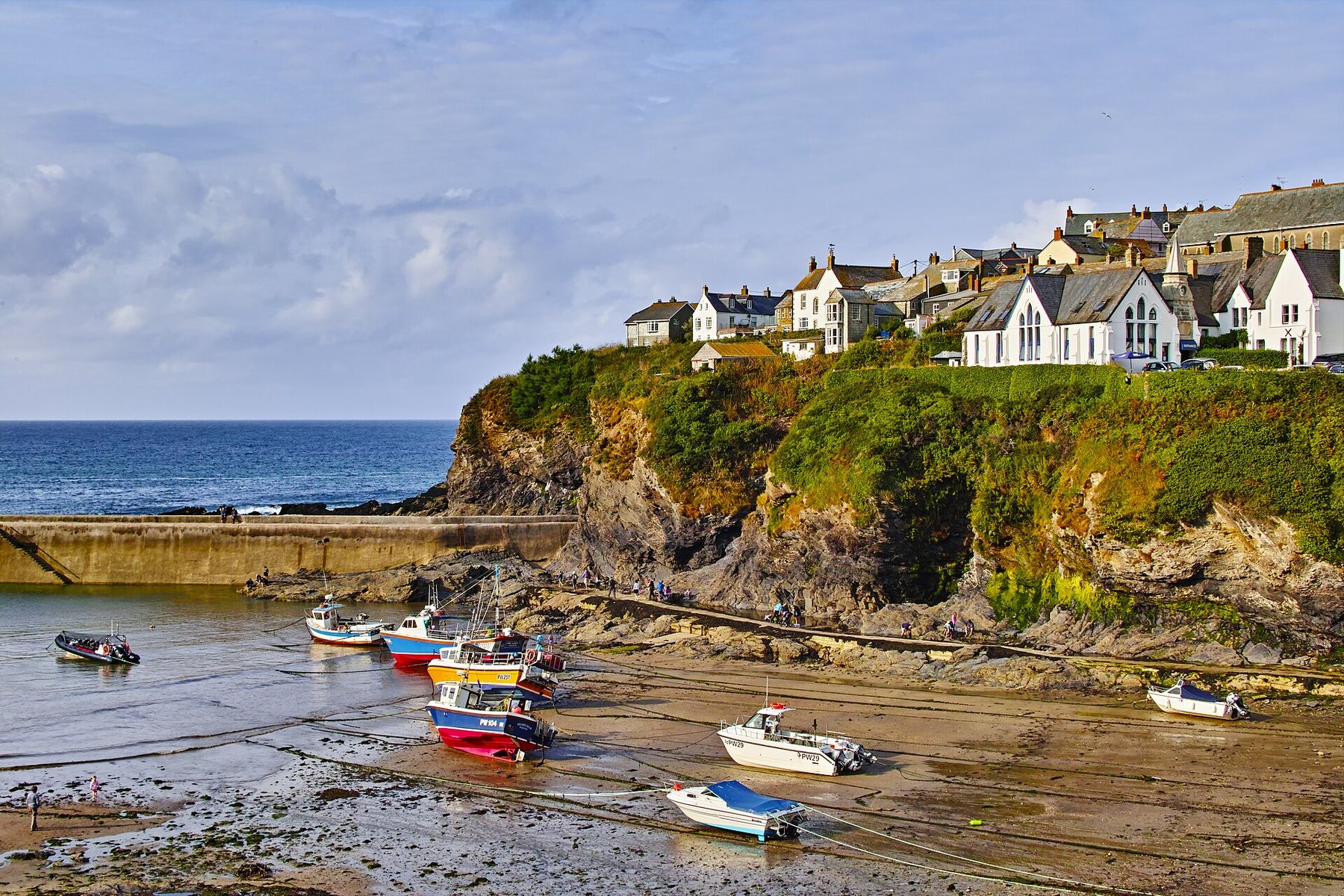
Boats resting on the sand of the harbor at Port Isaac, Cornwall, England, with houses on the cliff above, photographed on 17 August 2018. Photo: Port Isaac Harbour SDI1900 by Meriadoc Brandibuck, CC BY-SA 4.0, via Wikimedia Commons (resized).
From the record. This is a look back at February 2021. The desk wrote it on 11 October 2026 from sources published at the time; Stay Gazette opened in July 2026 and did not report this as it happened.
On 22 February 2021, Prime Minister Boris Johnson told the House of Commons that holiday lets in England could reopen at the second step of a four-step plan to ease lockdown, and that the step would begin no earlier than 12 April. They were to reopen only for use by individuals or household groups.
Hotels, hostels and B&Bs were placed one step later, no earlier than 17 May. The government's roadmap document, published the same day, called its dates indicative and said they were wholly contingent on the data. The measures applied in England. The press release from 10 Downing Street said the devolved administrations were setting out their own approaches for Scotland, Wales and Northern Ireland.
What step two allowed
The roadmap document set out the terms. At step two, overnight stays away from home would be permitted and self-contained accommodation could reopen. The document defined that as accommodation that does not require guests to share bathing facilities, entrances and exits, catering or sleeping facilities. It could be used only by members of the same household.
Three other lines in the document shaped what a booking could be:
- Social contact rules were not to change at step two. No indoor mixing between households would be allowed unless an exemption applied, and outdoor gatherings stayed limited to six people or two households.
- People eligible to form a support bubble would continue to be counted as part of the same household, a line the document gave in its section on step one.
- People were asked to minimize domestic travel where they could, and international holidays were still to be prohibited.
Step one made no room for holidays. From 29 March, the second part of that step, people would no longer be legally required to stay at home, but the document said they should not stay away from home overnight at that stage. Its summary table for 29 March carried two instructions: minimize travel, and no holidays.
The conditions on every date
Johnson gave the House the rule behind the timetable. Decisions at every stage, he said, would be “led by data not dates” and subjected to four tests. They covered the progress of the vaccine program, the vaccines' effect on hospitalizations and deaths, the risk that infection rates would cause a surge in hospitalizations and put unsustainable pressure on the National Health Service, and new variants of concern.
The press release set a minimum of five weeks between steps: four for the effect of each change to show in the data, and a further seven days as notice of what would be eased next. For step two, Johnson promised an announcement at least seven days in advance. The roadmap document added that if step two was delayed, the later steps would need to be pushed back to keep the five-week period.
The later steps were dated the same way:
- Step three, no earlier than 17 May. The remaining accommodation, such as hotels, hostels and B&Bs, could reopen. Indoors, the rule of six or two households would apply, and the government said it would keep under review whether it was safe to increase that.
- Step four, no earlier than 21 June. The government said it aimed to remove all legal limits on social contact.
The regulations behind the roadmap had still to go to Parliament. The press release said members would have an opportunity to vote on them in the coming weeks.
Why the plan moved in steps
Johnson told the House that more than 17.5 million people across the UK had been vaccinated, and that the numbers in hospital were only then beginning to fall below the first wave's peak of the previous April. He said the Chief Medical Officer was clear that moving any faster would mean acting before the impact of each step was known.
The roadmap document recorded the state of the trade it was reopening. Between 25 January and 7 February 2021, 62% of businesses in accommodation and food services had paused trading.
On money, Johnson assured the House that the government would not pull support away. The roadmap document said the Budget on 3 March would set out further detail on economic support.
How the trade answered
Travel Weekly reported on 23 February 2021 that domestic operators saw a spike in sales after the roadmap was revealed. Awaze, the company that owns Cottages.com and Hoseasons, said that immediately after the statement it recorded one booking every second and sold more than 10,000 UK breaks. The figures were the company's own, carried by TravelMole and Travel Weekly, and neither report gave the period in which the 10,000 were sold. Simon Altham, its group chief commercial officer, said: “Last year following similar announcements we saw bookings peak at one every 11 seconds, but this time demand has exceeded our expectations and comfortably broken that record.” He acknowledged that the wait would disappoint some customers.
Graham Donoghue, chief executive of Sykes Holiday Cottages, said self-catered stays were arguably among the safest ways to travel, so allowing them first made sense, Travel Weekly reported.
Others counted what the date cost. Travel Weekly reported that a start on 12 April meant the domestic trade would miss a second Easter. Deirdre Wells, chief executive of Visit Kent and Visit Hertfordshire, told the Guardian that losing Easter again was a great disappointment, given that the trade had shown the year before that it could operate in a Covid-secure way. James Mason, chief executive of Welcome to Yorkshire, warned in remarks carried by Travel Weekly: “Many businesses, particularly in hospitality may not find a way through the latest restrictions, if they cannot open before summer and further financial support is not forthcoming.”
The UK Short Term Accommodation Association put out a statement dated 22 February 2021 that welcomed the roadmap and made four requests of the government. The statement did not mention 12 April or any other date. It asked for financial support for all short-term rental businesses until all restrictions were removed, including those on international travel; for short-term rentals to be regarded as one of the first accommodation types allowed to take bookings again; for a good notice period before reopening, which it said its members would want to be three weeks; and for clear and consistent messages about what was allowed. The notice period in the roadmap was seven days.
The Gazette Verdict, looking back
The roadmap gave holiday-let owners a better deal than the rest of the accommodation sector, and its conditions deserved more of their attention than its date. Self-contained lets were placed in step two, five weeks ahead of the earliest date for hotels, hostels and B&Bs, and Awaze said it sold more than 10,000 UK breaks immediately after the statement. The price was written into the same documents. The date was no earlier than 12 April, which Travel Weekly reported meant missing a second Easter. A booking could hold one household. Confirmation was promised seven days ahead, where the short-term rental trade's association had asked for three weeks, and a delay to step two would push back every later step. With 62% of accommodation and food businesses paused, the answer on money waited for the Budget on 3 March. The lesson for a host: take the booking, and write the terms for the chance that the date moves.
The other side
A plan that cost the trade a second Easter was no favor, and those who objected had a case. Deirdre Wells of Visit Kent told the Guardian the trade had already shown it could operate in a Covid-secure way. James Mason of Welcome to Yorkshire warned that many businesses might not find a way through if they could not open before summer without more support. Seven days' notice was short for an owner who had to prepare a property and book supplies, the reasons the Short Term Accommodation Association had given for asking for three weeks. And a household-only rule ruled out bookings by groups drawn from more than one household.
What it meant for hosts
For the owner of a holiday let in England at the end of February 2021, the roadmap came down to a working list.
- No holiday stays before step two. The earliest date was 12 April, and the government promised to announce it at least seven days ahead.
- Only self-contained accommodation qualified at step two: no shared bathing facilities, entrances and exits, catering or sleeping facilities.
- One household per booking. The document's section on step one said a support bubble would continue to be counted as part of the same household.
- The remaining accommodation, such as hotels, hostels and B&Bs, had to wait for step three, no earlier than 17 May.
- Owners with property in Scotland, Wales or Northern Ireland had to look to those administrations' own plans.
The risk sat in the words no earlier than. An owner taking bookings for the week of 12 April was selling a date the government had said was contingent on the data, and a delay to step two would move the later steps as well.
Sources
- GOV.UK (Prime Minister's Office, 10 Downing Street), PM statement to the House of Commons on roadmap for easing lockdown restrictions in England: 22 February 2021 (22 February 2021).
- GOV.UK (Prime Minister's Office, 10 Downing Street), Prime Minister sets out roadmap to cautiously ease lockdown restrictions (22 February 2021).
- GOV.UK (Cabinet Office), COVID-19 Response - Spring 2021 (22 February 2021).
- Travel Weekly (UK), Domestic sector welcomes ‘clarity’ of PM’s roadmap (23 February 2021).
- The Guardian, Roadmap for easing lockdown in England disappoints tourism chiefs (22 February 2021).
- TravelMole, Awaze: 'We got one new booking every second' (23 February 2021).
- UK Short Term Accommodation Association (press release carried by Hospitality Net), The UK Prime Minister’s roadmap is a very welcome sign that good progress has been made in tackling the COVID-19 pandemic and for society to start planning a return to a more ‘normal life’. (22 February 2021).
Part of the Stay Gazette record for February 2021. Filed on 11 October 2026; every specific was checked against the sources above, which were read on or before that day. To report an error, write to the desk; see the corrections policy.

Also filed on February 2021
- The MoneyAirbnb's First Results as a Public Company Show a $4.6 Billion Net Loss for 2020Airbnb's revenue for 2020 fell 30% to $3.4 billion, and the company said charges tied to its initial public offering and the later rise in its share price contributed to a net loss of $4.6 billion. For hosts, the letter carried a plan to recruit more of them and no outlook for the rest of 2021.
- The recordFebruary 2021, the whole month
- The recordEvery month on the record