Airbnb Announces an Optional Cleaning Protocol and a 72-Hour Booking Buffer
On 27 April 2020 Airbnb said a Cleaning Protocol for hosts would launch in May, with a required 24-hour wait before entering a home. Hosts who could not commit to it could block reservations between stays instead.
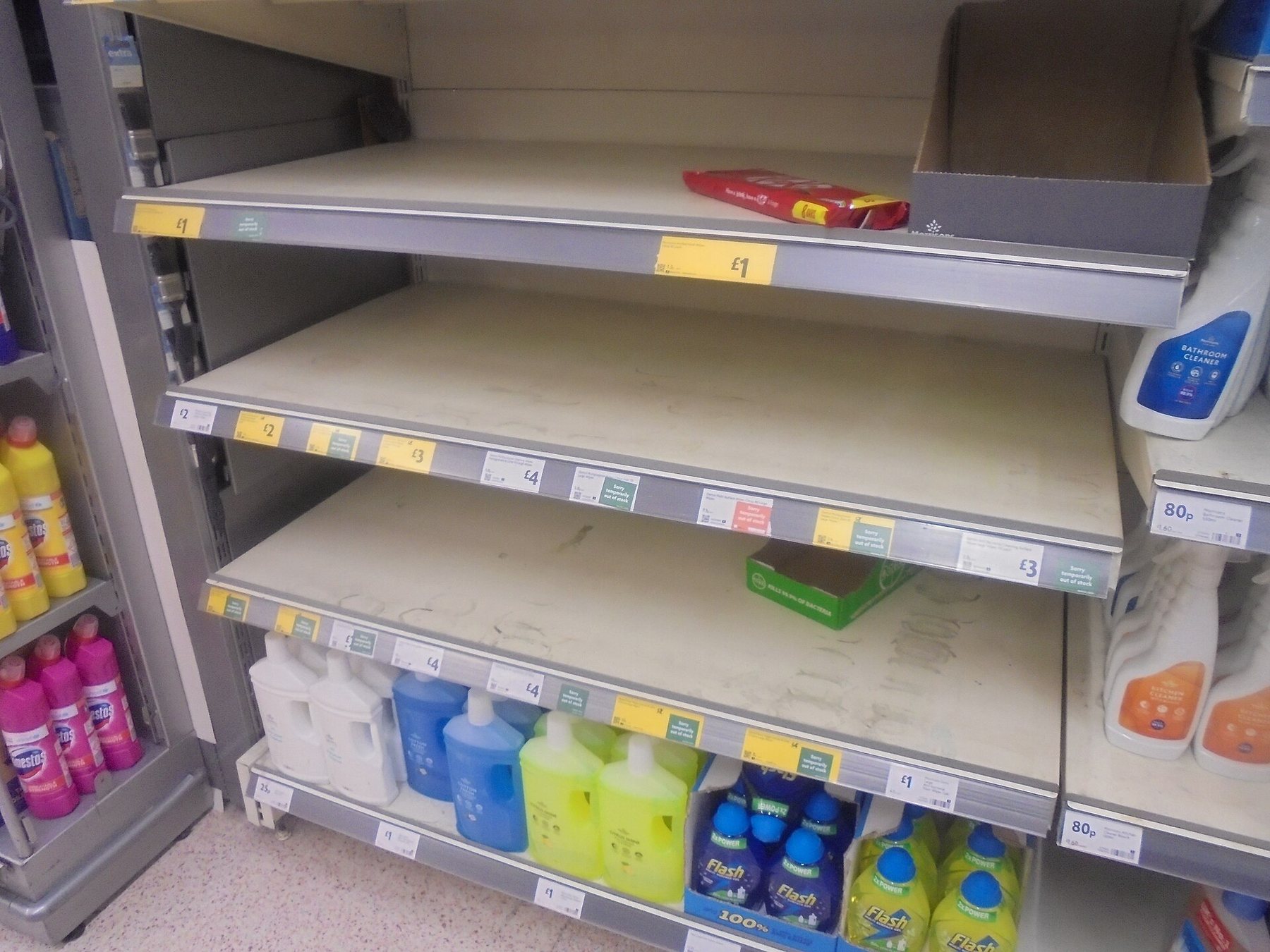
Largely empty shelves in the cleaning products aisle of the Morrisons supermarket in the Merrion Centre, Leeds, England, photographed on 5 March 2020. It shows a shop, not a rental, and was taken before Airbnb's announcement. Photo: Cleaning products sold out at Morrisons, Merrion Centre, Leeds (5th March 2020) by Mtaylor848, CC BY-SA 4.0, via Wikimedia Commons (resized).
From the record. This is a look back at April 2020. The desk wrote it on 11 October 2026 from sources published at the time; Stay Gazette opened in July 2026 and did not report this as it happened.
On 27 April 2020, Airbnb announced its Enhanced Cleaning Initiative, which it called the first overall standardized protocol for cleaning and sanitizing in home sharing. A Cleaning Protocol for hosts was to launch in May 2020, and it required a 24-hour wait before entering a home.
The program was optional. A host who could not commit to the protocol could choose a new feature called Booking Buffer instead, which blocked reservations between stays for a period set at 72 hours when it was announced. Airbnb said guests would be able to identify and book the listings that took part.
What the initiative contained
The Cleaning Protocol was a set of enhanced procedures with room-by-room cleaning guidance. Airbnb said the guidelines would include a learning and certification program for hosts. The protocol carried specific information on preventing Covid-19: personal protective equipment such as masks and gloves for hosts or their cleaners, and disinfectants approved by regulatory authorities.
The wait was part of the protocol. “A CDC recommended 24 hour wait period before entering is also required, as a precaution to address the possibility of particles that may remain airborne for a few hours,” the announcement said. A listing enrolled in the protocol would be available for a new stay as soon as the enhanced cleaning had been performed.
Booking Buffer was for hosts who could not commit to that. A host agreed to keep the home empty for a set period between stays, with no activity other than cleaning, and Airbnb blocked reservations automatically for that time. The period was set at 72 hours on the day of the announcement. The buffer included the same 24-hour wait before entering, and Airbnb said hosts using it should still follow CDC recommendations and whatever local guidance applied. The company said the idea was first conceived for its Frontline Stays project, in which hosts had offered more than 200,000 places to medical workers and first responders worldwide.
Neither route was compulsory. Airbnb said the protocol would be available to all hosts and that it encouraged them to commit to it. Fortune reported that the initiative was entirely optional, and that Airbnb believed most of its hosts would comply. CNN reported that the company would begin requiring rentals to stay vacant for 24 hours between a check-out and the start of a new reservation, and said in the same report that hosts were not required to follow the program. Airbnb's own text attached the wait to the protocol and to the buffer, and a host had to opt into either one.
Why Airbnb did it
Airbnb presented the initiative as preparation for reopening. Its announcement said governments were beginning to review restrictions ahead of reopening their communities for travel, and that the company was preparing for a future of travel focused on health and prevention. It said its work was informed by the published standards of the US Centers for Disease Control and Prevention, by experts such as Dr. Vivek Murthy, a former Surgeon General of the United States, and by companies in hospitality and medical hygiene such as Ecolab.
The message to guests was that a private home had an advantage over busier places. “Homes have become a place of shelter, and the future of travel will also rely on a new comfort zone, with the privacy and benefits of a home away from home, without crowds or high turnovers,” said Greg Greeley, President of Homes at Airbnb.
There was a message for officials too. Airbnb said governments, health authorities and communities would be able to refer to the listings in the program, which it said would allow a controlled approach to reopening travel.
Other travel companies were making similar moves. CNN reported that Marriott had announced the week before that it had begun spraying rooms with hospital-grade disinfectant and had rearranged lobby furniture to keep people apart.
The numbers behind it
Airbnb gave three figures of its own. It said 94 percent of all Airbnb reviews rated cleaning at 4 or 5 stars, which it read as guests being satisfied; a footnote described that as internal data as of 31 March 2020. It said that in a company survey carried out from 1 to 5 April 2020 among hosts in the US, Great Britain, Australia, France, Italy, Brazil, Korea and Mexico, 92 percent planned to host at least as often after the pandemic as before it. And it said that as of late March 2020, bookings for stays starting six months or more ahead were running above the level of a year earlier.
The outside numbers were weaker. CNN, citing the hospitality analytics company STR, reported that occupancy at US hotels had fallen to 23.4% of rooms in the week ending 18 April. It noted that Airbnb, as a privately held company, did not make its booking figures public. Fortune wrote that travel of any kind was not expected to rebound in 2020.
The limits Airbnb stated and the mood among hosts
None of the four news reports this story draws on quoted a host, a property manager or a trade body objecting to the protocol. The stated limits came from Airbnb. Its announcement said that risk in travel could never be fully eliminated and that the science was still evolving. Fortune reported Airbnb's acknowledgment that some hosts might not be able to commit to certification or to source the necessary products.
The company's case for joining was about guests. An Airbnb spokesperson told Fortune: “We believe that enrolling in our Enhanced Cleaning Initiative, with guidance and resources provided by Airbnb, is the best way for hosts to show guests that they take cleanliness and sanitization seriously.”
The announcement reached hosts who were already unhappy with Airbnb. CNN reported that the company had loosened its cancellation deadlines for guests and set up a $250 million fund to pay hosts who were affected. CNN reported that some of those changes had drawn outrage from hosts, who said the relief money was not enough to cover their losses from mass cancellations.
The Gazette Verdict, looking back
Airbnb's cleaning initiative was a sensible standard whose running cost fell on hosts. The company wrote the protocol, leaned on the standing of the CDC and a former Surgeon General, and kept control of the label guests would search for. Hosts were to supply the masks, the gloves, the approved disinfectant and the time for certification, and to give up bookable time: a 24-hour wait before anyone could go in, or 72 blocked hours under the buffer. Airbnb offered guidance, and its announcement named no payment toward any of it. Optional did not mean free to skip: a listing outside the program would be missing from the group guests would be able to search for. The hosts who stood to gain were those who could clean to the standard and turn a home fast. The lesson for a host: when a platform builds search around a voluntary standard, cost out the turnover and treat it as a requirement.
The other side
In April 2020, with stay-at-home orders in place, no single host could persuade a stranger that a home was safe to sleep in. One standard, informed by CDC guidance and a former Surgeon General, gave the smallest host a credibility that would have been out of reach alone, and gave governments a list of homes to point to when they reopened. Marriott had already announced hospital-grade disinfectant for its rooms, and US hotel occupancy stood at 23.4%. Against that, masks, disinfectant and some empty nights were a small price for a way back to bookings. Airbnb left hosts a choice of the protocol, the buffer or neither, and said the risk could not be removed.
What it meant for hosts
At the end of April 2020 the protocol had been announced and had not launched. A host had until the launch in May to decide between three courses.
- Enroll in the Cleaning Protocol when it opened. That meant the certification program, protective equipment for the host or the cleaners, approved disinfectants, and a 24-hour wait before entering. In return the listing could take a new stay as soon as the enhanced cleaning was done, and guests would be able to identify it.
- Opt into Booking Buffer. That meant reservations blocked automatically between stays, for a period set at 72 hours, with the same 24-hour wait before entering. It was the route for hosts who could not commit to certification, and it took nights off the calendar.
- Do neither. Nothing in the announcement required a host to join. The listing would then sit outside the group that Airbnb said guests, governments and health authorities could refer to.
The practical work before the launch was to find a supply of masks, gloves and approved disinfectant, to agree the new routine with a cleaner, and to work out what a longer gap between guests would do to the calendar.
Sources
- Airbnb Newsroom, Airbnb's Enhanced Cleaning Initiative for the Future of Travel (27 April 2020).
- Fortune, Airbnb hopes new cleaning guidelines will bring guests back after the pandemic (27 April 2020).
- CNN (as published by WISH-TV), Airbnb will make some property owners wait 24 hours between guests (27 April 2020).
- TTG Asia, Airbnb to launch cleaning protocol (28 April 2020).
- Agence France-Presse (as published by The Jakarta Post), Airbnb unveils new cleaning protocols in bid to revive bookings (28 April 2020).
Part of the Stay Gazette record for April 2020. Filed on 11 October 2026; every specific was checked against the sources above, which were read on or before that day. To report an error, write to the desk; see the corrections policy.

Also filed on April 2020
- The MoneyAirbnb Raises $2 Billion in Two Deals as the Pandemic Freezes TravelAirbnb said on 6 April 2020 that Silver Lake and Sixth Street Partners would invest $1 billion, and on 14 April that it had commitments for a $1 billion term loan. Airbnb published neither price. Of the first deal, $5 million was marked for a Superhost relief fund.
- The recordApril 2020, the whole month
- The recordEvery month on the record