Florida Suspends Vacation Rentals for 14 Days and Leaves Hotels Open
Governor Ron DeSantis signed Executive Order 20-87 on 27 March 2020. Vacation rentals could take no new reservations and no new check-ins, and an owner who broke the order or advertised risked the state license. Hotels, motels, resorts and time shares were exempt.
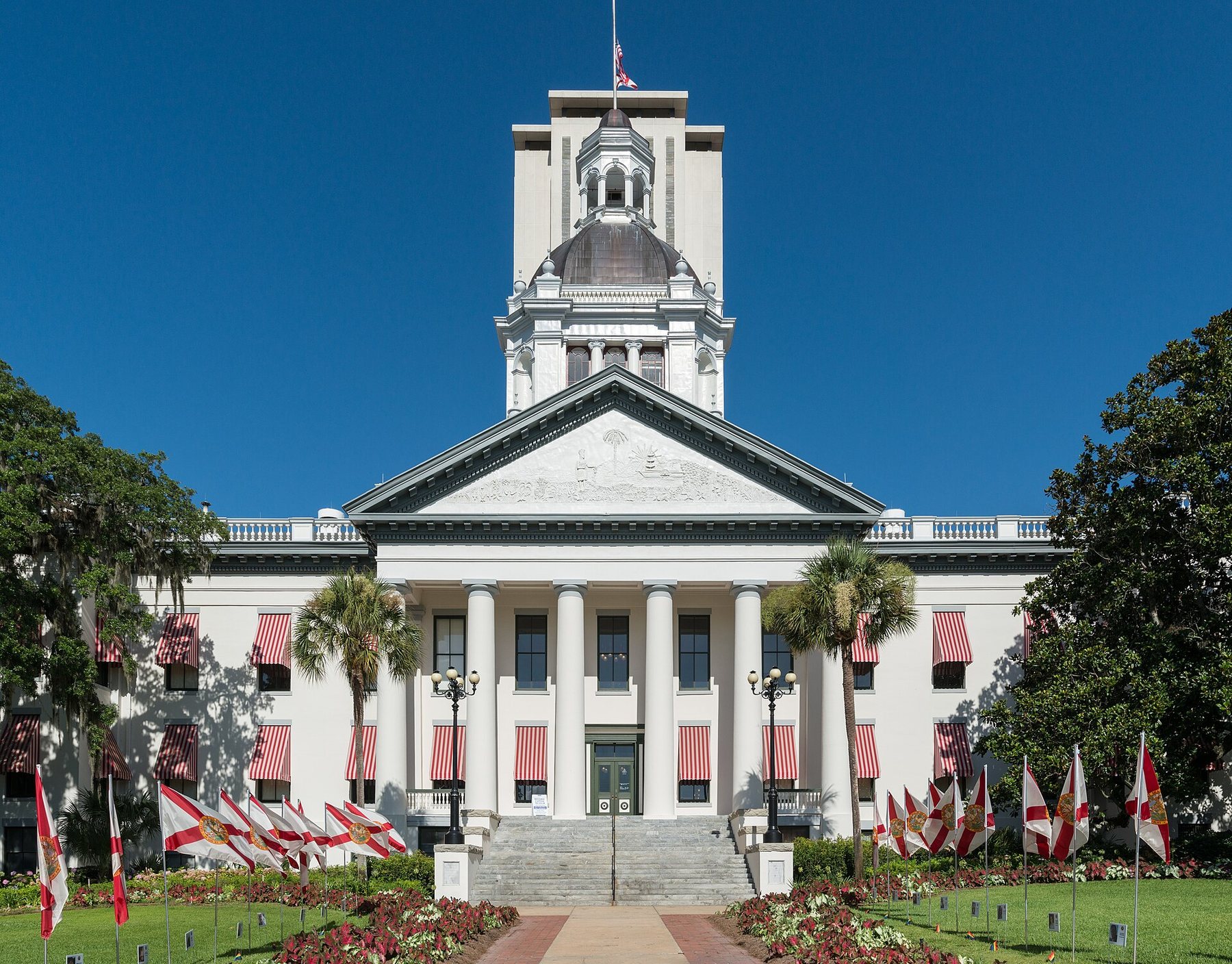
The old Florida State Capitol in Tallahassee, with the tower of the new Capitol behind it, photographed in July 2016. Executive Order 20-87 was signed at Tallahassee on 27 March 2020. The photograph was taken before that date. Photo: Old Florida State Capitol, Tallahassee, East view 20160711 1 by DXR, CC BY-SA 4.0, via Wikimedia Commons (resized).
From the record. This is a look back at March 2020. The desk wrote it on 11 October 2026 from sources published at the time; Stay Gazette opened in July 2026 and did not report this as it happened.
On 27 March 2020, Florida Governor Ron DeSantis signed Executive Order 20-87, which ordered everyone renting out vacation rental properties in the state to suspend operations. Vacation rentals could take no new reservations and could check in no new guests while the order lasted. It was written to expire in 14 days unless extended.
Hotels, motels, inns, resorts and time share projects were left out. So were long-term rentals. An owner who broke the order, or who went on advertising a vacation rental, risked losing the state license and a second-degree misdemeanor charge. The order's stated concern was people leaving other states for Florida as the coronavirus spread.
What the order said
The order was titled Vacation Rental Closures, was signed at Tallahassee and took immediate effect. It was addressed to all parties engaged in the rental of vacation rental properties, as Florida law defines them. Its central sentence left little room: “Vacation rentals are prohibited from making new reservations or bookings and shall not accept new guests for check-in for the duration of this order.”
It then defined what it covered. The directive included the rental of any house, condominium, cooperative or dwelling unit that was also a transient public lodging establishment under Florida law and met one of three tests. The unit was rented for periods of less than 30 days or one calendar month, whichever was less. Or it was advertised or held out to the public as a place regularly rented to guests. Or it was otherwise regulated as a vacation rental by the Department of Business and Professional Regulation, known as DBPR.
Four groups were outside the order:
- hotels, motels, inns, resorts, non-transient public lodging establishments and time share projects;
- long-term rentals;
- stays where guests were already in a vacation rental, or had already booked and were scheduled to check in no later than 28 March 2020;
- rentals to people performing military, emergency, governmental, health or infrastructure response, and to travelers engaged in non-vacation commercial activities.
The order gave no end date. It said only that it would expire in 14 days unless extended by a later order. WFSU News in Tallahassee read that as a bar on new reservations and check-ins through 10 April.
The penalties
Enforcement went to DBPR, the state department that regulates vacation rentals. The order told it to issue guidance as needed, to inspect licensed properties and the third-party platforms where Florida vacation rentals might be advertised, and to alert state authorities to evidence of violations.
Two penalties followed. DBPR was told to revoke the vacation rental license of any party that violated the order or otherwise advertised vacation rental opportunities while it was in force. And any party that violated the order, or attempted to through advertising or other means of solicitation, could be charged with a second-degree misdemeanor. Advertising appeared in both clauses. Read plainly, an owner could lose the license for advertising alone.
Why the governor acted
The order set out its reasoning in its opening clauses. DeSantis had declared a state of emergency for the whole of Florida on 9 March 2020. The Centers for Disease Control and Prevention had cautioned against non-essential travel within the United States. Florida, the order said, was seeing an increase in people fleeing to the state from places where shelter-in-place orders were being put in force or where the virus was spreading in the community. It said many of Florida's Covid-19 cases had come from people arriving from abroad and from other states. Vacation rentals, and the third-party platforms advertising them, were described as attractive lodging for people coming into Florida.
DeSantis announced the suspension on the same Friday, the News Service of Florida reported, as he added New Orleans and other areas of Louisiana to a list of Covid-19 hotspots whose travelers had to self-isolate on arrival in Florida. On the Monday of that week he had ordered travelers from New York, New Jersey and Connecticut to self-isolate for 14 days. Florida had 2,900 confirmed cases among residents and visitors as of that Friday afternoon, the news service reported.
On vacation rentals he was direct. People in the hotspots wanted to come to Florida, he said, and it was not the time. “So the vacation rentals will be suspended for two weeks. If you’re in one now, then finish and go home,” DeSantis said.
Hotels were exempt
Reporters noted the exemption on the day of the announcement. A report by the Associated Press and the News Service of Florida, carried by News4Jax in Jacksonville on 27 March 2020, said DeSantis would bar companies like Airbnb from renting homes and rooms to vacationers for two weeks. It added that the ban did not apply to hotels or motels. WFSU opened its report of 30 March 2020 with the same point: the measure did not apply to resorts, time-shares, hotels or inns.
WFSU spoke to an Ohio resident who owned a rental condo in Panama City Beach. “What’s the difference between them going to the Holiday Inn versus my condo? The Holiday Inn has a lot more money in their pocket than I do,” she said. She also said the order was hurting, but that she understood it, because she would not want a guest to go somewhere and feel unsafe. To comply, she planned to cancel a booking she had received for 10 April, and she said she was refunding everyone's deposit.
The state order was not the first in Florida. ShortTermRentalz reported on 24 March 2020 that Monroe County, which covers the Florida Keys, had ordered all of its hotels and short-term rentals to shut, for at least two weeks from 22 March. By that account, hotels and rentals in the Keys were ordered shut together. The same report said the state had declined to set rules for hotels and that many were closing by their own choice. In St. Augustine, News4Jax reported, dozens of businesses and hotels were closed on the day of the governor's announcement.
Police in at least one city prepared to help enforce the state order. A Spectrum Bay News 9 reporter wrote on 31 March 2020 that police in Holmes Beach planned to check whether different cars were arriving at rental homes from week to week, and to report offenders to DBPR.
The Gazette Verdict, looking back
Florida's order put the cost of keeping visitors out on one kind of lodging. It said vacation rentals drew people fleeing other states, then left hotels, motels, inns, resorts and time shares free to take the same people. An owner with one condo faced a canceled booking, refunded deposits and, for an advertisement alone, the loss of a state license and a misdemeanor charge. A hotel faced nothing under this order. Whatever the case for limiting travel, a rule that closes the rental and exempts the hotel is a rule about who pays, and here the host paid. The lesson for a host is that vacation rental operations can be suspended by one signature with a day's grace, and that a live listing can itself be the violation. Know the exemptions before they are needed: long-term rentals and stays by emergency and health responders stayed legal.
The other side
The order aimed at a specific risk, and vacation rentals fit it. Its own text said rentals and the platforms advertising them were attractive lodging for people leaving places under shelter-in-place orders, and a house or condo is where a household would wait out an outbreak. Hotels were already closing. ShortTermRentalz reported many shutting by choice, and News4Jax found dozens of businesses and hotels shut in St. Augustine. The order was also narrow. It ran 14 days, let guests in residence finish their stays, honored check-ins through 28 March and exempted long-term rentals and responders. The condo owner who questioned the hotel exemption told WFSU she understood the order.
What it meant for hosts
From 27 March 2020, a Florida host had five things to deal with.
- Bookings stopped. The order prohibited new reservations or bookings and new check-ins for as long as it lasted.
- Guests already in the property could finish their stay, and arrivals scheduled for no later than 28 March could be honored. The order made no such allowance for later arrivals. The Panama City Beach owner planned to cancel her booking for 10 April and refund the deposit.
- Advertising was a risk in its own right. The order named it as grounds for DBPR to revoke a license and as a way of attempting a violation that could bring a misdemeanor charge, and it sent DBPR to inspect third-party platforms.
- Some business stayed legal: long-term rentals, and rentals to people performing military, emergency, governmental, health or infrastructure response or traveling on non-vacation commercial business.
- The end date was open. The order ran 14 days unless extended by a later order, so a host could not count on a reopening date.
Sources
- State of Florida, Office of the Governor, Executive Order Number 20-87 (Emergency Management - COVID-19 - Vacation Rental Closures) (27 March 2020).
- News Service of Florida (as published by FlaglerLive), DeSantis Suspends Vacation Rentals for 2 Weeks and Adds Louisiana to Quarantine List, With Cop Checkpoints (27 March 2020).
- News4Jax (WJXT), with the Associated Press and News Service of Florida, Vacation rentals suspended in Florida under order from Gov. DeSantis (27 March 2020).
- WFSU News, DeSantis Suspends Vacation Rentals; Hotels, Resorts Exempt (30 March 2020).
- ShortTermRentalz, Florida Keys to shut all hotels and short-term rentals (24 March 2020).
- Spectrum Bay News 9, Vacation Rentals Suspended for Two Weeks Under Executive Order (2 April 2020).
Part of the Stay Gazette record for March 2020. Filed on 11 October 2026; every specific was checked against the sources above, which were read on or before that day. To report an error, write to the desk; see the corrections policy.

Also filed on March 2020
- PlatformsAirbnb Overrides Host Cancellation Policies and Refunds Covid Bookings in FullOn 14 March 2020 Airbnb let guests cancel pandemic-hit stays for a full refund, whatever cancellation policy the host had set. On 30 March it apologized to hosts and promised $250 million, paid at 25% of what a host's own policy would have paid.
- The recordMarch 2020, the whole month
- The recordEvery month on the record