Scotland Says Every Short-Term Let Will Need a License
A Scottish minister told Parliament that every short-term let would need a license with a mandatory safety standard, and that councils could require planning permission for whole-property lets in control areas. Hosts were left waiting for the fees, the tax and the detail.
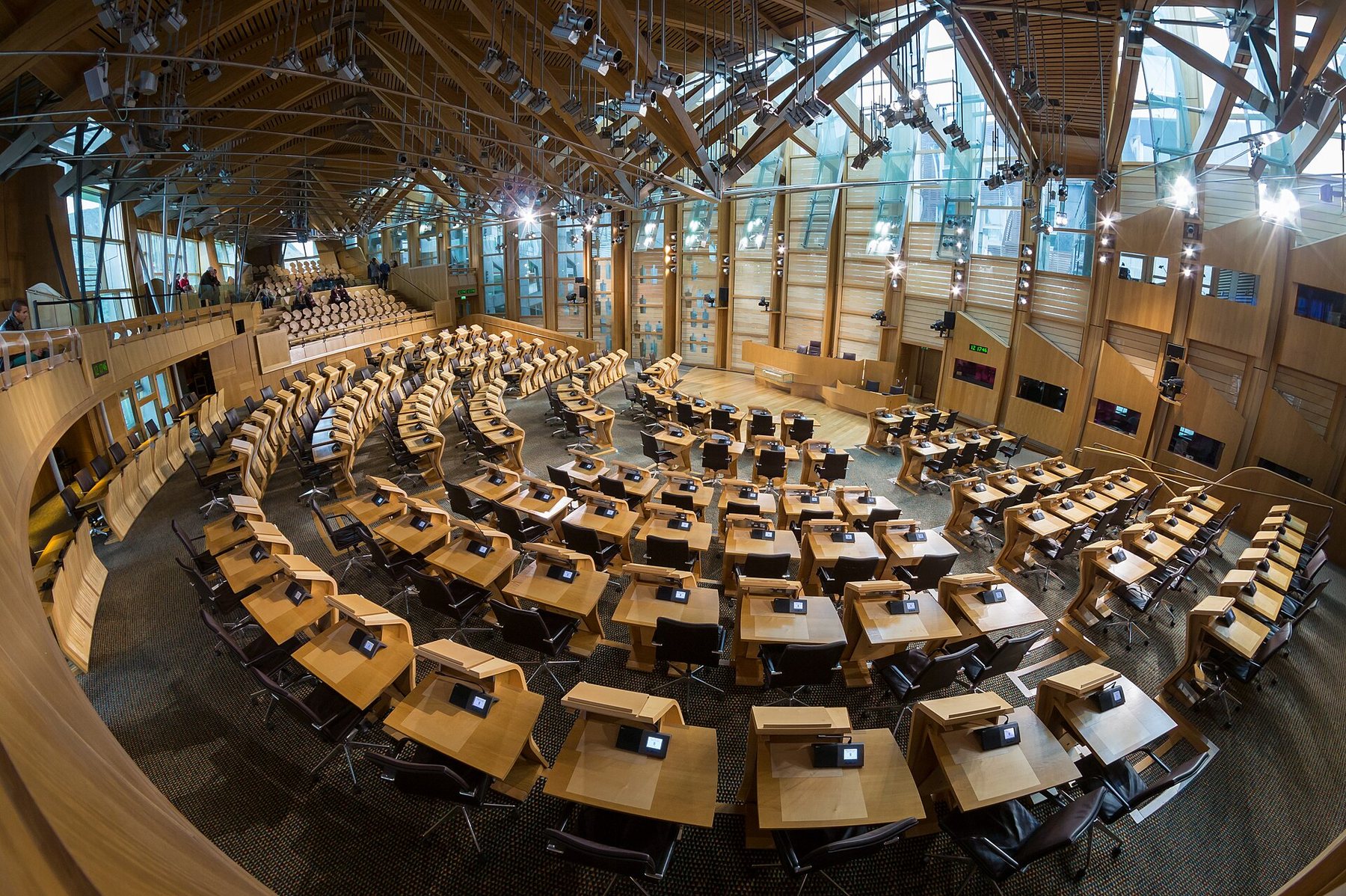
The debating chamber of the Scottish Parliament at Holyrood in Edinburgh, photographed in November 2013 with the members' desks empty. It does not show the statement of 8 January 2020. Photo: Scottish Parliament Debating Chamber 3 by Colin, CC BY-SA 4.0, via Wikimedia Commons (resized).
From the record. This is a look back at January 2020. The desk wrote it on 11 October 2026 from sources published at the time; Stay Gazette opened in July 2026 and did not report this as it happened.
On 8 January 2020, Kevin Stewart, Scotland's Minister for Local Government, Housing and Planning, told the Scottish Parliament that the government would set up a licensing scheme for short-term lets, give councils the power to create control areas where turning a whole property into a short-term let would need planning permission, and review how the lets were taxed.
Short-term let is the Scottish term for a short-term rental, and one part of the license was to apply to all of them. A basic safety standard would be mandatory across Scotland for every type of let, a room in a host's own home included. Everything beyond that was left to each council. The government said the regulations would be in place by spring 2021.
Edinburgh's council leader and the housing charity Shelter Scotland welcomed the statement. Airbnb warned against fees and bureaucracy, and the Scottish Conservatives raised the prospect of three separate charges on the same host.
What the minister announced
Stewart set out three measures. The first was a licensing scheme under an existing law, the Civic Government (Scotland) Act 1982. Beyond its compulsory safety component, councils would have discretion to add conditions of their own, and he gave littering and overcrowding as examples.
Councils would be able to charge hosts a fee. Answering questions, Stewart said he expected councils to set the fees and that they should be cost neutral, covering what it cost to administer the scheme and to make sure hosts complied. He also expected a council to withdraw a license from a host who did not keep to its conditions.
The second measure was the control area, under a power in the Planning (Scotland) Act 2019. Inside one, changing a whole property to a short-term let would always require planning permission. A council could choose whether to have a control area, and whether it covered all or part of its territory. Home sharing, which the government described as renting a room in your own home or letting others stay there while you were away on vacation, would not be affected.
The third was a tax review. Stewart gave no form for any new tax. He said it would be separate from the transient visitor levy, which councils were to get a discretionary power to charge, and that the money would stay with local authorities.
None of this was law in January 2020. Stewart said the detail still had to be developed and that the government would consult widely before laying regulations to come into force in spring 2021.
Why Scotland acted
The minister's first argument was housing. He told Parliament there had been a dramatic rise in the number of short-term lets in Scotland over the previous few years, that a substantial part of the growth was in whole-property rentals, and that the lets were highly concentrated. In the government's news release he said: “However, we know that in certain areas, particularly tourist hot spots, high numbers of short-term lets are causing problems and often make it harder for people to find homes to live in.”
Safety was the second. Stewart said the government's consultation had raised concerns about limited awareness of existing safety requirements, fire safety among them, and that councils could not monitor compliance because they did not know where short-term lets were operating.
The proposals followed a consultation launched in April 2019 that drew more than 1,000 responses. The government said the majority supported some form of regulation.
Edinburgh was the pressure point. The trade publication ShortTermRentalz reported that the capital held 31 percent of all short-term lets in Scotland. Sarah Boyack, a Labour member for Lothian, put the city's Airbnb-registered listings at more than 13,000 in the chamber.
Who welcomed it
Adam McVey, the Edinburgh council leader, said in remarks reported by the Edinburgh Evening News that the announcement met the council's request for mandatory licenses and would put the city in a position to use planning controls to stop the increase in short-term lets.
Graeme Brown, the director of Shelter Scotland, was quoted by STV News calling it a welcome first step and saying that licensing, taxation and limits were the right response.
Andy Wightman, a Green member for Lothian, said no license should be granted where planning permission was not in place. Boyack welcomed the licensing powers but said control areas sounded like rent pressure zones, which she said had failed, and asked whether councils could cap the number of short-term lets.
What the industry and the opposition said
Airbnb accepted regulation and argued about its cost. A spokesman quoted by STV News said the company had long supported fair regulations and a tourism tax in Scotland, and added: “Together we can help Scottish families share their homes and follow the rules, and avoid a system that excludes working families through fees, barriers and bureaucracy.” The Edinburgh Evening News reported that Airbnb wanted to clarify how the cost of licensing would fall on families who let a spare bedroom or their main home. Airbnb said travel on its platform was worth almost £2 million a day to the Scottish economy.
Shomik Panda, director general of the UK Short Term Accommodation Association, said in a response carried by ShortTermRentalz that the association was disappointed the government had chosen a mix of measures that could leave Scotland with uncertain and fragmented rules. By 24 January, the same publication reported, the association and the Association of Scotland's Self-Caterers had sent the minister a joint letter asking for clarity on five points: the definition of short-term letting, the terms of a license, the cost of licensing and planning permission, how control areas would be defined and justified, and how regulation and taxation would fit together.
In the chamber, Graham Simpson, the Scottish Conservatives' housing spokesman, welcomed the announcement, then asked who would set the fees, whether councils could refuse a license and whether there would be an appeal process. The Edinburgh Evening News quoted him as saying: “There is a danger that we could have a triple tax whammy on tourism if the SNP introduces an Airbnb tax on top of a tourist tax and a fee for licences.” His Conservative colleague Jeremy Balfour asked whether one host could be liable for all three.
Sandra White, the Scottish National Party member for Glasgow Kelvin, asked why every short-term let should be licensed when most of the problems in her constituency were with whole-property listings. Stewart agreed that sharing and swapping homes did not cause the same level of concern, and said safety was the exception: compliance had to be monitored in every let, whether or not the host was present.
The Gazette Verdict, looking back
Scotland chose a fair design and announced it with the price left blank. A safety license for every let, with planning limits only where a council drew a control area, fitted the problem the minister described. Councils gained on every line. They would set the fees, keep any new tax and decide where whole-property lets needed permission. Hosts got the bill without the amount: a fee meant to cover a council's costs, a tax with no stated form and a separate visitor levy. The host with one spare room was drawn in even though the minister agreed that home sharing caused less concern. A host's lesson was to treat a statement of intent as the start of the clock: get the safety paperwork in order, and press the council on fees while the rules were still being written.
The other side
A government that waits until every fee is costed never regulates. Stewart had more than 1,000 consultation responses, most of them in favor of some form of regulation, a housing charity saying people were locked out of homes, and the capital's council asking for these powers. He promised to consult before any regulation was laid, said fees should do no more than cover a council's costs, and left councils free to stop at the safety minimum. Announcing the direction in January 2020 gave hosts more than a year before the spring 2021 target. A blank price tag was the cost of being told early.
What it meant for hosts
In January 2020 the statement gave a host in Scotland nothing new to register and no new fee to pay, but four things to plan for.
- Every let, a spare room included, was on course to need a license with a mandatory safety standard, and the minister had singled out fire safety.
- A host letting a whole property in a place under pressure faced a second hurdle: in a control area, a change of use would always need planning permission.
- The budget line was open. A license fee set by the council, a new tax of no stated form and a visitor levy were all in view.
- The detail was still open. The five questions the trade bodies put to the minister were the ones a host needed answered before committing to another season.
Sources
- Scottish Government (gov.scot), Regulating short-term lets (8 January 2020).
- Scottish Parliament, Official Report, Meeting of the Parliament: 08/01/2020, Short-term Lets (8 January 2020).
- STV News, Councils given new powers in crackdown on short-term lets (8 January 2020).
- Edinburgh Evening News (read on the Midlothian Advertiser website), Scottish Government announces licensing scheme for Airbnbs (8 January 2020).
- ShortTermRentalz, Government announces rental law reform in Scotland (8 January 2020).
- ShortTermRentalz, UK STAA and ASSC submit joint letter over Scottish letting regulations (24 January 2020).
Part of the Stay Gazette record for January 2020. Filed on 11 October 2026; every specific was checked against the sources above, which were read on or before that day. To report an error, write to the desk; see the corrections policy.

Also filed on January 2020
- PlatformsAirbnb Pulls 28 Hollywood Hills Listings and Ties Staff Bonuses to SafetyAirbnb removed or suspended 28 Los Angeles listings that police had identified as party houses, then tied employee bonuses to guest safety and dedicated an additional $150 million to trust and safety. For hosts, January 2020 showed how a listing could be switched off.
- The recordJanuary 2020, the whole month
- The recordEvery month on the record